
Bill Minter sent me some recollections about Cobden-Sanderson’s bindings, which raise several interesting questions. Are bookbinders and book conservators—especially those in private practice—skewed in their appraisal of bindings since they generally deal with books that need to be fixed? Could Cobden-Sanderson actually taste the quality of leather? Does Bill have a second wind since he took a straight job with a regular paycheck?
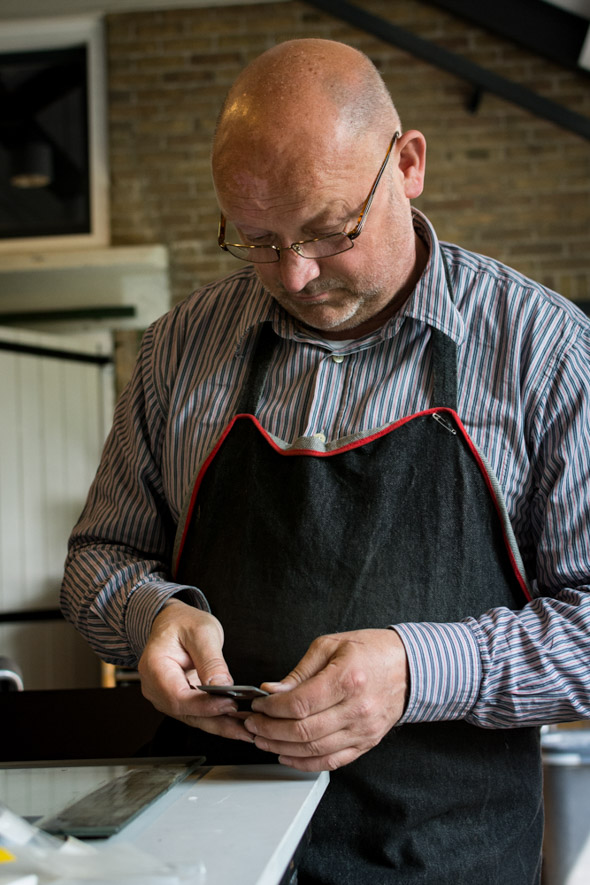
Before accepting the newly created position of Senior Book Conservator at The Pennsylvania State University Libraries (aka: Penn State), Bill was in private practice. While some may know of him as the developer of the ultrasonic welder for polyester film encapsulation, he has also dabbled with other ideas in book conservation. His email is: wdm14<at>psu<dot>edu
Bill is far too modest in this brief bio. Some of his “other ideas” include intact washing of water damaged books, a velcro based tying-up press, a video of how to maintain and adjust a board shear, the use of aluminum to lighten and make more rigid oversize drop spine boxes, and tips on how to quickly flatten rolled documents for digitizing. Most recently he has attempted to quantify some of the properties of teflon and bone folders. His poster should be in the poster area of the AIC website soon.
***
Bill writes (1):
I recently saw your blogpost about Cobden_Sanderson.
You wrote: “…but his bindings are really beautiful. I’ve had the opportunity to see many of them and to work on a couple of them as well. They are quite refreshing from much of the trade work of the day. Unfortunately, many of the materials he used are often poor quality. The books I’ve been able to see the structure of have common late nineteenth century structural weaknesses: very thin slips, tissue thin leather jointed endsheets, and overly pared covering leather. Ironically…”
I would suggest that when you are in Chicago the next time that you try to see his bindings at the various libraries.
Many years ago, Marianne Tidcombe was to speak to The Caxton Club. She arrived days early to see C-S’s bindings, as well as research her next book on woman binders. I insisted that she stay with my family, so that I could be her chauffeur.
When she arrived on Saturday afternoon, I told her about my 3-volume set of signed C-S bindings in brown leather and blind tooled. After much discussion, she had me (almost) convinced that my books were not C-S, because “he never bound in brown leather”. Upon going to my shop, indeed they were C-S. Until then, she had only seen rubbings of that particular binding.
(Teaser — the boards were detached as you might assume, but read on.)
Well, for two days we went to numerous libraries and, as I recall, every C-S binding was in excellent condition with the boards intact! AND, as I recall, there were no ‘brown’ leather bindings; most were either red, blue, green or other. After seeing maybe a dozen or more (20?) books, I asked the question, “you said that he did not bind in brown leather”. She explained that C-S knew that brown was not a good leather, for three specific reasons: 1) from working with the leather, 2) XXX?? (I do not recall the reason), and 3) (the best part) — that he could TASTE that the leather was TOO ACIDIC.
[Marianne Tidcombe writes:, “What I said in 1992 was not that C-S did not use brown leather for binding, but that he rarely used dyed pigskin – brown or any other colour – because it was acidic. He had an instinct for judging leather, and could tell by handling, smelling, and (yes) tasting, if it was acid. He chose goatskin, sealskin, and alum-tawed pigskin, all of exceptional quality, which is why his bindings have held up so remarkably well compared to many others bound in the same period. Your blind-tooled ‘Golden Legend’ bound at the Doves Bindery in about 1904(?) in brown dyed pigskin is an exception. I suspect he risked using it in this case because it took the blind impressions rather better.”] (2)
Aside from him tasting that the leather was too acidic, how would he have known that that was a problem? At the same time: how did they test for acidity during that time — litmus paper?
ANYWAY: To further enhance this story, the last stop was at the U Illinois — Chicago campus where there are approximately 19 bindings by Ellen Gates Starr of Hull House. Starr studied with C-S in the early 1900s. Her collection of bindings include, from my perspective: one binding using C-S leather and tooled by C-S; one binding tooled by EGS on leather supplied by C-S, and the remainder were (shall I suggest) other leathers that have not survived as well as the C-S type —– again, from my perspective. The bindings using C-S leather were, as I recall, in much better condition than the others. At the same time, one would assume that all of the books have been held in the same, Chicago environment all these years.
I wish there were a way to determine whose leather C-S used and how that leather was tanned, especially compared to other tanners. AND, why is it that he rarely used brown leather? Perhaps a world-wide survey of the condition of all C-S bindings would be helpful? This story (information) is from the 1990s, though I did see the Starr bindings again in 2003.
Hope this raises some questions about the condition of Cobden-Sanderson bindings.
One other comment: While you have done far more research than me, I would suggest that as conservators in private practice, we only see the failures and rarely get a chance to tour the stacks to examine a large number of bindings.
[Marianne Tidcombe writes: Re: Jeff Peachy, Cobden-Sanderson and leather, etc. Some of what he says is of course true, but I’m afraid he generalizes, based on a couple of books bound at the Doves Bindery, which is rather unfair. C-S had only a short period of training (with a trade binder), and his forwarder at the Doves Bindery was a tradesman. However, C-S was a trailblazer in advocating sound methods and materials, and passed his ideas on to Douglas Cockerell, who in turn promoted conservation binding. C-S had to find solutions to problems himself, and work out better methods as he went along. See, for example, the structurally sound Kelmscott Chaucers he bound at the Doves Bindery, and the concertina sewing he devised for Doves Press books printed on vellum.”] (3)
***
Peachey responds: First, let me acknowledge I am basing my original observations on a handful of bindings brought to me for conservation work, so this may well be a self-selecting sample. Secondly, Marianne Tidcombe, who is the world’s foremost expert on Cobden-Sanderson, and I am honored to have her comment here. She has written books on the The Doves Bindery, Cobden-Sanderson, and knows his bindings better than anyone. So in terms of the relative durability of his bindings to the general trade work of the day, I stand corrected. And I should have made it clear that I was only considering the books I have worked on, which were his tight-back tanned leather bindings.
However, another aspect to consider is the use or abuse that a book may have during its life. A high end signed Cobden-Sanderson binding likely was expensive, collected, used less, and therefore preserved better? Isn’t this also a self-selecting sample? And I would bet good money that any late nineteenth century tight-back tanned leather bindings (Cobden-Sanderson’s included) will not prove to be as durable as many other earlier bindings — both materially and structurally — though would like to learn what specifically Cobden-Sanderson did differently.
Are turn of the 20th century tight-back tanned leather bindings due a reappraisal?
NOTES:
__________________________________________________
- Email to Jeff Peachey from Bill Minter, 18 June 2016, 12:57 PM.
- Email to Bill Minter from Marianne Tidcombe, 22 June 2016, 2:05 PM.
- Email to Bill Minter from Marianne Tidcomve, 22 June 2016, 2:05 PM.





 Peachey Conservation