Old Horse Butt

horse butt

Detail from: Frederick W. La Croix  The Leather Specimen Book (Milwaukee: Pfister and Vogel Leather Co., 1915) Winterthur: TS965 L14. Courtesy Winterthur Museum, Garden and Library.

This small sample of horse butt is interesting because it is the earliest dateable horse butt I have seen, almost 100 years old.  Also note it is called a “Razor Strop Butt.” The skin itself looks much like the modern horse butt strops that I sell in my tool catalog, though it is almost twice as thick, suggesting an older animal. I haven’t found any material that works as well for stropping leather paring knives, which at 13 degrees approach the acute angle of a straight edge razor blade, which are often around 10 degrees. Horse butt has the right combination of elasticity, durability, firmness and density to make the perfect strop. It always cheers me up a bit to see a natural material—like hog hair bristles for our brushes—that hasn’t been supplanted by an artificial invention; perhaps because they subtly challenge unspoken assumptions of our technophillic culture.
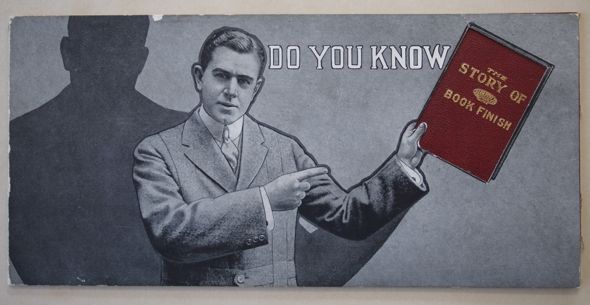
Fabrikoid

Do you know

Du Pont Fabrikoid Co., Do You Know the Story of Book Finish [ca. 1920] Front Cover, Promotional Pamphlet. Courtesy of the Hagley Museum and Library

Fabrikoid Co. was one of the predominant American manufactures of artificial leather, incorporated in 1902 and purchased by Du Pont in 1910.  Du Pont managed to get Henry Ford to use it as the covering on his Model T in 1914, putting it on over 130,00 cars. It was used for upholstery and other applications. The book in the pamphlet above is actually made of Fabrikoid book finish artificial leather, and mounted behind the cover in a cut out, creating this striking image. The chiaroscuro figure, surreal shadow, and pointing finger create an ominous, almost accusatory impression. The story of book finish is serious stuff.

how many hides has a cow

Du Pont Fabrikoid Co., Book Finish [ca. 1915] Detail of Back Cover, Promotional Pamphlet. Courtesy of the Hagley Museum and Library

Another great advertising campaign was the “How Many Hides?” Since Fabrikoid was essentially a less nitrated- nitrocellulose dissolved in castor oil, alcohol, benzene and amyl acetate, which was called pyroxilin (py-ROX-i-lin), it could be applied to different substrates: cloth, paper, or leather splits.  Du Pont hoped to capitalize on emphasizing the artificiality of “genuine” leather, and also casually reminded readers that Fabrikoid  was much cheaper. Sets of books such as Colliers Encyclopedia and the Harvard Classics were often bound in Fabrikoid. There are literally hundreds of variations on color, substrate, and texture just in book cloths.

_______________________

Jeffrey L. Meikle, “Presenting a New Material: From Imitation to Innovation with Fabrikoid” in The Journal of the Decorative Arts Society 1850-Present, No., 19 (1995), pp. 8-15.

Robert Kanigel  FAUX REAL: Genuine Leather and 200 Years of Inspired Fakes. Washington D.C.: Joseph Henry Press, 2007.

A Bookbinder’s Valentine

BookBinder.

Library Company of Philadelphia. ca. 1840-1880?

[New York] : H. De Marsan, Publisher of songs, 54 Chatham Street, N.Y

*

“My life’s a waste, I’m sick of paste; And printers, books and presses

Might quickly go to Jericho [1], Should Fortune smile, and bless tis I..

-Yes, but who’s the fool that would be thy Valentine?” [2]

______________

1. Jericho is a place of banishment, retirement, or drunkenness according to Partridge’s Dictionary of Slang.

2. As she says this line, there is an interesting workplace reversal going on: the male binder (husband?) is at the sewing frame, typically the woman’s job, and she is tooling, typically done by men. Is he wearing a kings crown or a jesters hat?