Throw-up and Drape

Throw up and drape
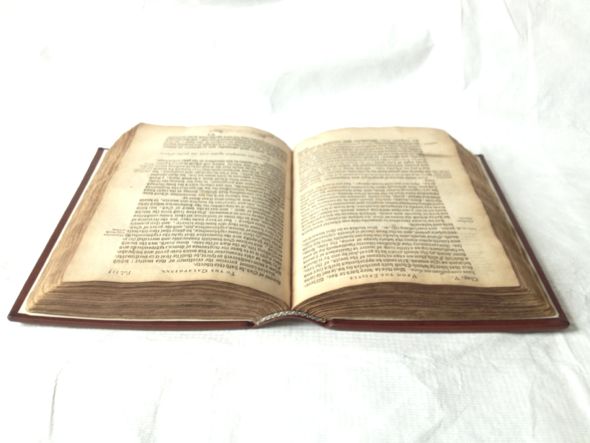
Martin Luther. A Commentarie of Martin Luther, London, 1616. Private Collection.

Throw-up is the degree to which the spine flexes in the opposite direction from its usual shape, or rises off the table if the book lying flat. Drape is the degree that the leaves flex. For example, a thick, small, cross grain leaf has virtually no drape, while the same paper might drape very well in a larger format when bending with the grain. Tom Conroy’s The Movement of the Book Spine discusses and illustrates these differences very well.

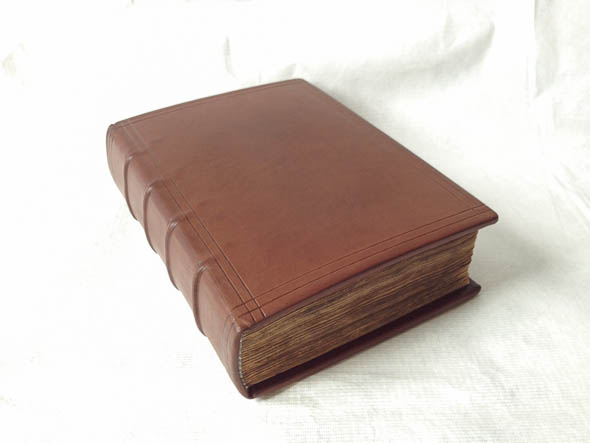
The above tight back book, which I rebound,  was resewn onto 5 cords, laced into handmade pasteboards, and covered in calf. It exhibits high throw up and well draping leaves. In this case, the sewing, sewing structure and spine linings were carefully chosen to achieve what I consider an optimal opening. This book lies flat without strain, yet when closed there is not excessive torquing or text-block drag

Rebinding is a major, very invasive, very expensive treatment, and rarely necessary. But it is hard to deny the appeal of a new binding: well functioning, easy to handle, and you do not need cradles to consult or read it. Of course, what is lost is the context of the text, the authenticity of the book in its totality, and simply the appeal of an antique object.
rebinding
Front Board. Martin Luther. A Commentarie of Martin Luther, London, 1616. Private Collection.


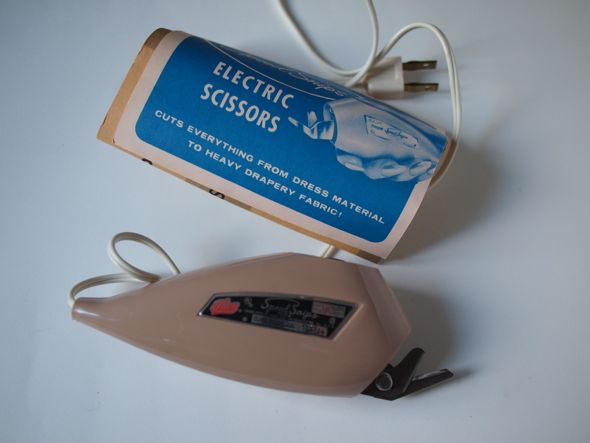
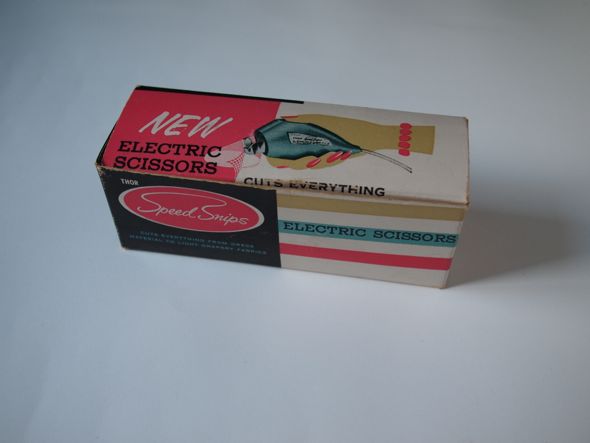
1967 Electric Scissors. With Headlight.


electric scissorsOLYMPUS DIGITAL CAMERA

OLYMPUS DIGITAL CAMERA

A 1967 Speed Snips electric Scissors.

When I first plugged it in, it only growled, but oiling the hinge and spring on the blades brought them snapping to life. They worked ok for cutting paper, I haven’t tried them cloth. Since the blades are so short, they need to be advanced somewhat slowly, so I’m not totally convinced they actually save that much time over a longer length “manual” scissors. But they do save some effort if accuracy is not paramount. It is surprisingly heavy.

Readers may also be interested in another electrified tool, a very rare West German electric bookbinders backing hammer, which I wrote about on 1 April 2011.


The Dinkification of Tools

French knives
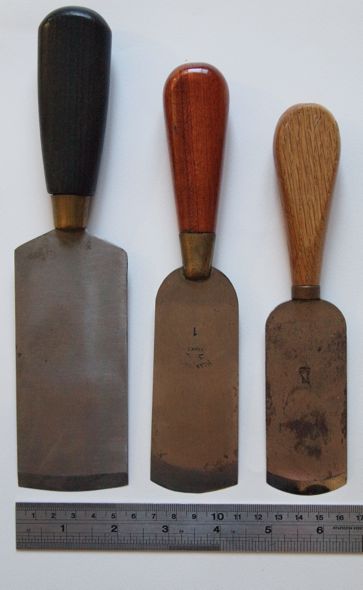
The dinkification of French leather paring knives. A completely unscientific approach. L-R: Big old knife, Medium moderately old knife, Small modern version.

Sometimes I half-jokingly refer to the dinkification of tools —the tendency of tools to get smaller, lighter, more flimsy, and often less functional — over time.

The above photo of three French Style leather paring knives from my collection illustrates this tendency nicely. I’m pretty sure they are arranged from the oldest on the left, to the newest on the right. Observe the cheapening of handle material: from ebony, to a stained wood, to a varnished one. The blades get thinner and narrower. The changes in the curve of the cutting edge is also of interest. The narrowest knife also has the greatest curve, which in my experience indicates it is designed for scraping than cutting, which runs counter to what I know historically about the history of leather paring.