Here is another gem from the Smithsonian Graphic Arts Model Collection, a very early — though not the first — guillotine for books or paper. Unfortunately, a fire destroyed the US Patent Office in 1836, so this model is the only remaining record. Visually, it looks much more like the neck cutting variety rather than ones for book or paper cutting. The massive blade operates by gravity rather than a lever or flywheel; again, like the non-book styles. Similar to all the early guillotines is that the blade operates straight up and down.
It’s always a dangerous game to cite the earliest book you have seen that contains this or that evidence, since it often gets superseded. Nevertheless, the earliest book I have seen that contains incontrovertible guillotine marks (thanks to a very damaged blade) is this Harper’s publisher’s cloth binding from 1834 of “The Works of Mrs. Sherwood”. The machine had a clamp and operated straight up and down. The curvature to the marks resulted from tightly clamping and distorting the unbeaten bookblock when cutting, a feature which the patent model above lacks, and when it is released it springs back into its resting shape.
Last week, I blogged about a scene from a movie depicting a copy press on top of a safe, and wondered if it was a way they were actually used in offices. Darryn Schneider of DAS Bookbinding in Australia sent me this wonderful image he found from the State Library of Victoria. Bingo! Well, at least there is one documented example….
Some nineteenth century style textured cloth I’ve made.
SHORT VERSION
Dot pattern nineteenth century style bookcloth for sale. Made with conservation grade materials. 14 x 22″ pieces. Order here.
LONG VERSION
Starting around 1823, bookcloth was embellished not only with color, but with texture. Although there were plainer types of cloth used on books before this, such as silk, velvet, canvas and muslin, when people refer to bookcloth, they often are referring to a starch filled, textured cloth. It was used on some of the earliest publisher’s bindings, like the Pickering Diamond Classic below.
A Pickering Diamond Classic. Le Rime del Petrarca, London, 1822. Height: 3.625 inches.
In the 1990’s, Tomlinson and Masters’ Bookcloth 1823-1980, provides a fascinating account of cloth manufacture, detailing how the early cloth was manufactured at the Winterbottom cloth company. The earliest book cloths seem to have been made in small pieces, like I make mine, but soon continuous rolls of textured bookcloth were cranked out. The complexity of the process is astounding, with at least five specialized types of machinery used, including three bowel padding mangles, backstarching mangles, friction calendaring machines, sentering machines, brush dampening machines, and embossing calendars. One wonders if any of this machinery is still extant. And if anyone could figure out how to operate it.
More recently, Andrea Krupp’s Bookcloth in England and America, 1823-1850 compared various bibliographic systems that describe these cloths, and includes an incredibly useful appendix with actual size photographs of many cloth patterns. And of course, we have the artifactual evidence on the books themselves to guide us.
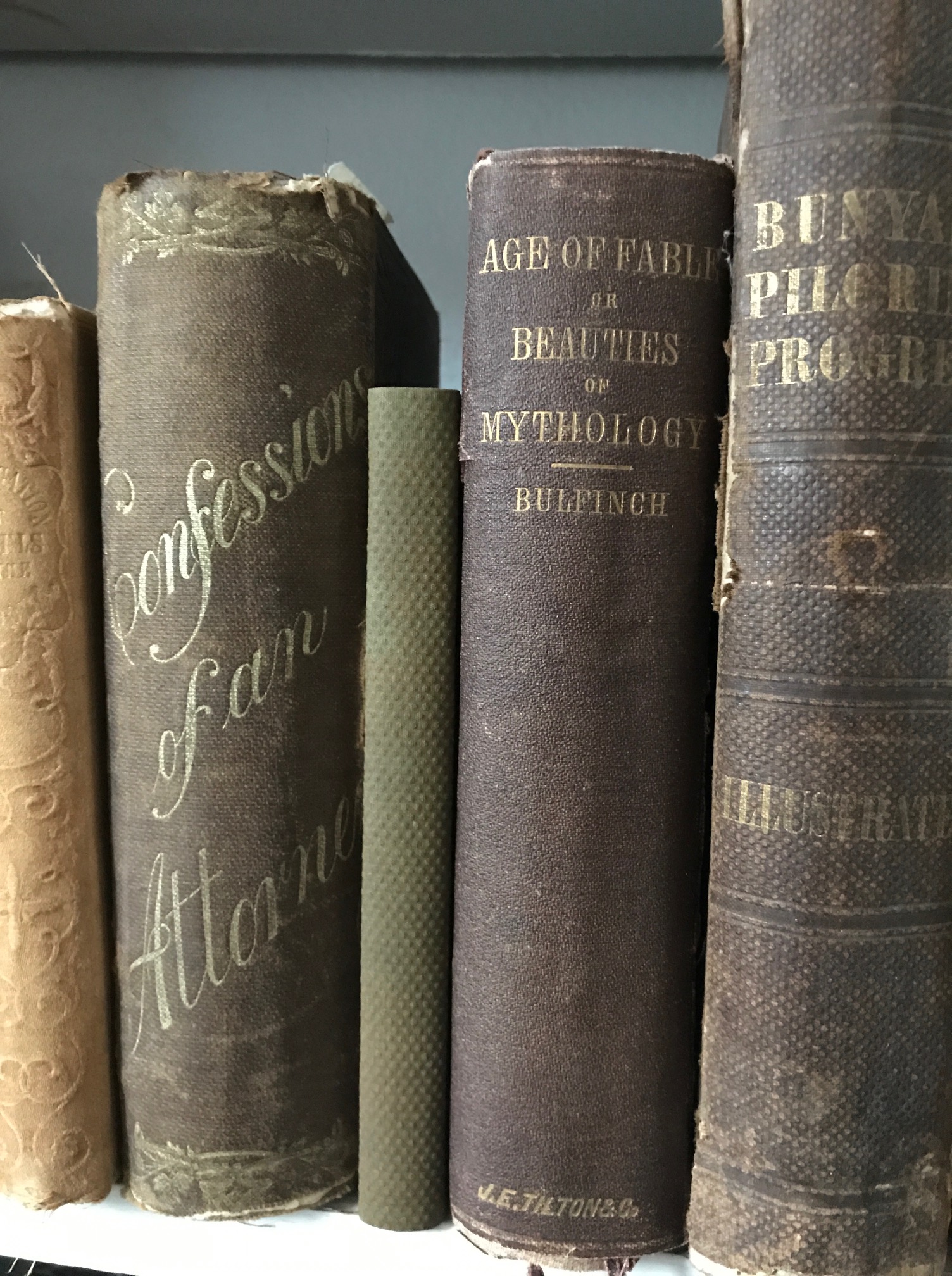
A book bound in my dot pattern book cloth among a few 19th century books.
So we know some things about how early bookcloth was invented, was originally made, and has evolved. Since there are no commercially available bookcloths that remotely resemble these early cloths, how can bookbinders and conservators make something similar on a small scale?
I’ve been interested in bookcloth for a while. I described replicating an earlier, untextured muslin using XSL dyes a couple of years ago. I’ve taught a number of classes on nineteenth century binding and done more cloth rebacks than I care to remember.
But the only source of published information about texturing book cloth I’ve found comes from Bill Minter in 1999. He briefly gives an overview of his methods in the Book and Paper Group Annual, Vol. 18. He begins with an unbleached muslin, to which he laminates an acrylic dyed Japanese tissue and sizes with methylcellulose. He creates texture by using wire screens as dies. This was in the context of creating a sympathetic new spine for a reback.
Another approach, by Vernon Wiering, uses dyes, starch paste and texturing plates to achieve a very realistic looking cloth, which he uses for his period and facsimile bindings.
Tim Ely, my first bookbinding teacher, has also experimented with texturing cloth using his etching press to create texture, and has an interesting conception of this as decorating the skin off the book, before attaching it.
An English style case binding covered in dot pattern cloth.
My own goals for making the cloth were fairly straightforward. I wanted to make a cloth that looked and felt similar to nineteenth century textured cloth, in a size that would be useful for a majority of books, that was made of conservation grade materials, was durable, and could be blind and gold stamped. I also wanted to make a cloth that would be affordable. On this last point, I may have failed. Mea culpa.
After a couple of months of experimenting, I developed a product that basically meets my criteria. The base is a scoured muslin, the coloring is conservation grade acrylics, and the sizing is methylcellulose and wheat starch paste. The die to texture it is made from stainless steel, and it is tissue backed to make gluing and handling easier. Each piece is 14 x 21 inches, big enough for two smaller books or one large one.
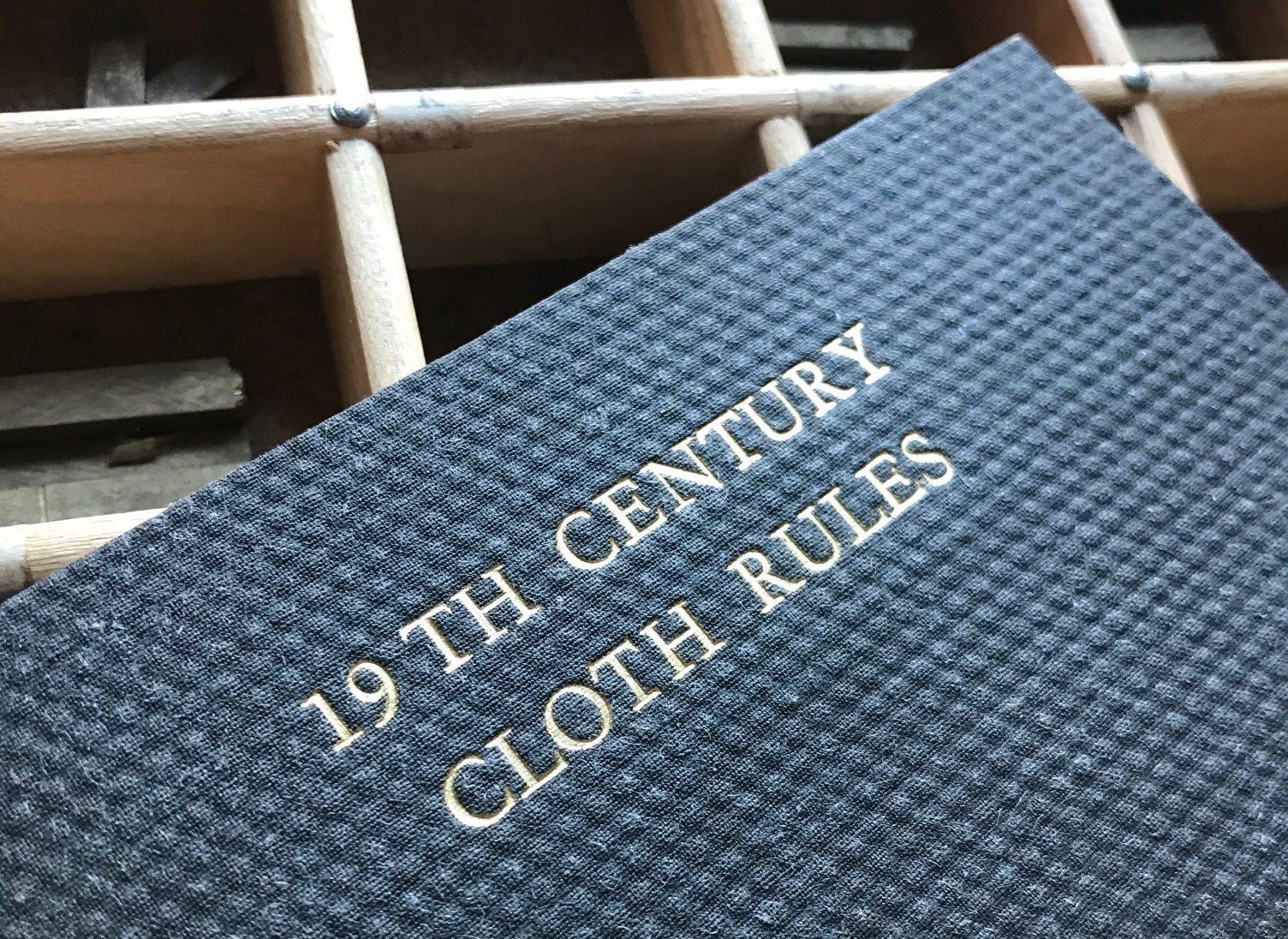
Detail of the dots.
The texture is pretty durable, though you have to use a light touch with your bone folder when turning-in, and be careful when casing-in. I lined my pressing boards with volara, aka. closed cell polyethylene foam to avoid smashing the dots.
To field test the durability, I recased a book I’m reading (Edmund Morris’s Edison, which I have mixed feelings about, btw) and treated it roughly by hauling it around in my backpack and for over a month. The cloth became a little abraded around the edges of the spine, on board edges, and on the dots, but overall survived quite well.
Tooling by precision dampening of the cloth and a heated roll.
The color is not completely even in the pieces I make, but varies slightly in order to blend in with the irregularities of a older cloths in historic collections. So far I’ve made muted browns, greens, and blues. The dot size and pattern is not an exact reproduction of anything historic, but meant to look sympathetic with a wide range of nineteenth century books. If you have an important nineteenth century book or need to make a box in a historical sympathetic cloth, this cloth will be perfect.
Gold foil stamping.
Dot Texture Nineteenth Century Style Bookcloth. The unbleached muslin is scoured and the pH adjusted to around 7. The cloth is dyed with conservation grade acrylics, and coated with wheat starch paste and methylcellulose. The embossing is done with a stainless steel die. The resulting cloth takes gold stamping and tooling well, and the cloth is dyed throughout the thickness so you can clean up a bit by scraping without exposing white fibers. The colors are all sympathetic with an aged nineteenth century pallet, primarily muted browns and greens. If you would like a particular color, I can let you know what I have. 14 x 22 inches. Purchase cloth here.
LIMITED TIME OFFER: I have some free small samples of the cloth, just contact me with your mailing address. Domestic US only. First come first serve.




 Peachey Conservation