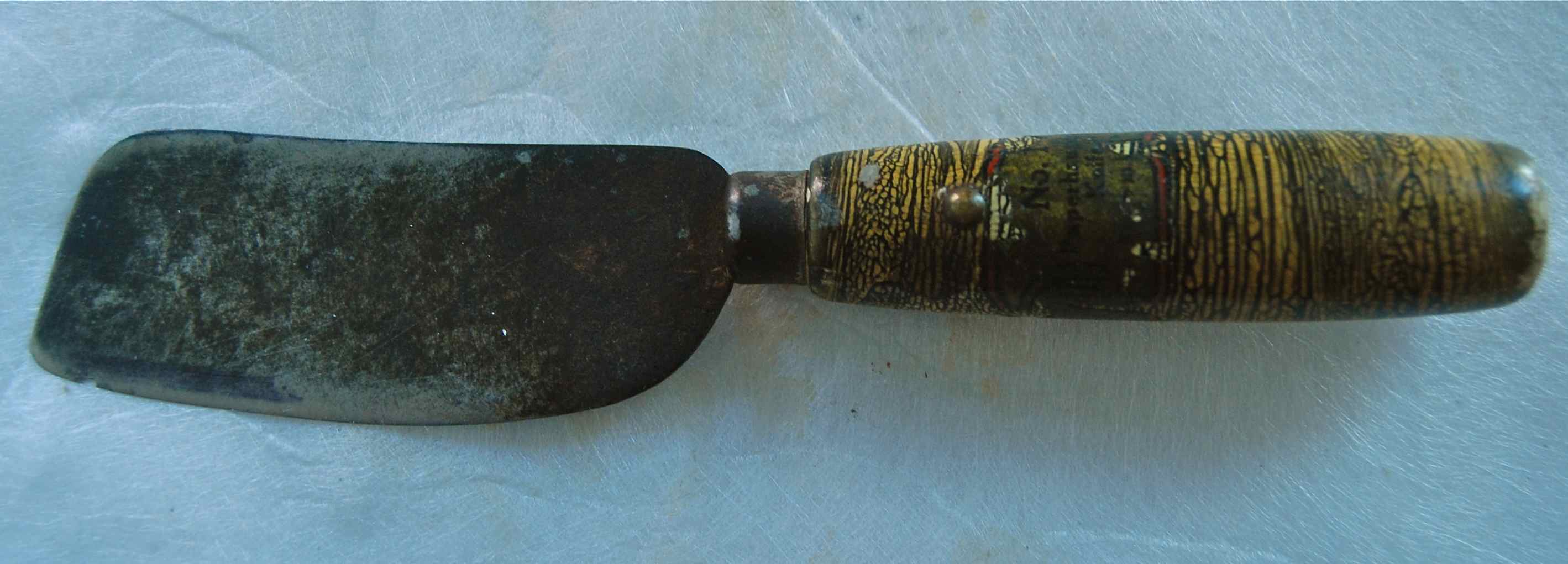
No. 1 Paperhangers Knife

I recently acquired this Knife.  It is 18 cm long, and the faded label appears to read “RIDGEL”, then “No. 1 Paperhangers Knife/ Made in U.S.A.”  The paint decorating the handle is quite spectacular, I’m guessing it is an oil based paint, but am unclear how this complex, tiny pattern was formed – the black paint appears to have been spun or dripped onto a turning handle? Any information is appreciated.

Outside Of The Text: My Work In Book Conservation

(The complete version of this article is at.  Center for Mennonite Writing, CMW Journal Vol. 2, No. 2. Don’t miss the new translation of a short lyric below Jan Luyken’s “The Bookbinder”, from his 1694 Book of Trades in the introduction to the Journal. My article details what book conservation is, how it differs from book restoration and bookbinding, then traces some ethical decisions during the course of a treatment. Below is the beginning.)

A book conservator often enters into public perception heavily colored by, and often confused with, romantic notions of a “Master Craftsman,” “Master Bookbinder,” or “Master Restorer.” In a world where many use their hands only to tap at a keyboard or lift a cup of coffee, the idea of a craftsman seems refreshingly simple, a bit anachronistic, very poetic and entirely appealing. Fortunately (or perhaps unfortunately!) these romantic ideas of a bookbinder bear little resemblance to what I do.

Although the terminology is somewhat debatable, in North America a bookbinder is usually someone who makes new fine bindings, or binds small editions, or repairs old books, often by putting new bindings on them. A book restorer, often working for the antiquarian or rare book trade, restores a book to an imagined, often pristine state, previous to damage, use or age. Many also make period bindings. (1) A book conservator attempts to preserve all the information that a book embodies, and ideally tries not to alter or change any existing element. Although conservators employ a full arsenal of craft skills, they also must know the history of book structure, be familiar with a wide variety of materials, have knowledge of preventative conservation and also understand methods of documentation. (2) The process is decidedly prosaic and cautious, and tends to adopt a scientific methodology.(3)

Figure 1

Fig 1. This romantic view is nothing new. Above is a 19th century plate of a bookbinder at work. Note the cherubic children who appear to be joyfully playing rather than working. Does the engraver imply that a bookbinder’s work was so simple a child could do it?

In contrast, bookbinding, or crafting an object, involves creating something, usually from raw or partially prepared materials. Craft often implies, at least today, a personal relationship to the work. Craft often involves handwork….

(READ THE ENTIRE ARTICLE HERE)

Or it is also located here:

http://www.mennonitewriting.org/journal/2/2/outside-text-my-work-book-conservation/

New Lifting Knives

These are the newly designed set of lifting knives, available for sale in the tool catalog section on the left.  Both of the knives are made from 01 steel, hardened to about Rc 59.  This hardness results in a durable edge for the prying and cutting.  The knives are polished, with no handle, so they can be used under water for backing removal.  They are based on a Roger Powell design, are perfect lifting covering material, splitting boards, and mechanical backing removal. They can used by right and left handers.  These knives will pay for themselves the first time you successfully lift something without having to do additional repairs. Both are 6″ long, and 1/16″ thick, half the thickness of the previous model.  The large knife is 1″wide, and perfect for lifting covering materials, splitting boards and mechanical backing removal.  If you are a paper conservator, and normally remove backing material with a scalpel, you will find this knife much more efficient, and safer for the user and the artifact.   The small 1/2″ knife is perfect for smaller books, turnins, lifting spines between raised bands, etc….  The rounded, beveled corners allow you to twist the knife when cutting through slips, for example. These knives are the perfect union of quality, simplicity and functionality.   The set includes two knives and a folding leather case, held together with magnets and protects the blades when not in use.    $225.00