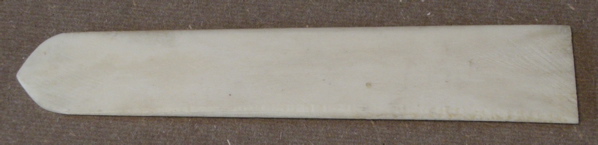
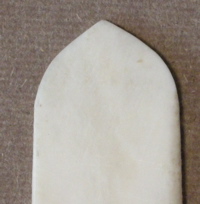
At first glance this looks like a typical recased book. But on closer inspection, it looks like a first attempt at a recase, maybe learned from a bookbinding manuel without the benefit of a teacher. The squares aren’t even, the grain of the buckram isn’t aligned properly, there is a blob of PVA on the upper board, the joints are too wide, the spine piece on the case is too wide and the case is not correctly aligned. The cloth isn’t stuck evenly to the edges of the board, giving them a rounded, heavy and crude appearance.

The corners are about four times too large and the turnins are at a weird angle. Not visible in these images, but half title page is skinned where the previous endsheets were removed, the new endsheets aren’t trimmed even with the textblock, the spine lining is uneven and extends past the edge of the textblock at the head.
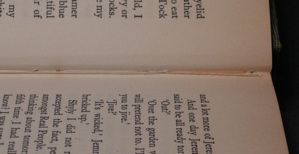
The sewing holes go through the textblock instead of the spinefold, most of them miss or encircle the tapes and there are several places where they are loose.
Apparently, this book exhibits almost every possible mistake when recasing.
But I recased this book in 1991, while working as a Technician at at an institution. I recased about 5 books a day for more than a year–over 1,000 books. And I did this one blindfolded. I couldn’t see anything, and had to rely solely on my sense of touch, and the habits I had build up. A coworker bet me lunch that I couldn’t do it, and it was a steak au poivre he treated me to that day. Nothing was precut- I cut the cloth from the roll, folded the endsheets and cut the boards on the board shear. The only step I cheated at was to have a pre-threaded needle. I doubt I could do this again, the muscle memory performing these repetitive tasks is long gone since I now specialize in single item treatments. It took about 2 hours, and I had several witnesses standing by with Band-Aids, a tourniquet and 911 on speed dial.
It is interesting how our perception of this book radically shifts, given the above contextual information. For me, it goes from “this book looks terrible” to “wow, not too bad”. And it serves as a reminder for conservators to gather as much contextual information about the object being treated, because the “mistakes” in this book are not “mistakes”, they are a record of the unusual circumstances of how it was created.
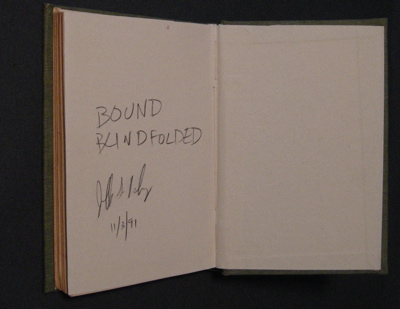
DISCLAIMER: BLINDFOLDED BOOKBINDING IS AN INHERENTLY DANGEROUS ACTIVITY, AND THIS AUTHOR NEITHER ENCOURAGES OR ASSUMES ANY LIABILITY FOR ANYONE ATTEMPTING IT.



 Peachey Conservation