A collection of boards bindings from a circulating library is being sold by Antiquates. Considered together, it forms pretty strong evidence against the traditional view boards bindings are entirely temporary structures, since the books contain circulation records.
Bookbinders might be interest in several other items in this catalog, particularly a run of The Bookbinding Trades Journal, or a fascinating book (I have a reprint) that details the murder of a bookbinder’s finishing tool maker by a bookbinder: Cook, the murderer, or the Leicester tragedy: Being a Full and Faithful Account of the horrible assassination of Mr. John Paas, of London, On the 30th of May, 1832, perpetrated by James Cook, of Leicester; with an authentic detail of the cruel means adopted by the murderer to accomplish the bloody deed…. A short summary of the incident is on the British Library Blog.
And if a reader of this blog is feeling the holiday spirit particularly strong this year, I confidently recommend that any of these items would make a wonderful Christmas gift for me. Thanks in advance!
A collection of publishers’ boards bindings for sale. Source: https://www.antiquates.co.uk/images/ListBbPrintFinalCompressed.pdf
Boards bindings are traditionally regarded by bibliophiles as rude, drab, ugly, and temporary. This disparagement alone perks my interest.
“Unfit for a gentleman’s library!” I imagine a Victorian barrister exclaiming, hurtling the ugly blue paper volume towards the marble fireplace, in the process tearing the spine and detaching the front board. “See, see,” he triumphantly states, pointing with his fat forefinger at the vile, dirty, weak and damaged paper covered binding.
Although there are a number of differing definitions of what temporary means, a common one regards them as a weak and non-permanent. This was a book meant to be rebound once a purchased — preferably into a “real” leather binding — so the traditional bibliophiles say.
What makes this collection fantastic is that it documents the use of each book, though likely this is somewhat less than the actual use. Twenty times, at least for this volume, as well as an unknown history since the documentation. These books are not in great shape, as the first image illustrates. But they are still functional.
The Puck building once housed the largest lithographic printing press operation under one roof in the world. This gorgeous 1887 Romanesque revival building is located in Nolita, New York City, and was home to Puck magazine between 1871 and 1918. Puck was the first political satire magazine in the United States, and the first weekly to use color lithography.
The building primarily housed printing related industries throughout most of the twentieth century, though in the 1980’s, another satirical magazine, Spy, had its headquarters there. Kurt Anderson, the co-founder of Spy, also has the distinction of being the first person to call attention to Donald Trump’s bizarrely small hands. Anderson also named him one of the 10 most embarrassing New Yorkers in 1986. Ironically, Ivanka Trump and Jared Kushner have a condo in this very building, ostensibly to store their contemporary art collection, and Kushner Enterprises now owns the building.
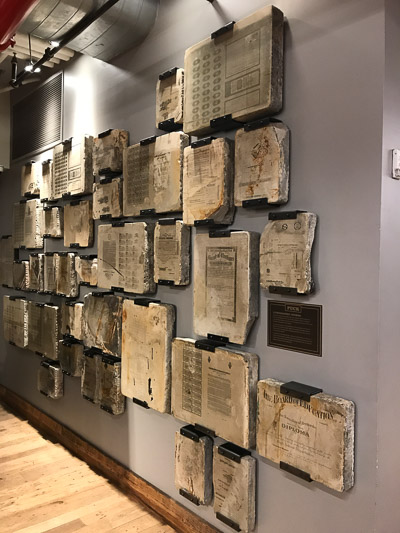
Anyway, the first couple of floors are occupied by REI’s flagship store for outdoor performance sportswear. Even if you aren’t in the mood to shop for 300 different types of wool hiking socks, there is a fairly large collection of lithographic stones on display. These were discovered when the building was renovated in 2011.
Lithographic stones on display. I bet some of you would love to dig your knife into these babies!
Some are very damaged, but I’m glad to see them preserved and displayed. Some appear to have been in wet soil for quite some time. A small plaque mentions they presumably came from the J. Ottmann Lithographing Company, which began in the 1880’s.
About 20% of the stones in this display are right-reading, like this one.
The display includes a number of right-reading stones. Terry Bellinger calls these “mother stones” and describes a stone to stone transfer. The often used mother stone was printed onto a daughter stone (creating a reversed image), then the daughter stone was used for the printing onto paper, generating a right-reading image once again. The mother stones could also be ganged together onto a larger daughter stone. For example, four of these Board of Education certificates in the image above could be printed onto a large daughter stone, then all four images printed at the same time onto a sheet of paper. In addition to speed, he mentions this technique protected the mother stone from damage.
A recent thread on the Book-Arts_L Listserv, “Question about stone lithography and printing” raised some questions about stone to stone transfer, since it would be quite difficult to register the stone upside down, it would be prone to cracking, and difficult to lift off. Ludwig Mohr describes a method of first transferring the image from a right reading stone onto an Albumen saturated piece of paper, then is then used to print from, presumably pasted to a stone? If a wrong-reading image was printed onto a carrier, then it would transfer back to a right-reading final print.
Of course, different printers may have used different techniques to print from a right-reading stone, but given the prevalence of these stones it bears more investigation. I didn’t notice anything written about it in the 1904 Handbook of Lithography. Further info is appreciated.
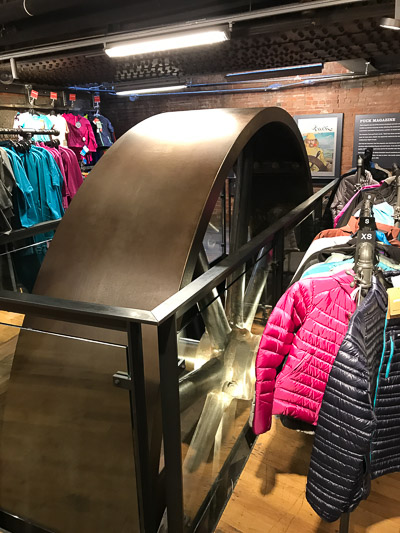
Gigantic flywheel.
Also in the store there are also two massive cast iron flywheels from the original power plant. They form an odd contrast to the featherweight plastic performance hiking gear. But who doesn’t like monster cast iron flywheels? Or featherweight plastic performance hiking gear?
An undated photo of the original configuration of the flywheels.
Lithographed cartoons and illustrations formed a large part of Puck magazine’s content. So much so, that the letterpress department felt it humorous to issue the following notice in 1881, in an attempt to elevate their emoticons to the level of visual art that existed elsewhere in the magazine.
Some of the stropping sprays, pastes, and substrates I’ve been experimenting with.
A meter was originally intended to be one ten-millionth of the distance from the North Pole to the South Pole where it passed through Paris. The Measure of All Things is a facinating book by Ken Adler which documents this feat of triangulation — in the middle of the French revolution, no less — and also explores how the defined length of a meter has since changed. A millionth of a meter is a micron. As a point of reference, a hair on your head is about 40 microns wide. A thousandth of a micron is a nanometer. Yes, I’ve been thinking small!
Typically, I hand sharpen following a grit progression of 80, 40, 15, 5, micron on 3M microfinishng films with water as a lubricant, strop with a .5 micron Chromium Oxide (CrO2), honing compound on the flesh side of a horse butt strop, then finish stropping on naked flesh side kangaroo. Don’t get me wrong, this works quite well. And there are many other ways to sharpen a knife.
Inspired by some other sharpening approaches, two aspects of my routine seemed to need a little tweaking. First, I eliminated the large jump between 5 and .5 micron, and found some finer grits for a final stropping. Adding a 1 and .3 micron 3M PSA finishing film filled in the gap nicely during sharpening. And a final stropping with a .1 micron Poly Crystalline Diamond (PCD) diamond on polyester leather has dialed up the sharpness to eleven.
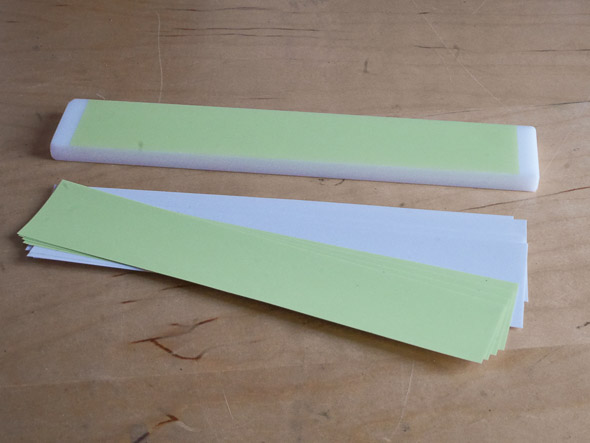
3M finishing film. The lime green is one micron, and the very bluish looking (in this image) white is .3 micron. The delrin plate is in the back.
PCD or Cubic Boron Nitride (CBN) compounds smaller than .25 micron don’t work well on real leather for two reasons: the expensive spray soaks into the leather and disappears alarmingly fast, and the natural abrasiveness of the leather itself is sometimes coarser than the spray.
One solution is to use a polyester leather, which is similar to “nanocloth”, a term Ken Swartz has coined and a great product he sells. Polyester leather is made from an ultra micro fiber that holds sub-micron sprays incredibly well, is very thin so the cutting edge does not become rounded, and is extraordinarily durable. Human hair is roughly 20 denier, but this ultra micro fiber is .04 denier. Denier is the mass in grams of 9000 meters of a given fiber. It is difficult to imagine how small and light this fiber is: 9 kilometers (over 5.5 miles) of it only weights .04 grams! All of these tiny little fibers hold the diamond particles loosely while allowing them to move around a bit, exposing new sharp edges. I think this is why they last so long.
In other words, this polyester leather is a perfect substrate for .25 micron and smaller sized sprays. I’ve experimented with the .25 micron (~64,000 grit, 250 nanometer), .1 micron ( ~160,000 grit, 100 nanometer), and .025 micron ( ~640,000 grit, 25 nanometer). These are available in PCD and CBN. The diamond seems to stay sharp longer (because of the shape and hardness?), cuts a bit faster, though is more expensive. The .25 micron is pretty close to the .5 micron CrO2 I usually use, and though it does cut quicker and lasts longer, it seems an unnecessary expense. Waxy pastes don’t apply or stick well to polyester leather.
In terms of initial cutting performance and cutting edge longevity, I can’t really tell much, if any, difference between blades stropped with the .1 micron or .025 micron. Even so, the idea of a one fortieth of a micron edge does have an almost irrational appeal, but is it just a placebo effect? Also theoretically, the smaller the grit progression in your sharpening sequence, the finer the cutting edge, and the faster you get there. But everyone has to decide for themselves if the trade off in time spent sharpening is worth the final result.
Diamond compounds are expensive, but once they are loaded onto the polyester leather they last for a long time. In my experiments, I’ve used a single polyester leather strop loaded with .1 micron for over 100 knives without recharging, and it isn’t dead yet.
I’m a convert to this new sequence. It really doesn’t take much additional time, and the resulting edge is better. All the knives I make now follow a 80, 40, 15, 5, 1, .3 micron sharpening sequence, and a .1 micron stropping. When I am paring leather for my own projects, I do a two stage stropping sequence to keep the knife sharp. First, a .5 micron CrO2 on horse butt followed by .1 micron PCD on polyester leather. Once the edge becomes too obtuse, then it is time to resharpen.
Choose your poison and treat yourself to a sharpest knife you’ve ever experienced for this Christmas!
SuperStrop. Note how thin the polyester leather is on the far side, as compared to the horse butt.
SUPERSTROP
The Superstrop has a half inch thick cast acrylic core, which is the flattest plastic available, as well as being very dimensionally stable. Flesh side horse butt is mounted on one side and flesh side polyester ultra-microfiber leather on the other. The strop has a nice heft, about 14 ounces, so it doesn’t move around on the bench while stropping. The polyester leather comes loaded with .1 micron Poly Crystalline Diamond (PCD) compound, which should last a very long time. Sub-micron diamond replacement sprays are readily available. Replacement PSA horse butt and PSA Polyester leather is also available. When working, I like to use the .5 micron Chromium Oxide (CrO2) honing compound on the horse butt, wipe off the knife to prevent grit contamination, then finish with the .1 micron PCD. Also available with polyester leather on both sides, loaded with .1 and .025 micron PCD.






 Peachey Conservation
#/media/File:Emoticons_Puck_1881_with_Text.png)