Small. Really Small. Submicron Sharpening. Polyester Leather. SuperStrop.

Some of the stropping sprays, pastes, and substrates I’ve been experimenting with.

A meter was originally intended to be one ten-millionth of the distance from the North Pole to the South Pole where it passed through Paris. The Measure of All Things is a facinating book by Ken Adler which documents this feat of triangulation — in the middle of the French revolution, no less — and also explores how the defined length of a meter has since changed. A millionth of a meter is a micron. As a point of reference, a hair on your head is about 40 microns wide. A thousandth of a micron is a nanometer. Yes, I’ve been thinking small!

Typically, I hand sharpen following a grit progression of 80, 40, 15, 5, micron on 3M microfinishng films with water as a lubricant, strop with a .5 micron Chromium Oxide (CrO2), honing compound on the flesh side of a horse butt strop, then finish stropping on naked flesh side kangaroo. Don’t get me wrong, this works quite well. And there are many other ways to sharpen a knife.

Inspired by some other sharpening approaches, two aspects of my routine seemed to need a little tweaking. First, I eliminated the large jump between 5 and .5 micron, and found some finer grits for a final stropping.  Adding a 1 and .3 micron 3M PSA finishing film filled in the gap nicely during sharpening. And a final stropping with a .1 micron Poly Crystalline Diamond (PCD) diamond on polyester leather has dialed up the sharpness to eleven.

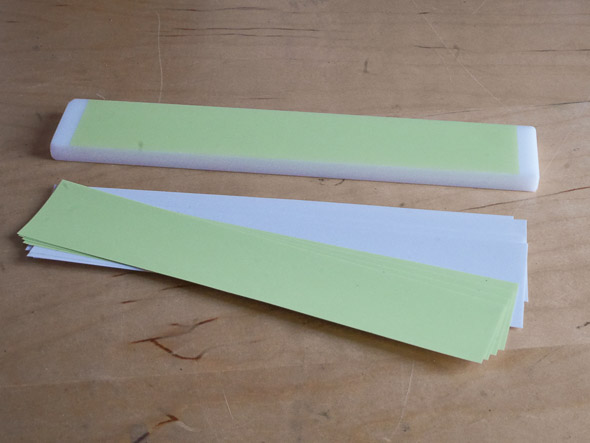
3M finishing film. The lime green is one micron, and the very bluish looking (in this image) white is .3 micron. The delrin plate is in the back.

PCD or Cubic Boron Nitride (CBN) compounds smaller than .25 micron don’t work well on real leather for two reasons: the expensive spray soaks into the leather and disappears alarmingly fast, and the natural abrasiveness of the leather itself is sometimes coarser than the spray.

One solution is to use a polyester leather, which is similar to “nanocloth”, a term Ken Swartz has coined and a great product he sells. Polyester leather is made from an ultra micro fiber that holds sub-micron sprays incredibly well, is very thin so the cutting edge does not become rounded, and is extraordinarily durable. Human hair is roughly 20 denier, but this ultra micro fiber is .04 denier. Denier is the mass in grams of 9000 meters of a given fiber. It is difficult to imagine how small and light this fiber is: 9 kilometers (over 5.5 miles) of it only weights .04 grams! All of these tiny little fibers hold the diamond particles loosely while allowing them to move around a bit, exposing new sharp edges.  I think this is why they last so long.

In other words, this polyester leather is a perfect substrate for .25  micron and smaller sized sprays. I’ve experimented with the  .25 micron (~64,000 grit, 250 nanometer),  .1 micron ( ~160,000 grit, 100 nanometer), and .025 micron ( ~640,000 grit, 25 nanometer). These are available in PCD and CBN. The diamond seems to stay sharp longer (because of the shape and hardness?), cuts a bit faster, though is more expensive. The .25 micron is pretty close to the .5 micron CrO2 I usually use, and though it does cut quicker and lasts longer, it seems an unnecessary expense. Waxy pastes don’t apply or stick well to polyester leather.

In terms of initial cutting performance and cutting edge longevity, I can’t really tell much, if any, difference between blades stropped with the  .1 micron or  .025 micron. Even so, the idea of a one fortieth of a micron edge does have an almost irrational appeal, but is it just a placebo effect? Also theoretically, the smaller the grit progression in your sharpening sequence, the finer the cutting edge, and the faster you get there. But everyone has to decide for themselves if the trade off in time spent sharpening is worth the final result.

Diamond compounds are expensive, but once they are loaded onto the polyester leather they last for a long time. In my experiments, I’ve used a single polyester leather strop loaded with .1 micron for over 100 knives without recharging, and it isn’t dead yet.

I’m a convert to this new sequence.  It really doesn’t take much additional time, and the resulting edge is better. All the knives I make now follow a 80, 40, 15, 5, 1, .3 micron sharpening sequence, and a .1 micron stropping. When I am paring leather for my own projects, I do a two stage stropping sequence to keep the knife sharp. First, a  .5 micron CrO2 on horse butt followed by .1 micron PCD  on polyester leather. Once the edge becomes too obtuse, then it is time to resharpen.

Choose your poison and treat yourself to a sharpest knife you’ve ever experienced for this Christmas!

SuperStrop. Note how thin the polyester leather is on the far side, as compared to the horse butt.

SUPERSTROP

The Superstrop has a half inch thick cast acrylic core, which is the flattest plastic available, as well as being very dimensionally stable.  Flesh side horse butt is mounted on one side and flesh side polyester ultra-microfiber leather on the other. The strop has a nice heft, about 14 ounces, so it doesn’t move around on the bench while stropping. The polyester leather comes loaded with .1 micron Poly Crystalline Diamond (PCD) compound, which should last a very long time. Sub-micron diamond replacement sprays are readily available. Replacement PSA horse butt and PSA Polyester leather is also available. When working, I like to use the .5 micron Chromium Oxide (CrO2) honing compound on the horse butt, wipe off the knife to prevent grit contamination, then finish with the .1 micron PCD. Also available with polyester leather on both sides, loaded with .1 and .025 micron PCD.

SuperStrop.  14″ x 2.5″ x ~.625″.   $85.00

Replacement ~15″ x 3″ PSA flesh side horsebutt: $35.00

Replacement ~15″ x 3″ PSA flesh side polyester leather: $35.00


3M PSA FILM, ONE AND .3 MICRON.

3M finishing films.1 micron is lime green and .3 micron is white.

Delrin plate, machined and lapped flat. Fits into my sharpening system. 12 x 2 x .5″: $50.00

1 micron and .3 micron 3M PSA finishing film, 4 sheets each. 12 x 2″: $10.00


Samson Paper Press

The Robert C. Williams Museum of Papermaking in Atlanta has one of the largest — and oldest — papermaking presses I’ve ever seen. Look at the size of the top beam, which is about two feet square!

The entire museum is fantastic. It started at the Massachusetts Institute of Technology in 1939, consisting primarily of Dard Hunter’s papermaking books and artifacts. Then it moved to the Institute of Paper Chemistry in 1954, was added to over the years, and finally landed at Georgia Tech in 2003.

The “Samson Paper Press”, constructed in 1790, was used by Hodgkinson and Co. in Wookey Hole England until the early twentieth century, according to the label. I’m not sure if the name refers to this press in particular, or is a generic term for any massive press.

It has an iron thread which generates much more power than a wooden one, due to the reduction of friction. I’m starting to think that all images of early nineteenth century presses with a ball above the platen also have iron thread.  Samson has a ratchet wheel and pawl mechanism to prevent the platen from backing off when fully tightened.

The tommy bar, or press pin, is lying on the black plinth in front of the press and is about six feet long! Not visible is the iron renforcement on the end of the bar which fits into the four holed iron ball. I imagine Samson securely attached to the ceiling or wall, and three or four men working together to fully tighten it. The daylight is roughly 3.5 feet, which would be about the height of a typical post (a stack of the newly formed sheets and felts). Possibly a century of use might account for the deterioration on the lower wooden platen, or it may have been sunk into the earth under the floor. The uprights are iron faced on the two short sides. A few decades later, by the 1830’s, most presses were made completely or iron or steel, making Samson an interesting transitional press, incorporating both wood and iron.

Around the same time, the French papermaking press depicted in Diderot’s Encyclopédie appears to have wooden threads, but a similar iron ratchet mechanism to prevent it from backing off. I have a hard time believing a small wood pawl could withstand the compression.

Encyclopédie, ou dictionnaire raisonné des sciences, des arts et des métiers, etc., eds. Denis Diderot and Jean le Rond d’Alembert. University of Chicago: ARTFL Encyclopédie Project (Autumn 2017 Edition), Robert Morrissey and Glenn Roe (eds), http://encyclopedie.uchicago.edu/.


Phive Star Light

The Phive CL-1 illuminating a book being sewn on a Nokey sewing frame.

My first workbench light was a twin tube florescent I found on the street.  The long tubes illuminated very evenly, without casting shadows from my own hands while I was working. Eventually the buzz from the ballast became intolerable, and I switched to a 100 watt round swing-arm adjustable style, which most people use.

Recently, I decided to try out the Phive CL-1 LED lamp. So far it is a great light. It looks high-tech, the arm is easy to position, and more importantly stays in position. The 5000k color temperature is pretty close to daylight. The area where the LED’s are mounted is very small, so you can position it close to yourself or to your work.

The bulb does not seem to be replaceable, but the lifespan is estimated to be 50,000 hours, which is 17 years at 8 hours a day — very close to my own working lifespan.