Samson Paper Press

The Robert C. Williams Museum of Papermaking in Atlanta has one of the largest — and oldest — papermaking presses I’ve ever seen. Look at the size of the top beam, which is about two feet square!

The entire museum is fantastic. It started at the Massachusetts Institute of Technology in 1939, consisting primarily of Dard Hunter’s papermaking books and artifacts. Then it moved to the Institute of Paper Chemistry in 1954, was added to over the years, and finally landed at Georgia Tech in 2003.

The “Samson Paper Press”, constructed in 1790, was used by Hodgkinson and Co. in Wookey Hole England until the early twentieth century, according to the label. I’m not sure if the name refers to this press in particular, or is a generic term for any massive press.

It has an iron thread which generates much more power than a wooden one, due to the reduction of friction. I’m starting to think that all images of early nineteenth century presses with a ball above the platen also have iron thread.  Samson has a ratchet wheel and pawl mechanism to prevent the platen from backing off when fully tightened.

The tommy bar, or press pin, is lying on the black plinth in front of the press and is about six feet long! Not visible is the iron renforcement on the end of the bar which fits into the four holed iron ball. I imagine Samson securely attached to the ceiling or wall, and three or four men working together to fully tighten it. The daylight is roughly 3.5 feet, which would be about the height of a typical post (a stack of the newly formed sheets and felts). Possibly a century of use might account for the deterioration on the lower wooden platen, or it may have been sunk into the earth under the floor. The uprights are iron faced on the two short sides. A few decades later, by the 1830’s, most presses were made completely or iron or steel, making Samson an interesting transitional press, incorporating both wood and iron.

Around the same time, the French papermaking press depicted in Diderot’s Encyclopédie appears to have wooden threads, but a similar iron ratchet mechanism to prevent it from backing off. I have a hard time believing a small wood pawl could withstand the compression.

Encyclopédie, ou dictionnaire raisonné des sciences, des arts et des métiers, etc., eds. Denis Diderot and Jean le Rond d’Alembert. University of Chicago: ARTFL Encyclopédie Project (Autumn 2017 Edition), Robert Morrissey and Glenn Roe (eds), http://encyclopedie.uchicago.edu/.


Phive Star Light

The Phive CL-1 illuminating a book being sewn on a Nokey sewing frame.

My first workbench light was a twin tube florescent I found on the street.  The long tubes illuminated very evenly, without casting shadows from my own hands while I was working. Eventually the buzz from the ballast became intolerable, and I switched to a 100 watt round swing-arm adjustable style, which most people use.

Recently, I decided to try out the Phive CL-1 LED lamp. So far it is a great light. It looks high-tech, the arm is easy to position, and more importantly stays in position. The 5000k color temperature is pretty close to daylight. The area where the LED’s are mounted is very small, so you can position it close to yourself or to your work.

The bulb does not seem to be replaceable, but the lifespan is estimated to be 50,000 hours, which is 17 years at 8 hours a day — very close to my own working lifespan.

Just Looking

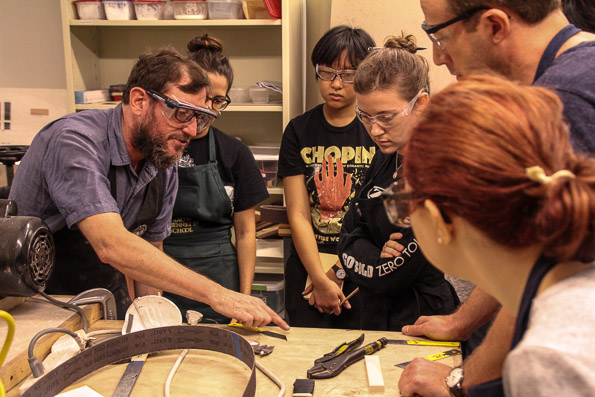
Once a year I teach a knife sharpening and tool making workshop in the bookbinding department at North Bennett Street School (NBSS) in Boston.  NBSS has the finest bench oriented two year bookbinding program in the world. If you have the passion, drive, commitment, dedication — and are crazy enough to pursue this antiquated profession in the 21st century — this is the place to do it. You will find many kindred spirits in your cohort.

I cover all aspects of sharpening related to bookbinding: blade angles, bevel angles, types of steel, types knives, types of grits, grit progression, hand grinding using power tools, free hand sharpening, and stropping. These techniques can be adapted to virtually any type of sharpening system: oil stones, diamond stones, waterstones, lapping powders and finishing films. Free hand sharpening throws many students into the deep end, for a while, but ultimately equips them to sharpen most types of edge tools. Most bookbinding knives have complex shapes and handles  which preclude the use of jigs or honing guides.

The foundation of this class is critical looking. Critical looking is not only closely watching the instructor demonstrate a technique, but it is looking at what you have done. Often when sighting or aligning, one eye is better than two.

Once you can visually analyze what your hands have done, then you can correct, alter, adjust, repeat your hand technique. Critical thinking is taught via writing in undergraduate curriculums. Could critical looking be linked to drawing?  Taking a photo or shooting a video can be a useful shortcut for note taking that may gloss over important aspects, such as processing and replicating. Drawing really forces you to look closer, again and again and again.

Critical looking is different from just looking. In a narrow sense it means learning to interpret what you are looking at, what the scratch patterns, reflections, divots, rounded bevels mean in relation to how you were holding the knife. In a broader sense it means understanding  what the effect of your actions are. Critical looking is the basis of all sharpening, maybe all craft skills?


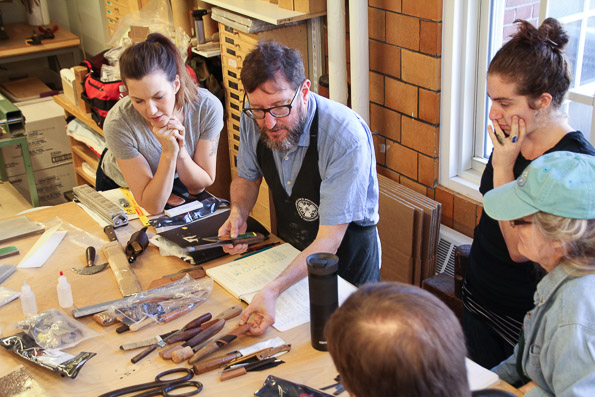
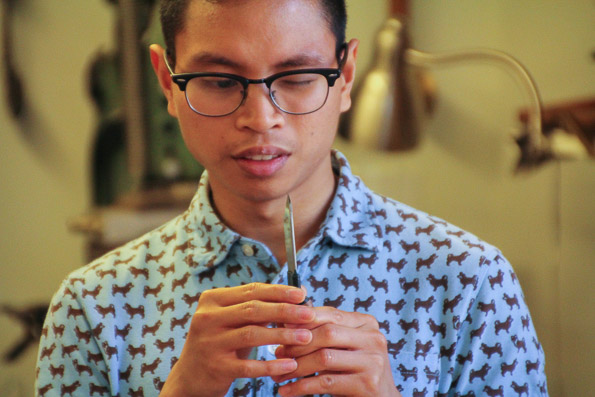
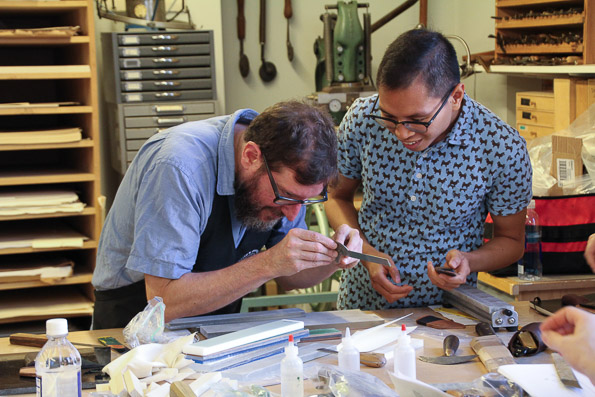
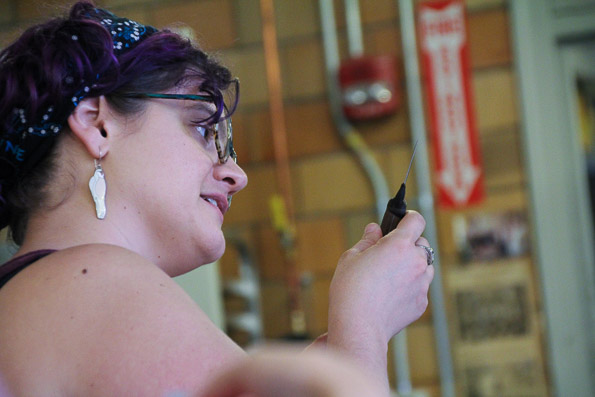
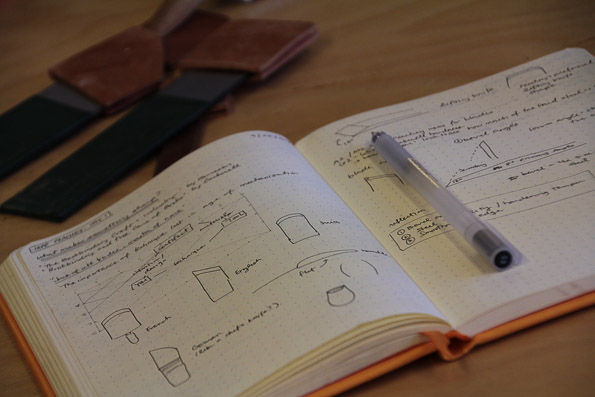
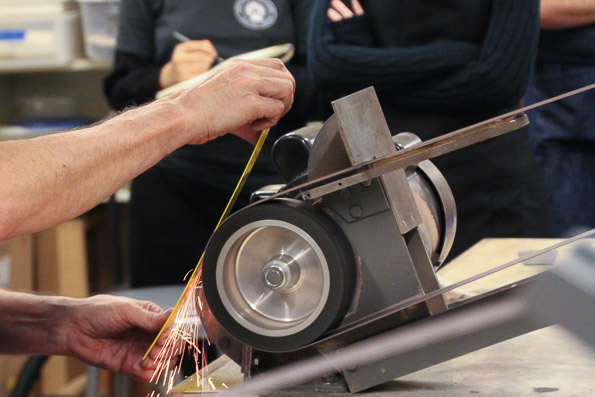
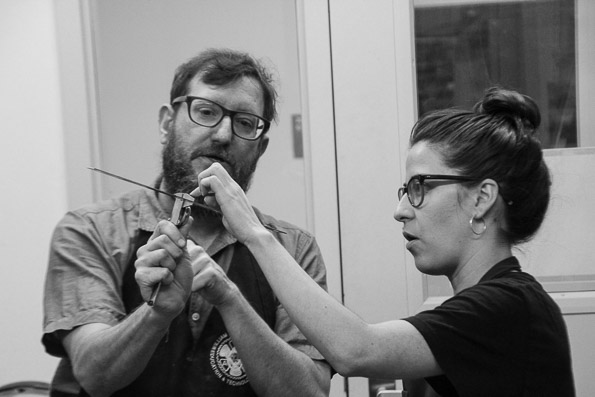
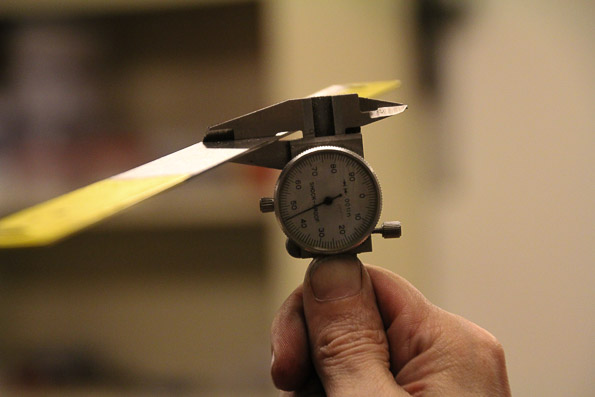
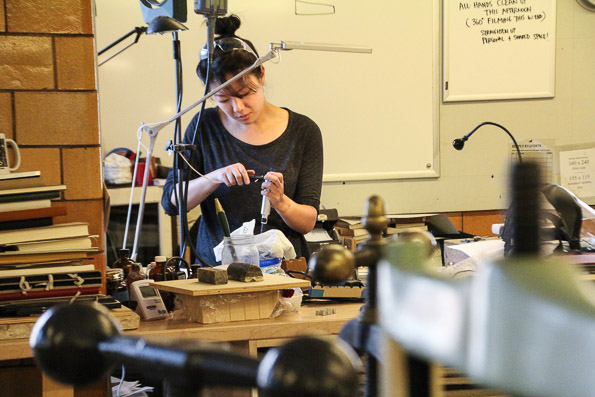
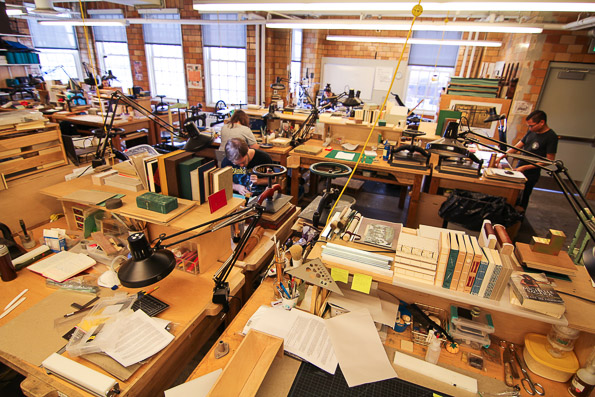
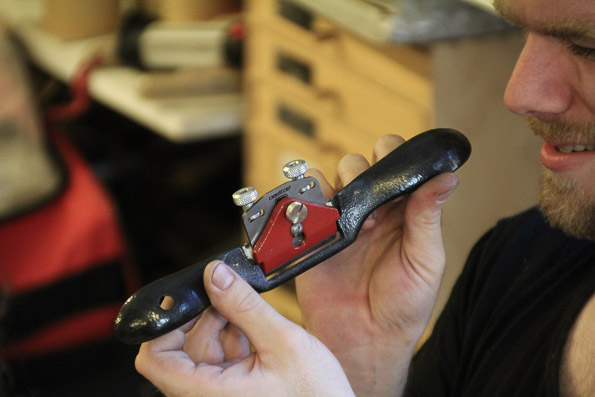
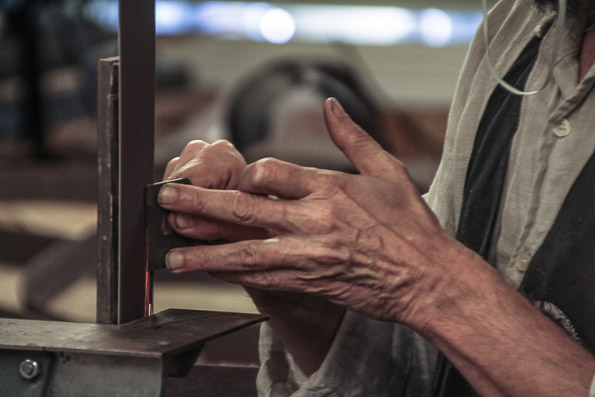
Below are some images of the 2017 workshop shot by Brian Burnett.


All Photos Copyright 2017 Brian Burnett. And he was critically looking.