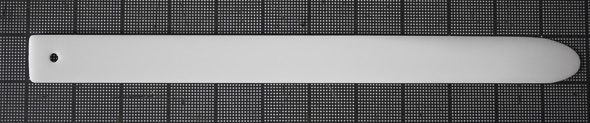
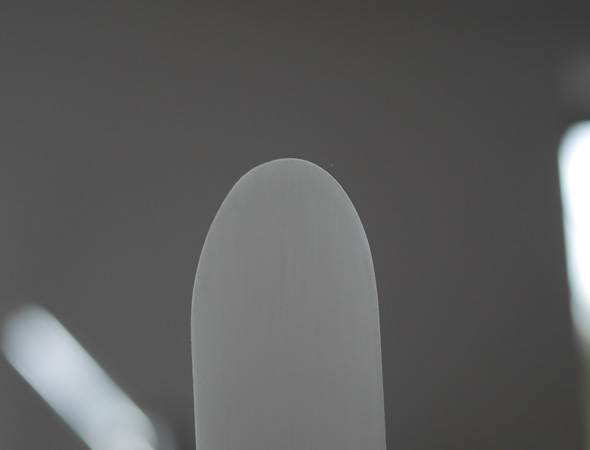
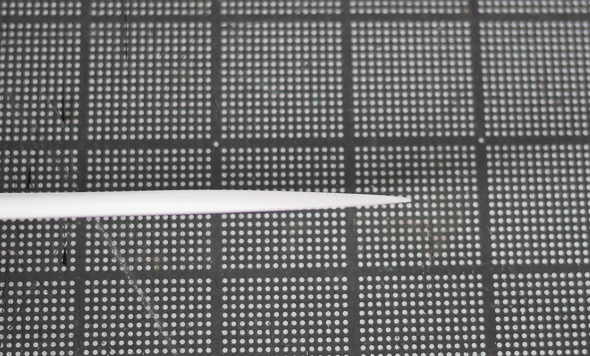
Top of Delrin lifting tool. The tip is sharp for about an inch on each side. The rest of the tool edges are rounded for a comfortable grip..Detail of the general shape of the tip.Detail of the gradual reduction in thickness at the tip.
This delrin lifting tool is useful for general lifting, mechanical backing removal, and whenever you need to gently pry or delaminate something. Both book and paper conservators will find this an essential component of their toolkit. Although it is thicker than the carbon fiber lifter I make and sell, it has a slightly lower coefficient of friction, so slides a bit better, and it is more ridgid. If you like your teflon lifter but are tired of how easily the cutting edge bends, this might be the tool for you. Obviously, it is not as durable as metal. But it is always great to have as wide of a range of tools as possible. These delrin lifters are hand sharpened to achieve the best possible balance between initial cutting performance and edge retention. The edge is easy to maintain by sanding or scraping. Click on “Tool Catalog” above for ordering information.
In the sixth century, Cassiodorus wrote this wonderful description of the impact of writing on papyrus on the thought process:
“Before [papyrus was discovered] the sayings of the wise, the thoughts of the ancients were in danger. For how could the writer have been able to write quickly, when, the hardness of the bark resisting him he would scarcely have been able to be ready? The excitement of the mind submits to the unfitting hindrances; when the words are harassed, the mental powers are compelled to grow lukewarm … This was fit only for the beginnings of the world. Then papyrus was discovered, and therewith was eloquence made possible … So smooth and so continuous, the snowy entrails of a green herb, which keeps the sweet harvest of the mind, and resorts it to the reader whenever he chooses to consult it; which is the faithful witness to all human action.”
-Elspeth Whitney, “Paradise Restored: The Mechanical Arts from Antiquity through the Thirteenth Century”, Transactions of the American Philosophical Society 80, Part 1, (1990): 67.
Bernard C. Middleton. A Bookbinder’s Miscellany. Oxford, England: Alan Isaac Rare Books, 2015. xv, 114 p. ill. 25 pounds sterling, plus 9 pounds shipping to USA. 500 copies. http://aibooks.co.uk
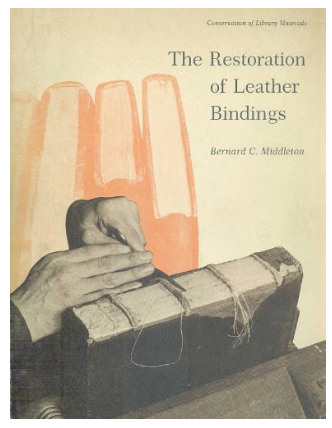
When I attended the Bookbinding 2000 Conference, I thought it might be Bernard C. Middleton’s last hurrah. After all, he had brokered the transfer of his extraordinary collection of books about bookbinding to Rochester Institute of Technology’s Wallace Library Cary Collection. He was 75 years old. He had written two of the most influential books on the craft of bookbinding in the 20th century. The elegant hands (his?) on the cover of the Restoration of Leather Bindings possibly inspired more of us to enter the is field than any of his writing. The bindings I’ve handled of his have been exemplary. What was left to do?
Fifteen years later, we have another book, consisting of three new essays and nineteen previously published ones. Most appeared originally in Paper & Print, The British & Colonial Printer, Printing World, and The Book Collector in the 1950’s, but all were new to me. This is another essential book, written in Middleton’s straightforward style and packed with observations on forwarding, finishing, and the state of the craft in general.
This book pairs nicely with his indispensable History of English Craft Bookbinding Technique, because it does deal with technique, while despite the title, his History primarily concerns structure. Technique is an elusive beast. Only traces of it remain in artifacts, and it is often difficult to understand how a particular action was accomplished, even if one can arrive at a similar looking result using current tools and techniques. But understanding and interpreting historic subtitles are essential for understanding the evolution of any craft.
This is precisely why A Bookbinders Miscellany is so important: it is a first hand account (and quite often critique) of fine, trade, extra, craft, restoration, and art binding techniques in the mid-20th century. It is invaluable to gain insight into what binders were doing and discussing, especially if it is now considered dated from our current, conservation oriented approach.
The book also records the tension between art school training, with its emphasis on design, and a decline in craft trade binding skills in the post WW2 era. Bookbinder Sam Ellenport’s introduction situates the book within this milieu.
For readers not so interested in binding history or design philosophy, this book also contains many practical tips for full leather binding. “Notes on The Art of Covering with Leather”, and “Notes on the Hand Sewing of Books” both contain extremely useful how-to information. “The Supported French Groove” details this often forgotten binding which combines advantages of the case and in-boards binding.
In possibly his most personal essay, published for the first time, “Old vs. New: A Division of Interest”, Middleton reflects on the nature of design, restoration, disorganization, and the value of dirt in his bindery. He considers his professional life “… a muddle — a muddle which, though it constantly exasperates me, certainly provides a wealth of interest.” (p. 106) Frankly, it is hard to consider this scholar and craftsman’s career anything close to a muddle, and I hope this is just an example of English self-deprication.
So why is this excellent and informative limited edition book priced so low? Come on, for all Middleton has given during his life, can’t we give a little more back to him? If bookbinders do not value the physical book, can we expect anyone else to?
“Bookbinding is a challenge — a challenge to our skill and our intellect. To master this craft is to master many things. True mastery has yet to be achieved, but we must all press forward in the endeavor to create the nearest approach to the Book Perfect.” (p. 44) Middleton is realistic when describing the present state of binding, but retains hope for the future. I’m inspired to do the same.