Gebrauchsspuren

Gebrauchsspuren [1], like many other extremely precise and descriptive German terms, does not have an exact English equivalent. Generally it means marks or traces of use, a physical record of existence in the life-world.

When I examine a book, it is important to determine how the mark occurred, what it might mean to the object, its history, the culture that made it, the individual who purchased it, and so on. Marks of use are not only important historically, but are becoming increasingly valued aesthetically, perhaps as a counterpoint to our digitally sanitized environment. It sounds stupid to say this, but part of what I like about old things is that they look old!

I’ll go out on a limb.  I predict that in the future, the books that have real gebrauchsspuren will be the most valued. We already see the beginnings of this with some institutions buying heavily annotated and marked up copies. Although this is concerned with the text, I suspect (and hope) it will spread to the binding as well. For me, a pristine, unread book is often as uninteresting as a made-for-the-collectible-market plastic toy in the original blister pack.

Check back with me in 2040, the year singularity is projected to begin.

NOTE

1.  I discovered this term thanks to Graham Moss’s  The Anagnostakis Pocket Guide to Austrian, German and Swiss Antiquarian Bookdealers Terminology (Oldham, England: Incline Press, 2012) Graham is the man! Hats off for making this useful pamphlet. He also has printed many excellent and very reasonably priced books in sheets for binding.
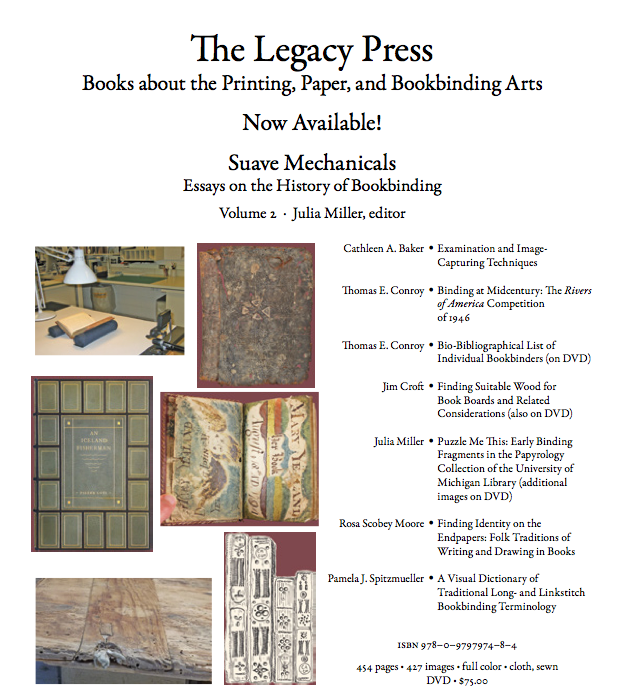
Suave Mechanicals Volume 2 – Just Published

Cathleen A. Baker, founder of The Legacy Press, has just published Volume 2 of Suave Mechanicals, Edited by Julia Miller.  I had a chance to read an early version of Jim Croft’s contribution, and it is packed full of information derived from a lifetime of working with wood and books, all presented in the unique Croftian style.  I’m looking forward to reading the entire book, and just purchased it through the Chicago Distribution Center. And if you don’t have Volume 1, you are missing my own contribution, “Beating, Rolling and Pressing: The Compression of Signatures in Bookbinding Prior to Sewing”  Buy them both and save on shipping!

VOLUME 2 INCLUDES:

Cathleen A. Baker   •  Examination and Image-Capturing Techniques

Thomas E. Conroy   •  Binding at Midcentury: The Rivers of America Competition of 1946

Thomas E. Conroy   •  Bio-Bibliographical List of Individual Bookbinders (on DVD)

Jim Croft    •  Finding Suitable Wood for Book Boards and Related Considerations (also on DVD)

Julia Miller   •  Puzzle Me This: Early Binding Fragments in the Papyrology Collection of the University of Michigan Library (additional images on DVD)

Rosa Scobey Moore   •  Finding Identity on the Endpapers: Folk Traditions of Writing and Drawing in Books

Pamela J. Spitzmueller   •  A Visual Dictionary of Traditional Long- and Linkstitch Bookbinding Terminology


Screen Shot 2015-02-27 at 5.05.00 PM

Larger version of this advertisement: Suave Mechanicals Vol 2.  Please circulate.

Confusing Book Conservators

It is confusing for the public to understand the differences between Bookbinder, Book Restorer and Book Conservator. Book Conservationist is never used, except by the uninitiated.  Below are how some of these terms are commonly used — more precisely, how I wish the terms were commonly used — in the United States.

Bookbinder: Someone who makes books consisting of partially prepared materials from other crafts, rebinds and sometimes repairs older books.

Book Restorer: Someone who makes old books look an imagined “new”.

Book Conservator: Someone who preserves the historic, intrinsic, artistic and artifactual value of books through preventive measures and physical intervention.

The New York Public Library has muddied the waters even further, with a program called New York Public Library Conservators.  In this case, the term “Conservator” means someone who supports or maintains NYPL financially. This adds confusion, and creates the need for more explanation. But if you have an extra $15,000.00 – $24,999.00, you can call yourself a New York Public Library Carnegie Conservator, which sounds like an endowed professional position.

conservators
Application form for New York Public Library Conservators Program, 2015.

Further resources if you want to read more of my rants discussing these terms:

https://jeffpeachey.com/2010/03/30/outside-of-the-text-my-work-in-book-conservation/

https://jeffpeachey.com/2010/03/11/a-future-for-book-conservation-at-the-end-of-the-mechanical-age/

http://www.bookbindersmuseum.org/the-future-of-book-restoration/  The second comment.

https://jeffpeachey.com/2013/05/07/book-conservation-and-book-restoration-and-ngrams/

 https://jeffpeachey.com/2008/11/11/comments-on-clarkson-conservation-and-craft/