Laotian Kitchen Knife and Vietnamese Vegetable Peeler

veg knife

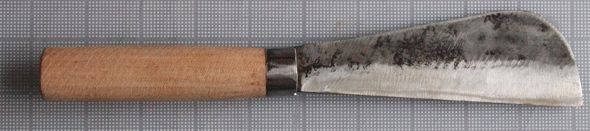
In Laos, at a food market outside Vientiane, I purchased this kitchen knife. I saw many people using knives similar to this. There are many crude forging and grinding marks on it, gradually tapering to a decent cutting edge. Much like the  hacksaw paring knife I wrote about previously, this knife is pure function with little effort expended on decoration or polishing.  The steel itself is a very respectable HRC 55-60. One interesting feature is the complex curve on the back of the blade, possibly to add rigidity to the tip, since the blade is fairly thin, between .048-.051″. Many kitchen knives I saw were shaped like this. Or it might be give the blade additional life as it is reground, since the tip may get reground or used more?  The blade is partially morticed into the steel ferrule, which makes it feel quite solid. The blade angle is slightly offset from the center axis of the handle, an indication it is designed to be used freehand, not on a cutting block.  The handle was turned on a lathe, there are marks from a tailstock center on the bottom, and it was quickly smoothed with a rasp. This gives the unfinished wood handle (some kind of dense hardwood) a very pleasing feel and grip. I really like the feel of unfinished wood for tool handles, though they do get dirty quite quickly.

.
peeler

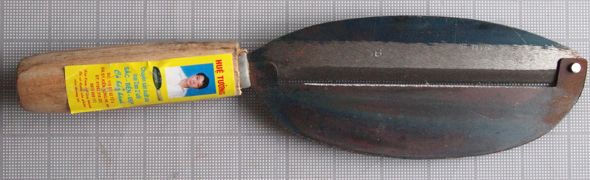
I purchased this vegetable peeler in Vietnam, and believe it or not, this 12″ long version was the smallest of five sizes offered.  The name of the company, or man who made it is named “Hue Tuong”. Vegetable peelers (as well as  mandolins, scabbard planes, spill planes, and a few others) interest me because they reverse the standard way planes or spokeshaves are used— what is usually the waste is actually the useful product. The steel is similar to the knife above, HRC 55-60, but it looks like it is made from rolled stock. This knife is also offset from the central axis, like the Laotian knife above. The knife is made of two pieces, I suspect both to make the manufacture and resharpening easier. A rivet holds the two pieces together at the top, and by simply removing the handle it can be opened 180 degrees and resharpened. Very clever. This knife is sharpened to a finer grit than the one above. I’m still working on my technique when using it.

Now that I have these knives, I really should try some of the fancy fruit and vegetable carving, like this beautiful watermelon.
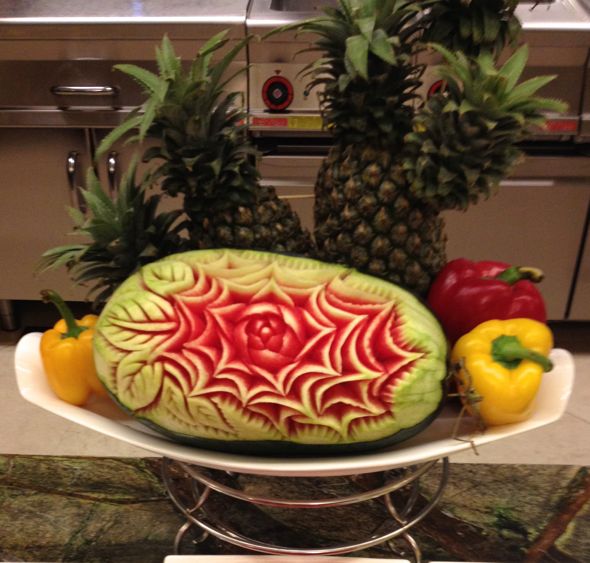
watermellon


Nguyen Era Vietnamese Books

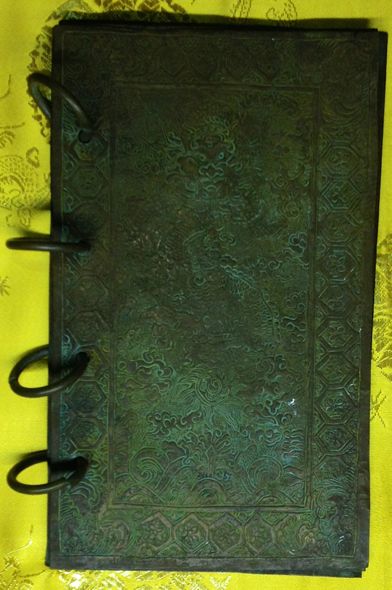
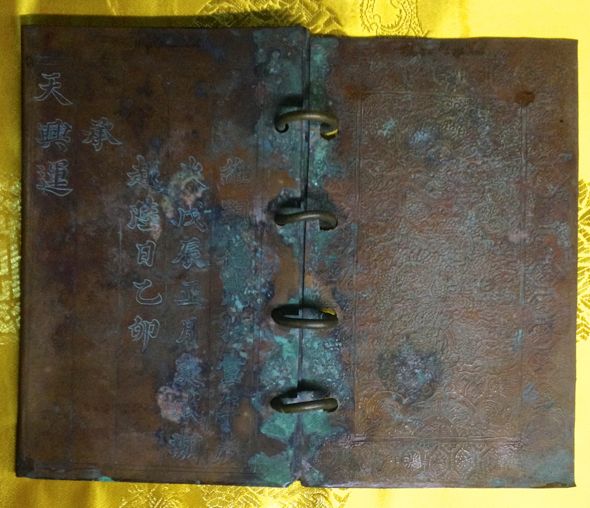
Also in Huế, Vietnam, which I wrote about last week, I noticed several books in the Museum of Royal Fine Arts. There made from copper and silk. All of these books were from the Nguyen Era (1802-1945) but were not dated more precisely. I wish I knew more about Vietnamese book history, and if these materials were common or only used for special books.

These material extremes of leaf material are of interest: nothing drapes quite as well as a silk book, or as little as a metal one. The copper book is held together with four large rings, and the silk book is bound in what we usually call a Chinese style binding, stab sewn at the spine with the pages folded at the foreedge.

As I look back at these images, it seems the cooper book must also have a fold at the fore edge—for the repossé or chased decoration is on both sides of the leaf— or possibly the leaves were much thicker than I recall. I guess I need to go back to re-examine….

Hue 1

Copper Book. Huế Museum of Royal Fine Arts, 1802-1945

.

Hue2

Copper Book. Huế Museum of Royal Fine Arts, 1802-1945

.

hue3

Silk Book. Huế Museum of Royal Fine Arts, 1802-1945

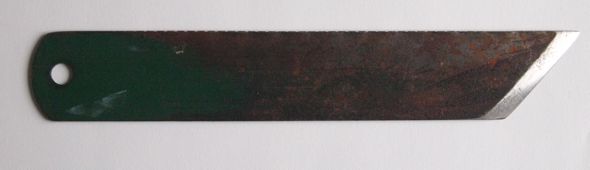
Vietnamese Hacksaw Knife for Shoe Repair

I traveled in Vietnam around the New Year. In Huế, which was the capitol of Vietnam until 1945, there was a small mobile shoe repair stand on the street. In addition to the ubiquitous Vietnamese plastic stools, this cobbler had a small assortment of shoe repair tools laid out on a work-cloth.  I noticed the knife he was using was made out of a hacksaw blade, so I offered to purchase it. When traveling, I often like to try to purchase tools from people that are actually using them, so I can see how they are used in context and know that they work. He named what must have been an outrageous price, because when I accepted he nearly fell off his stool.  A few minutes after I left, I noticed he was quickly packing up his business, hopefully to take the day off and celebrate his big score. We were both extremely happy with this transaction.

shoe repair1 shoe repair tools

Tools from a shoe repair stand in Vietnam.  

On the top row: pair of shoes, a coarse artificial and medium natural sharpening stone. On the bottom row: some rubber sole scraps, a white bottle containing some kind of adhesive, curved and angled gouges (for cutting channels into soles before sewing?), an angle nipper, a straight and bent awl, and scissors. The cloth is both a table and can be rolled up to transport the tools.

 hacksaw knife backhacksaw knifeKnife made from a hacksaw blade that I purchased from the man in the above images. On the bottom the partially ground teeth that provide a pleasing grip.

The steel is fully hardened throughout, above HRC 65, and I assume M2 or M3 steel, but who knows. The top and bottom of blade itself is quite planar, in contrast to the Starrett blades I use, which are dished out in the center and take quite a bit of flattening. I’ve now seen knives made from hacksaw blades of Russian, English, Brazilian, Mexican, American, and Chinese origins. It is cool to find fully hardened hacksaw steel, formed by stock reduction, used as knives around the world. I use a M3 hacksaw English Style paring knife often in my own work. I like the balance of good edge retention at low angles, initial cutting performance and ease of resharpening.

A small amount of the teeth were left on the edge of the blade, giving a pleasing grip and visually reminiscent of file work found on high end European knives. There is a slight back bevel and the included blade bevel angle is 12 degrees. The back bevel might aid in the complex shapes—such as paring shoe soles. The blade angle is about 45 degrees. Although the blade itself was somewhat coarsely sharpened, it cut the rubber sole material quite easily when he demonstrated it. Overall, a basic, well made knife without superflous decoration or polishing.

I wasn’t able to find any knives like this in the local markets, so I’m curious if the cobbler made this himself or if there is a Vietnamese Jeff Peachey doppleganger who peddles them.