A Book and a Model of a Book

model and book

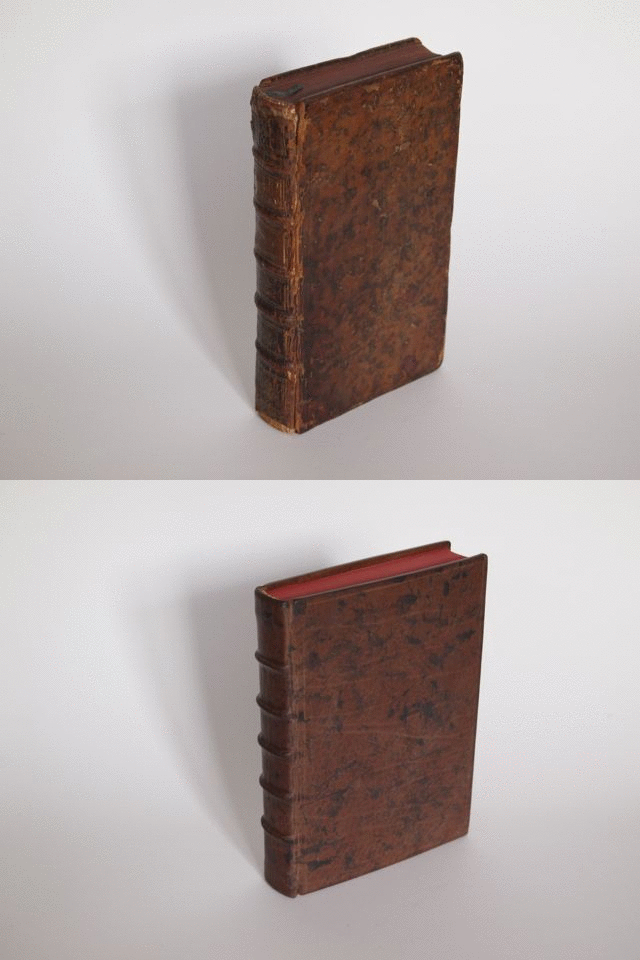
A two image gif: a model of an 18th century French binding and a real 18th century French Binding

Conservators often make models of bindings in order to understand how materials, structures, and techniques interact. Models are different from a facsimile or pastiche bindings: they are not intended to look like an old binding, but are made as closely as possible to replicate an historic structure. Making models helps conservators understand subtleties and procedures of construction, and aids in determining what physical evidence is essential to preserve. While acknowledging a model’s new materials, conservators can also use them as a mock-up to test treatment options.

The model above was made by following the technical descriptions in Diderot, Dudin, and Gauffencourt. (1)  How does this gif inform our understanding of the relationship between the model and historic binding?  How can the lacuna between them be interpreted? In this gif, the model simultaneously bursts out of the historic binding as the binding disappears into the model, possibly analogous to our conceptual understanding of the two.

___________________

1. Denis Diderot and Jean le Rond d’Alembert Encylopedié ou Dictionnaire Raisonne des Sciences, des Arts et des Métiers, Paris, 1751-1780; René Martin Dudin L’Art du Relieur-Doreur de Livres, Paris: Saillant & Nyon, 1772; Jean-Vincent Capronnier de Gauffecourt Traité de la Relieure des Livres (originally 1737) trans. by Claude Benaiteau, Austin: W. Thomas Taylor, 1987.

Added 17 Sept 2014:

Model and book

Upcoming Event: Time and the Book, Yale University, September 12 and 13, 2014

Next week, on September 12 and 13, 2014, I will be participating in a symposium sponsored by the Yale Program in the History of the Book.  Registration for the symposium is full; however, Kathryn James’s lecture, “Time in Place” is open to the public.  It is great that academics are becoming interested in the book as a material object; I suspect there will be some fascinating discussions.

symposium


A Beautiful Binding

The Ultimate Historic Structure

A class present from “Historic Book Structures for Conservators” students.

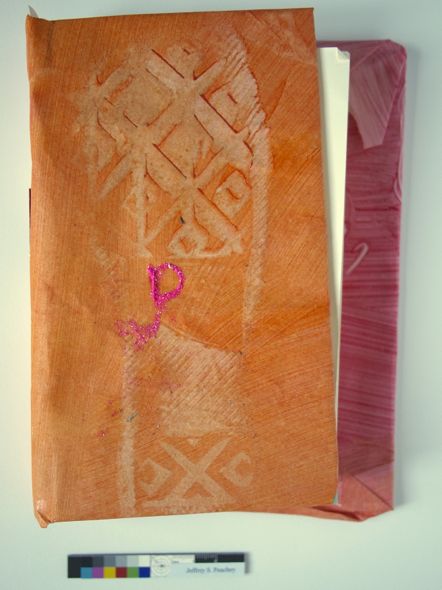
At the end of an exhausting and exhilarating five weeks of teaching “Historic Book Structures for Conservators” in Boston, the students demonstrated what they had learned by making this binding for me.

The folding is uneven. Some of the pages have the imprint of the bottom of a shoe. The book is sewn on three recessed tapes, sometimes bypass, sometimes all-along, sometimes two-on, and sometimes three-on. There are very large weird knots in the sewing thread and untrimmed sewing thread where the joins are. At points the thread misses the gutter by an inch. The spine is lined with blue painters tape. One edge is partially trimmed. Several sections are out of alignment by half an inch. The back half of the book is case bound, though the turn-ins are on top of the end sheet. The spine piece is missing. The front of the book is laced on with tapes that begin on the inside of the board. Some corners of the board are exposed, some turned in without trimming.  All of the squares vary wildly, with the front board smaller than the text block. The entire book is skewed. The pastepaper covering material is not properly adhered, with large areas popping away, and there are some extremely odd cuts in it. There is a small piece of triangular leather on the spine that seems inspired by a “Tomorrow’s Past” binding we discussed in class. The lower board, not visible in the image above, contains numerous handwritten inscriptions: “Peachey” within a circular object that appears to be a peach. The title on the spine, not visible in the image above, is made with glitter and reads “NBSS 2014” as it the “JP” initials on the front cover, off center.

It was great to have a class who were sophisticated enough to realize that doing everything wrong can be a measure of how much they learned. Bravo!