Fabrikoid

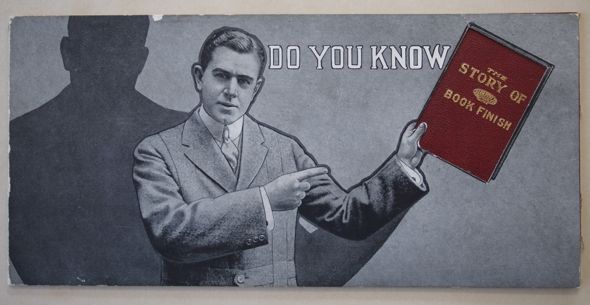
Do you know

Du Pont Fabrikoid Co., Do You Know the Story of Book Finish [ca. 1920] Front Cover, Promotional Pamphlet. Courtesy of the Hagley Museum and Library

Fabrikoid Co. was one of the predominant American manufactures of artificial leather, incorporated in 1902 and purchased by Du Pont in 1910.  Du Pont managed to get Henry Ford to use it as the covering on his Model T in 1914, putting it on over 130,00 cars. It was used for upholstery and other applications. The book in the pamphlet above is actually made of Fabrikoid book finish artificial leather, and mounted behind the cover in a cut out, creating this striking image. The chiaroscuro figure, surreal shadow, and pointing finger create an ominous, almost accusatory impression. The story of book finish is serious stuff.

how many hides has a cow

Du Pont Fabrikoid Co., Book Finish [ca. 1915] Detail of Back Cover, Promotional Pamphlet. Courtesy of the Hagley Museum and Library

Another great advertising campaign was the “How Many Hides?” Since Fabrikoid was essentially a less nitrated- nitrocellulose dissolved in castor oil, alcohol, benzene and amyl acetate, which was called pyroxilin (py-ROX-i-lin), it could be applied to different substrates: cloth, paper, or leather splits.  Du Pont hoped to capitalize on emphasizing the artificiality of “genuine” leather, and also casually reminded readers that Fabrikoid  was much cheaper. Sets of books such as Colliers Encyclopedia and the Harvard Classics were often bound in Fabrikoid. There are literally hundreds of variations on color, substrate, and texture just in book cloths.

_______________________

Jeffrey L. Meikle, “Presenting a New Material: From Imitation to Innovation with Fabrikoid” in The Journal of the Decorative Arts Society 1850-Present, No., 19 (1995), pp. 8-15.

Robert Kanigel  FAUX REAL: Genuine Leather and 200 Years of Inspired Fakes. Washington D.C.: Joseph Henry Press, 2007.

A Bookbinder’s Valentine

BookBinder.

Library Company of Philadelphia. ca. 1840-1880?

[New York] : H. De Marsan, Publisher of songs, 54 Chatham Street, N.Y

*

“My life’s a waste, I’m sick of paste; And printers, books and presses

Might quickly go to Jericho [1], Should Fortune smile, and bless tis I..

-Yes, but who’s the fool that would be thy Valentine?” [2]

______________

1. Jericho is a place of banishment, retirement, or drunkenness according to Partridge’s Dictionary of Slang.

2. As she says this line, there is an interesting workplace reversal going on: the male binder (husband?) is at the sewing frame, typically the woman’s job, and she is tooling, typically done by men. Is he wearing a kings crown or a jesters hat?

EEK!

Surface cleaning an entire book can evoke a range of emotions, from mind numbingly boring, to mind numbingly repetitive, to mind numbingly tedious. The problem is that you have to remain acutely aware of tiny changes in the paper surface, dirt composition, tears, soiling, stains, etc. to avoid damaging the pages. After hundreds of pages (hours of cleaning) of back and white text, I almost fell over when I suddenly saw colored fur.

mouse3

OLYMPUS DIGITAL CAMERA

Certaine Sermons or Homilies appointed to be read in Churches…. London: Printed by John Bill, 1623. Collection David Kastan. Top: Hair on mouse skin. Bottom: detail of the flesh side. Why did someone put it in this book?

In section 3, on page 123, I found the remains of a very cute mouse.  When I inspected it, it appeared tanned with the hair on, the tail and legs removed.  Even more oddly, it was not causing any staining or damage, so I left it in place. The homilie where the mouse was found is titled “Concerning Prayer”, and for the curious, there are no textual rodent references on the adjacent pages. It is difficult to believe that this was an accident, and there were half a dozen other more usual items put into this book: leaves, ferns, seeds, scraps paper with notes.  It is tempting to concoct a story why the mouse was put there: possibly as an alert from a teacher to see if the student was actually reading these dry sermons?  A wake up call? A reminder of the inevitability of death for living things, as compared to the longevity of the written word?