
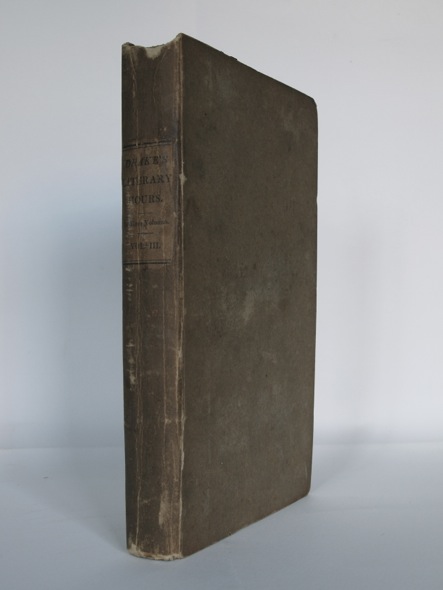
Nathan Drake. Literary Hours: Or Sketches, Critical, Narrative, and Poetical. The Fourth Edition, Corrected. London: Longman, Hurst, Rees, Orme, and Brown, 1820. This board binding is covered in one sheet of paper, has a printed spine label on a tight-back spine, and substantial squares.
John Townsend, the one and only Anonymous Bookbinder, has once again agreed to be a guest blogger. Boards bindings (also called publishers’ board bindings, in-boards bindings, boarded bindings, paper covered board bindings, publishers’ boards, plain boards, boards bindings, in-boards publisher’s bindings, original boards, publishers’ trade bindings [1]) are particularly interesting in the way they prefigure certain aspects of publishers’ cloth case bindings. John’s short essay, which is from a Paper and Book Intensive workshop he conducted in 2011, is a succinct introduction to this often neglected binding style, which until now has been missing from the web. John writes:
“Publishers’ board bindings” refer to an inexpensive retail style of binding that emerged in England in the mid-18th century. It typically consists of a sewn textblock with untrimmed edges, thin pasteboards laced on and covered in paper. The covering was often with three pieces of paper: a plain paper pasted down tight on the spine and slightly overlapping the sides (i.e. quarter binding), with a blue or gray paper covering the remainder of the sides. There are many variations, including covering with a single colored sheet (frequently gray); boards with or without squares; spines covered with leather or vellum instead of paper; the use of a made or natural hollow, etc. Different colors of paper were used at various time, with some colors identified with particular publishers.
By the end of the 18th century, books in boards had become the most common way for books to be sold. Although often described as temporary bindings, recent scholarship has demonstrated that they are more likely intended to help meet the growing demand for books at a cost the broader public could afford. As such, it is unlikely they were issued by publishers with the expectation that buyers would necessarily have them rebound at a later time. It was common for publishers to issue books in boards at the time they issued the same books in sheep or calf leather for those interested and willing to pay more.
The style and its variation had a very long life in the marketplace. After the introduction of bookcloth in the mid-1820s, cloth rather than paper spines was used for popular titles, especially novels. After mechanization took over many aspects of book production, the boards style continued to appear on certain types of publications, such as proceeding of scholarly societies, print versions of important library catalogs, and other bibliographic works. Many examples can be found well into the second half of the twentieth century.
Cowie’s Bookbinder’s Manual (1828 and subsequent editions) may be the first written account of the process for board bindings. But the key structural features of board bindings are easily observed in the many surviving examples and it is clear that the style changed little between its introduction and Cowie’s description. Somewhat later (1835), Arnett’s Bibliopegia describes it as “the commonest way of doing up books in this country.”
Despite its reputation as “temporary,” many thousands of board bindings still exist. Given their age and the fact that they were often not regarded as important, these are often in reasonably good condition. Deterioration is typically due as much to poor storage and degraded materials as to structural deficiencies. The structure is worth studying as a transition between leather binding and case binding. Many of its features—sewing on cords, laced on boards, tight back spine covering—are identical in form to traditional leather bindings, but performed with less expensive materials. (The temporary shortage of leather and its high cost in the 1760s being one reason for the development of board bindings.) By one account, the development of bookcloth by William Pickering (circa 1823) was his desire for a neater way of doing boarded bindings. Thus, cloth was developed as a substitute for board bindings, rather than a substitute for leather bindings, as is sometimes assumed.
Board bindings represent a significant development in the history of bookbinding and book selling. As a structure, they also have many possibilities to offer bookbinders, conservators and book artists who look to historical models for instruction and inspiration. As far as being merely temporary, it is worth remembering that, “All bindings are perishable, whether of wood, leather, paper or cloth. At their best, and treated well, books in boards offered a binding as lasting as any other.” (Hill, p. 273)
References
Bennett, Stuart. Trade Bookbinding in the British Isles 1660-1800. New Castle, DE: Oak Knoll Press/The British Library, 2004. An important work challenging and expanding the definition of publishers’ bindings. Section V.1 of chapter three (p. 80-85) deals with board bindings.
Cowie, George. Cowie’s Bookbinder’s Manual. London: W. Strange, 1853. Acessed online 19 Apr 2011 at http://www.archive.org/details/cowiesbookbinder00cowi.
Hannett [Arnett], John. Bibliopegia; or, the Art of Bookbinding in All Its Branches. New York: Garland Publishing, Inc, 1980. (Reprint of the 1835 edition.) Part IV (p. 161-163) has a brief account “Of Boarding” and “Cloth Boarding.”
Hill, Jonathan E. “From Provisional to Permanent: Books in Boards, 1790-1840.” The Library: Transactions of the Bibliographic Society 21.no. 3 (September) (1999) : 247-273. A scholarly account of various stages in the development of board bindings, challenging the early 20th century assertion that they were “mere sheet-containers.”
Pearson, David. English Bookbinding Styles 1450-1800. London and New Castle, De: The British Library and Oak Knoll Press, 2005. Chapter VI, “Cheap and Temporary Bindings,” deals with bindings in boards, p. 159 -163. Despite the chapter title, Pearson follows Hill’s view that board bindings were often very often intended to be more permanent that often assumed.
Notes
[1] “Boarding” also refers to the working of leather to make it more pliable, give it a more even consistency, and raise the grain. “Out of boards” binding refers to trimming the edges before the boards are attached, as in school-book and case binding. The term “in-boards” sometimes refers generally to a bound books, rather than a cased ones.


