Two Ways of Reinforcing Splits in Wood

Walnut board with splits

I inherited this lovely walnut board, 16.25″ wide, 24″ long. Unfortunately, it was starting to crack in two places. I repaired the larger crack with an ash bowtie (aka butterfly), which I rounded to echo the grain of the board. It it is the full thickness of the board. In the image you can see how it has pulled the crack together next to it very tightly, so that it almost seems to disappear. I tried a different repair on the smaller crack, an end-grain insert, also ash, that has two wedge shaped legs on the inside. I’m hoping this will keep the board from splitting more, though it didn’t seem to affect the appearance of the current crack.

In both cases, I drilled the walnut to remove the majority of the wood, then cleaned it up with chisels. Working on something I own is a pleasant change from the ethical constrictions of performing conservation work on wooden book boards. It is also a good chance to experiment a bit, since I will be able to monitor any changes. On a related note, a version of the article Alexis Hagadorn and I wrote, “The use of parchment to reinforce split wooden bookboards, with preliminary observations into the effects of RH cycling on these repairs”  (Journal of the Institute of Conservation, Vol. 33, No. I, p. 41-63) should be available soon online at Columbia University’s repository. I’ll post a link when this happens.

Ngrams: Book Conservation, Art Conservation, Book Restoration, Art Restoration

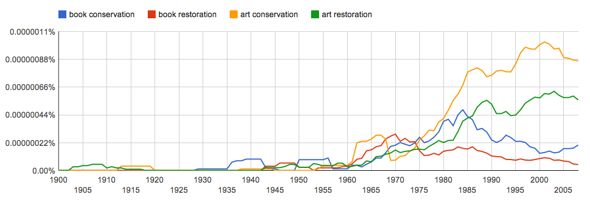
An N-gram is a continuous series of letters or words. In linguistics, they are useful for gathering information about frequency of use. Google has an Ngram tool that uses more than eight million of the texts it has scanned, which is estimated to be six percent of all books ever published. I thought it might be interesting to compare four terms: book conservation,  art conservation, book restoration, and art restoration. I selected the years 1900-2008 and added some smoothing to make the trends more clear. It is also possible to distinguish between English and American usage, though I didn’t do this.
conservation book

Larger table at Google Ngrams

A couple of things jumped out at me. The use of the term conservation essentially overtook the term restoration in the mid-1970’s, which also roughly correlates with the beginning of professionalism in the field: the founding of the American Institute for Conservation (1972), journals, graduate schools, conferences, etc….

We see a peak in book conservation in the mid-1980’s.  The Columbia University Library and Archives program was in full swing and grant money was plentiful. Microfilming was still the dominant method of reformatting. Book conservation, along with book restoration, has declined precipitously since this time.

The term book conservation gets used roughly 25% as much as art conservation in 2008. It also seems to be on a bit of an upswing.

For a short time in the late 1960’s and early 1970’s, book restoration was even more popular than art conservation. I’m not quite sure what explains this, the Florence Flood? Chance?

It is debatable exactly how the frequency of these terms used in publications reflects the growth, size and public perception of the field. They also likely bear little resemblance to the actual practice of restoration and conservation.  Additionally, I think journal articles are not included, as well as online sources, which might change things dramatically.

My gut feeling, though, is that this graph roughly mirrors the popularity, size and funding for book conservation, which has declined significantly over the past 25 years. Art conservation seems to have declined less, but still significantly since 2000. But the frequency of these terms is still about half of the peak. It has often been noted that creating a written body of literature for book conservation is a necessary step towards professionalism and even some kind of certification in the United States, which currently does not exist.  Are we farther away from that goal now than we were in 1985?

Ngrams can be a pleasant time sink serious tool for the statistical analysis of use frequency patterns. Finally, we can answer such crucial questions as were The Beatles more popular than Jesus Christ?

Cooked Books

In preparation for an upcoming lecture on book boxes (May 23, 2013, 6:30) and workshop on drop spine cradle boxes (May 24-25, 2013) at Columbia College in Chicago, I’ve run across some crazy ideas on how to protect a book.  The housing system below is noteworthy. Over 200 books at an NYC Institution were treated this way.

Crazy Housing

The outer shell is an acidic marbled paper and a laser printed paper label.  As you can see, it is difficult to unwrap the book without tearing the deteriorated paper. The laser printed label seems to date this treatment after the early 1990’s. Is it my imagination, an accident, or did the person who wrapped this book take extreme care to try and match the marbled patterns at the join of the paper?

Crazy Housing

The next layer is the big surprise: aluminum foil. At the moment, I can only think of one reason for wrapping a book in foil, to prepare it for baking. I’m not sure what the Interactions between the aluminum and leather might be, but the mechanical problems are quite apparent, since the extra aluminum is rolled up and pushed onto the head and tail of the text block causing uneven stresses when the book is shelved upright. Again, it is unwieldy to unwrap.

Crazy Housing 3

These books were also given an marinade of potassium lactate according to the treatment records. I think this must have caused some of the blackening and changes to the surface texture of the leather—they do look a little like they have been baked. Potassium lactate is used as an antimicrobial preservative in Hot Dogs.

Putting potassium lactate on leather books is a very bad idea, though. Even though it is discussed in some older book restoration manuals, it has been discontinued because of the damage it can cause. Tom Conroy (in the first comment) dates this treatment to 1984. At least one conservation vendor in the US still sells it, though.

The best way to preserve leather bindings is to put nothing on them. If there is already red rot, you should consult with a book conservator. Pass the ketchup.