Cobden-Sanderson’s Workshop

cobden sanderson workshop

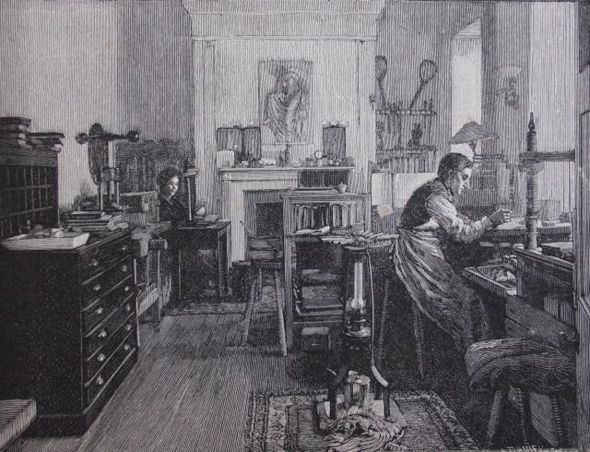
Cobden-Sanderson’s Workshop, Illustrated London News, March 1890, p. 323. My Collection.

Updated 25 Nov. 2013. The above attribution was handwritten on the top of the page the image was on; unfortunately it is incorrect. If anyone knows where this is from please let me know.

The quality of Cobden-Sanderson’s work is perhaps only matched by the size of his ego. In true arts and crafts fashion, he raises handwork—especially his handwork— to almost godlike status. His quasi-religious writings are hard to swallow, but his bindings are really beautiful. I’ve had the opportunity to see many of them and to work on a couple of them as well. They are quite refreshing from much of the trade work of the day. Unfortunately, many of the materials he used are often poor quality. The books I’ve been able to see the structure of have common late nineteenth century structural weaknesses: very thin slips, tissue thin leather jointed endsheets, and overly pared covering leather. Ironically, in the article he wrote to accompany the above illustration, he derided “temporary” bindings, like the cloth case, which have often survived in better condition than his bound books.

The studio or workshop of a craftsman often tantalizing in the details of tools and equipment. Cobden-Sanderson and Anne, his wife (he also took her surname, unusual for the time) work in a domestic interior, an English parlor. There are not many tools or much equipment pictured, a chest of drawers on the left, perhaps for storage, a two-rod nipping press with typically English ball ends on the handle. I think this is sitting on a woodworking bench with a leg vice, not a lying press: only one wood screw handle is visible. Reportedly, Cobden-Sanderson was also quite interested in wood carving around this time. Anne sits in the corner next to the fireplace sewing on a frame that is resting on a small table. It appears a paste pot sits on a stool, next to some books stored on their fore edge (!) on a bookshelf. Other tools and tennis (or squash?) rackets hang on the wall. Cobden Sanderson sits on a high workbench, wearing a very long work apron. Just behind him is a freestanding gas finishing stove. On his right is another sewing frame, with a dedicated stool. The central placement of the finishing stove reflects his emphasis on tooling, which was considered the creative aspect of bookbinding at the time.

Cobden-Sanderson, and the arts and crafts movement in general, tried to wrestle bookbinding away from machines, and machine like hand-work as practiced by the large trade binderies of the day. His workshop suggests a smaller, more intimate surrounding is a way to accomplish this, a return to an idealized medieval past. In Cobden-Sanderson’s workshop, craft is integrated into the life of the craftsman, the workshop and the home united.

______________________________________

The  top illustration is after a photograph reproduced in Marianne Tidcombe The Bookbindings of T.J. Cobden-Sanderson: A Study of His Work, 1884-93, London: The British Library, 1984. In the case of this image, there is little doubt that it accurately describes his workplace.

New Tool! The Finger for Conservation

The Finger

The Finger® in use conserving a plate from C. Collodi’s Pinocchio, Gift Edition, 1920.

Many conservators, in a variety of specialities, like to make their own tools.  However this can be time consuming and distract the dedicated conservation professional from the more necessary tasks of endless paperwork. Last year, I introduced the now ubiquitous SPIT™. After a year of making prototypes and incorporating suggestions from testers, I feel I have finally perfected a new essential tool: The Finger®.  

The idea came to me late one night when I was using a Yad to read my Torah, and I’m not even Jewish.  The small size of the finger, and more importantly finger nail, would be ideal for the mechanical removal of surface accretions. FIngernails have an ideal flexibility and hardness. But a regular fingernail is often much too large for the types of delicate paperwork that conservators generally engage in, and is inconveniently attached to the extreme outer ends of our fingers. The Finger® is a delicate and versatile tool for use on the most sensitive of substrates.  It has a pleasing weight and a gentle warmth, and will pay for itself after the first successful treatment. Above all, it will be a constant reminder that the conservator is subservient to the objects of cultural heritage that we treat.

The Finger® is made from hand carved swiss pear wood, 6″ (152mm) long and .6″ (15mm) wide at the palm. .25 oz (7 g). The nail is replaceable, contact me for current prices, though there is often a three month delay while I grow a new one of adequate length.

THE FINGER® (ITEM# FU) $495.00

It Is Not His Book. Huh?

this is not his book

Samuel Daniel, The Whole Works of Samuel Daniel, London, 1623. Collection David Kasten.

Seeing someone’s name, or a list of names, in a book is not unusual. It is still practiced to indicate ownership, prevent theft, and possibly to add value depending on the name. Names when accompanied by dates are often useful for establishing family history and can aid in dating bindings and repairs.

Earlier books sometimes posit the locus of identity to the book itself; “I belong to Peachey” for example. Sometimes a name is followed by the phrase, “this is my book”.  This has always seemed a bit strange to me—why would someone sign a book that wasn’t theirs?  Doesn’t the name alone signify ownership?

In this case, perhaps it doesn’t. Did Thomas Sedgewick sign a book that wasn’t his? The writing appears to be from the same hand; the ink color and degree of corrosion are quite similar, and the handwriting looks similar to me, especially the heavy “k”‘s at the end. Another possibility is that after reading the book he no longer wanted to be associated with it. Or maybe someone else added the second line, to deny Thomas Sedgewick ownership, or simply as a joke?