Henry Hebert’s Five Essential Book Conservation Tools

Henry Hebert

Conservator for Special Collections, Duke University Libraries

Preservation Underground Blog


1. A decent laptop with an internet connection: Thinking about the tools I use every day, this one is at the top of the list, because there is so much work that goes into a successful conservation treatment before you even touch the object. There is the research: about the object, about the materials you will use, or about different treatment methods you could potentially employ (and maybe haven’t even done before). There is the communication: with your conservator colleagues, asking for their experiences working on similar objects, with curators to get more information about past and potential use by researchers or students, or sometimes even with the creator of the object. There is the documentation: the written condition report, the treatment proposal, and the lists of treatment procedures and materials you ended up using. In a pinch, you can even use the camera on the device to take photos before, during, and after your treatment.

Henry’s handmade elk bone folder.

2. A bone folder: If I could only have access to one folder, I would probably choose bone over Teflon for rigidity and quality of the edge. Out of the drawer of folders that I have, the one I gravitate toward most is a piece of elk bone which I shaped 10 or so years ago. It’s a little over 8″ long and mimics the shape of a butterknife. One end has a sharper edge that works well for scoring, while the other is wide and flat for compressing sections or consolidating a board corner.

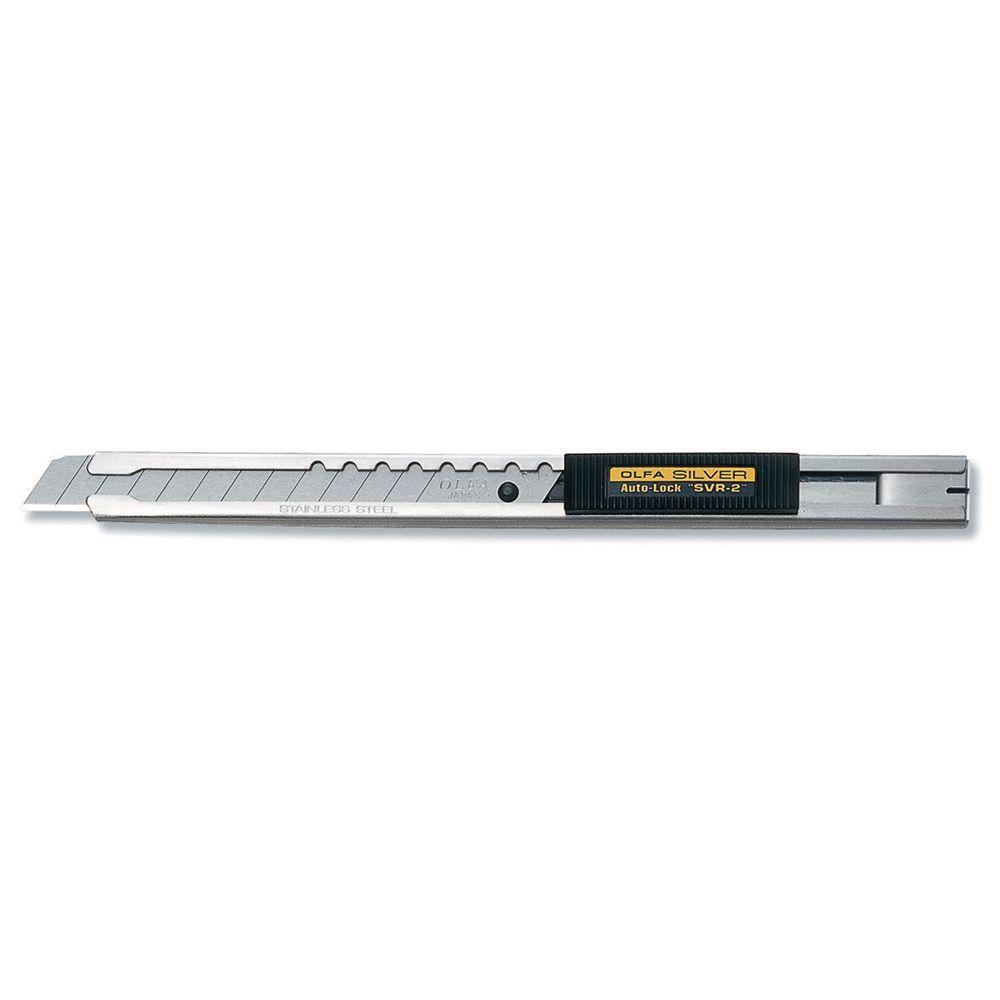
The olfa silver snap blade knife.

3. Olfa 9mm stainless steel slide-lock knife: I probably use this knife the most, because I end up making so many enclosures and the snap-off blades allow for a quick refresh. You can also fully extend the blade to cut through thick ethafoam planks for custom supports. There are so many little design details on this Olfa that I love. The removable endcap serves as both a pocket clip and blade snapping tool. The blade case even includes a small compartment to store old blade fragments. (I get to bring a pack of blades, too… right?)

Customized  #2 Casselli microspatula.

4. Modified #2 Casselli microspatula: The 6 1/8″ Casselli micro-spatula is great for lifting. Two modifications have really improved the working properties of this tool for me: shaping the ends and making the center handle thicker. I’ve added a single bevel to the rounded end to make it more like a blade. The unmodified octagonal handle is fine for quick work, but really becomes tiresome on the pads of my index finger and thumb after lengthy use. I have wrapped the center of mine with Elastack (by Sutton Scientifics) to increase the circumference of the handle and make it more comfortable to hold.

Muji mechanical pencil.

5. Muji “Low Center Gravity” 0.5mm mechanical pencil: I often use a mechanical pencil to make small measurement marks on material that I am cutting or folding. Sometimes it is necessary to number loose pages to keep them in order during treatment, and a mechanical pencil with thin graphite is the best tool for the job. I’ve found this $9 mechanical pencil, with a weighted and knurled aluminum tip, is one of the most comfortable to use and great quality for the price.

There are a number of other tools which I very reluctantly pushed off the list, including: Staedtler Mars white vinyl erasers (because you always have to dry clean first, right?), spring dividers, a Starrett pin vise with insulated octagonal handle, and (of course) a straight edge of some kind would come in handy. I really like my 12″ rigid Starrett rule with both metric and imperial graduation, but I often find myself wishing it were longer.

Brien Beidler’s Five Essential Bookbinding Tools

Brien’s sparkle heart finishing tool.

Brien Beidler

1. Needle
2. Bone Folder
3. Paring Knife
4. Brush
5. Sparkle Heart Finishing Tool
I selected these tools because I use them regularly during different parts of the process with every book I make. Of course, the needle I can use for marking up, sewing, and fraying out cords. The bone folder not only serves it’s purpose of general material manipulation, but I’d also use it for ‘tooling’ lines on the cover. In addition to paring leather, the knife can be used as an all purpose knife for cutting material as well as a plough blade for edge trimming. I can’t really think of a decent substitute for a good brush as far as applying adhesive goes. And I love tooling, so I had to include a finishing tool. I picked the sparkle heart because a binding without heart in/on it is no book at all!


Brien’s five tools.

James Reid-Cunningham’s Five Essential Book Conservation Tools

Jim’s five bookbinding tools. “I wonder if my choices are the most essential, or just the ones I enjoy using the most.”

James Reid-Cunningham

Bookbinder and conservator in private practice

Caselli spatula: I’ve had this one since 1984 and I use it virtually
every day.

Splinter forceps: a cross between a tweezers and a needle nose pliers
that allows you to securely hold onto something very small.

Pin vise: for holding needles, drill bits, small files, etc. I have
30-40 pin vises of different shapes and sizes. This design is useful
because the wooden handle rotates in your hand so you can use it for
drilling very small holes.

Dividers: A four-inch divider bought at a flea market for $1, it was
made by the L. S. S. Co. in Athol, Mass. The design was patented in
1885.

Teflon spatula: I carved this from a lab tool called a “policeman,” used
for cleaning tubing. This shape of spatula has a thousand uses for
lifting and splitting.