Why the Present High Costs of Bookbinding? Bindery Wages in 1920

It is often claimed that the most skilled, and highest paid position in a bookbindery was the finisher. However, in 1920, the J.F. Tapley Co. paid the head stamper $50 a week, while an extra finisher earned a bit less, $47. Even the casing-in machine operator earned $2 more than the hand casing-in position, at $44 a week. Wages varied between $37 and $50 for skilled male work. At least for this company, machine operation was apparently valued more highly than hand work, likely because it was more profitable.  All the workers are referred to as “operatives”, whether engaged in machine or hand work.

The argumentative title of this company produced pamphlet, “Why the present high costs of bookbinding?” indicates some defensiveness and weariness when asked this question. I can totally relate. And since I work alone I can’t blame it on rising employee wages. The pamphlet cites increases in other costs, such as materials, as additional factors. The rise in wages between 1917 and 1920 is startling, but apparently there were no increases between 1911 – 1917.
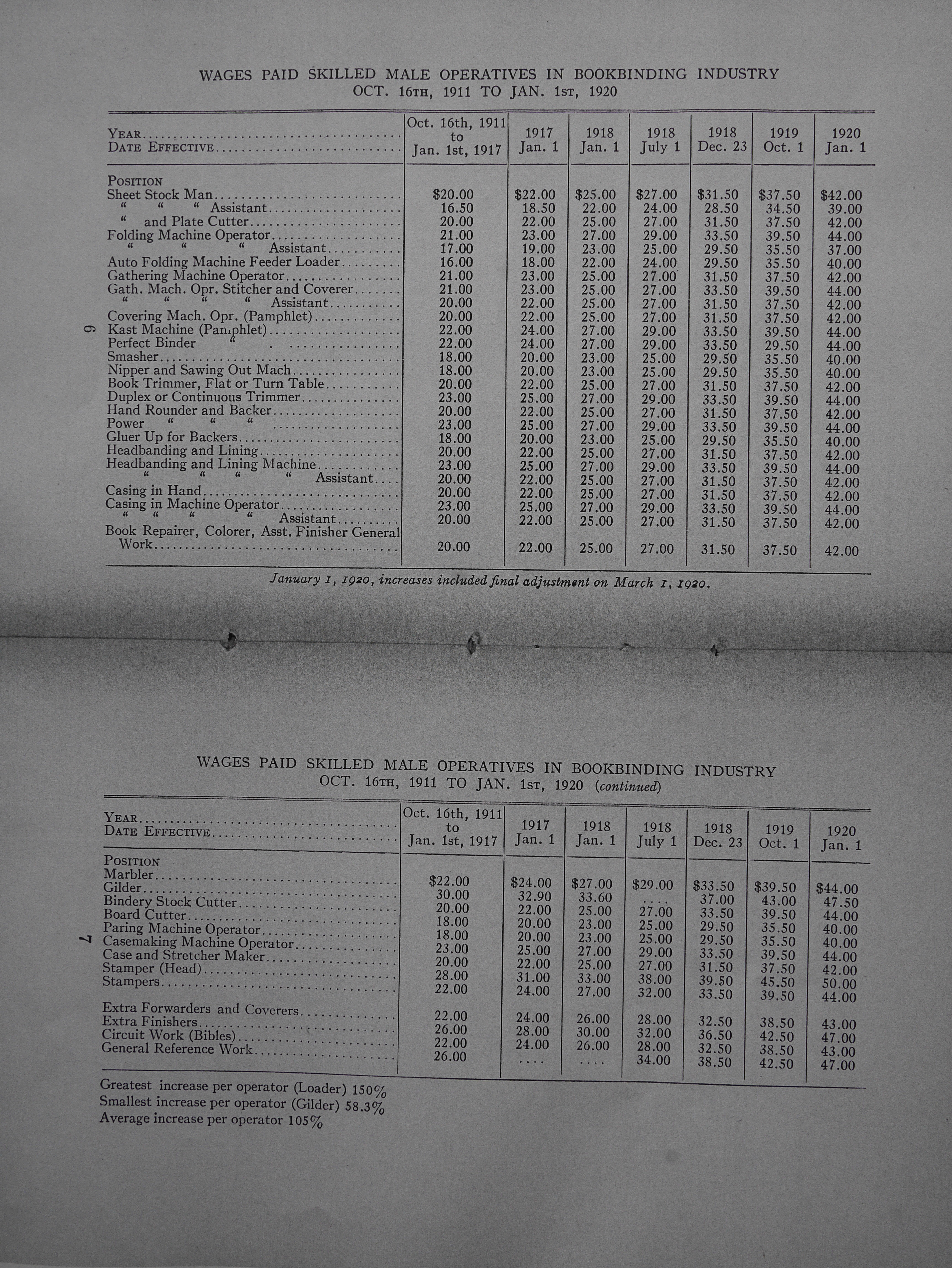
Why the present high costs in bookbinding? J.F. Tapley Co.: New York, 1920. Bernard C. Middleton Collection of Books on Bookbinding, Cary Collection, Rochester Institute of Technology.

Below is the breakdown for the women operatives. Women’s positions in trade binderies were very stable at least since the eighteenth century. This is a surprising to me, given how much books changed during this time. They primarily did the folding, gathering, sewing, and laying-on of gold. The highest paid woman’s position was the head gold layer, at $27.50.

Women also operated the machine that replaced their traditional hand work. I can’t quite understand why the work itself was more gendered than operating a machine. Usually men operated the machines in factories at this time.

Why the present high costs in bookbinding? J.F. Tapley Co.: New York, 1920. Bernard C. Middleton Collection of Books on Bookbinding, Cary Collection, Rochester Institute of Technology.

Of course there were many women hand bookbinders making fantastic books around this time. One of my favorites is Sybil Pye, and her hallucinatory take on traditional book design still looks fresh today. She was an aunt of David Pye, the wood carver, turner, and craft philosopher. David Pye’s “Nature and Art of Workmanship” is a common entry text for bookbinding students interested in exploring larger questions of Craft. The circle grows smaller.
Some Well Known Ex-Bookbinders

There are likely more famous people who apprenticed as bookbinders and left the field, than bookbinders who are well known. Hope for all of us in a second career?


George Davis, 1850-1907, Father of chemical engineering

Rudolf Diesel, 1858-1913(?), Inventor of diesel engine

Johan Most, 1846-1906, Anarchist

Michael Faraday, 1791-1867, Discovered electromagnetic induction

Johann Strauss, 1804-1849, Musician

Josef Sudek, 1896-1976, Photographer

William Swain, Inventor of Quack Patent Medicine “Swaim’s Panacea”


Others?

A Method of Brushing Glue onto Paper

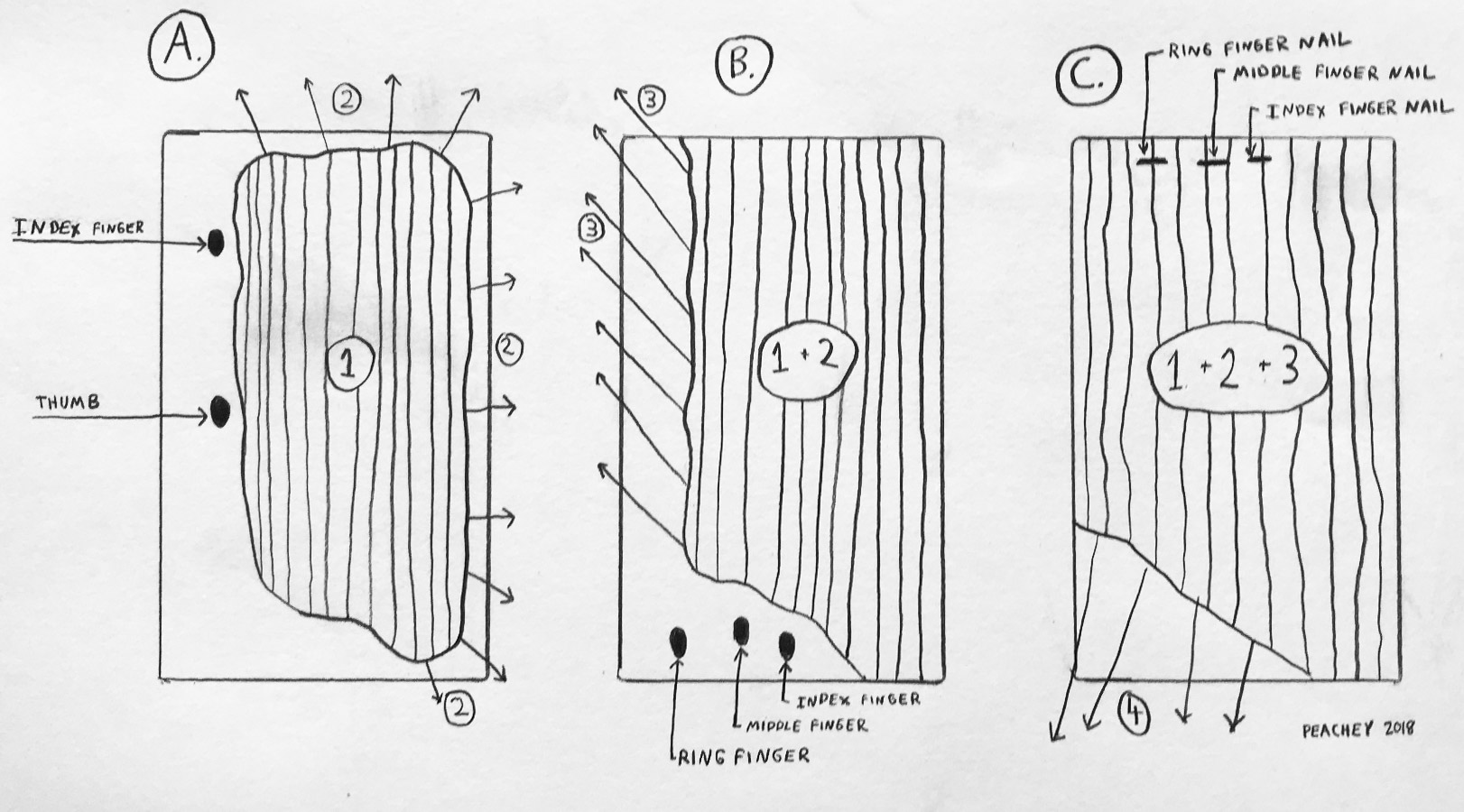
I’ll be teaching a hardcover pamphlet binding workshop to a group of undergraduates later this week, and wanted to include a diagram illustrating the technique of gluing paper.  I couldn’t find anything useful on the web, so had to draw my own. Is it considered too basic to bother describing? Clean and efficient glue handling is one of the most fundamental skills in bookbinding, and a common place to make mistakes.

The sequence of applying adhesive to paper for a right hander. Click on the image to enlarge.

If your adhesive is the right consistency, your brush the right size, and it is charged appropriately, you should be able to cover the entire sheet without adding more. This is how I was taught by Thea Hamman, a German trained bindery supervisor who worked for many years at Columbia University.

A.  Apply the adhesive to a large area in the center of the sheet of paper, which is placed on a larger waste sheet. Press down firmly with your index finger and thumb to keep the sheet from shifting. If the paper is large or highly reactive to moisture, you might want to relax it by misting with water. I usually jigger the brush back in forth in Area 1 during application. Make sure to put enough on to later drag it over the edges.  Most commonly, I use a 1 inch Princeton 5450 Natural Bristle Brush. Since the adhesive is not on the waste sheet yet, if the paper happens to shift or expand a bit, the good side of the sheet remains clean. Next, brush the adhesive in Area 2, off the top and right side. If the paper expands or warps, hold it down so that it moves towards the left, so adhesive doesn’t get on the good side. 

B. Move your hand and place your ring, middle and index finger on the bottom of the sheet, in the area where there is not adhesive, then brush the top left side. This can also help keep the sheet from curling into into itself. On small sheets, 1, 2, and 3 can be done at the same time. All of this depends on a balancing how fast you are working, how reactive your paper is, and how much moisture is in your adhesive.

C. Now place your fingernails fairly flat on the top edge, making sure not not to dent the paper. By using the flat parts of your nails, the adhesive doesn’t get on your fingertips. If you do happen to get a little glue on your fingers, it is useful to keep a damp rag nearby to wipe them clean. Finish spreading the adhesive and lift the paper near two opposite corners, and stick it in place. Smooth it down, starting in the center, working outward, with the part of your hands that is opposite your thumbs to eliminate any bubbles.  This avoids your fingertips which now have adhesive on them. Then achieve firm adhesion by burnishing using a Delrin folder, or your weapon of choice.

Please comment if you have another preferred method!