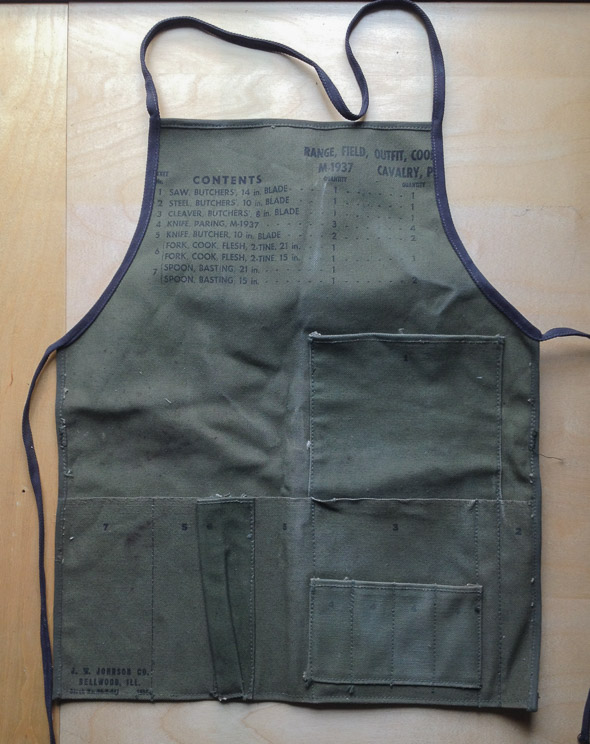
Someone — not me! — converted a standard WWII M-1937 Canvas Field Cooking Outfit Bag into an apron. When not used as an apron, the tools store in the appropriately labeled pockets. Although I can’t condone altering historical artifacts, this is a pretty cool idea.
Someone should make a Bookbinder’s Apron/ Tool Roll. What are the essential bookbinding tools?
Currently my most used tools are: two 1″ Princeton Brush Co. Gesso brushes, two #8 Princeton Brush Co. flat hog bristle brushes, a Delrin Hera, a large Jim Croft elk bone folder, a Green River Shop knife, a Japanese water brush, a 5″ Mundial scissors, Dumont and Sons #2a and #5 tweezers, a M2 Paring knife, a Pentel .7mm mechanical pencil, a thick steelcraft 12″ tempered ruler, an NT A-300GR snap-off knife, a Caselli Micro-spatula, a Delrin folder, and a 6″ Stevens dividers.
Add an adjustable neck, side-ties long enough to knot in front, and you have your first sale right here!
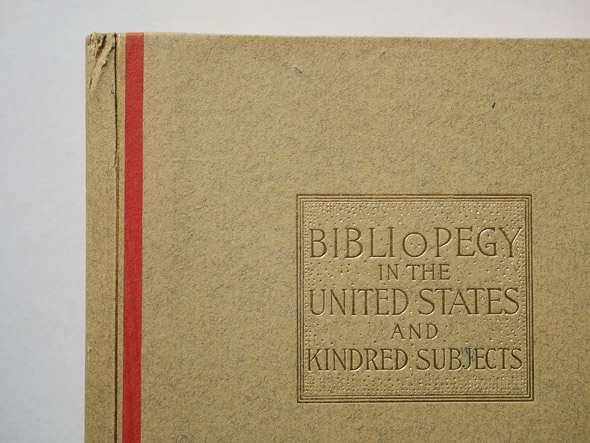
Andrews, William Loring. Bibliopegy in the United States and Kindred Subjects. New York: Dodd Mead and Co., 1902, x.
It is well worth spending some time with the illustrations in Loring’s Bibliopegy. The online version gives a sense of them, but can’t capture the detail found in the book. Some are printed with two or more plates, one for the leather and one to reproduce the gold tooling. Others are photogravure. All are spectacular.
The text is sometimes of interest, especially Loring’s “explication” of the bookbinding section in Hazen’s 1837 Panaroma. He considered it the first treatise on American Bookbinding, although we now know most of it is recycled from earlier English Books of Trades. Even Nicholson’s 1856 Manual of the Art of Bookbinding, now generally considered the first American Bookbinding manual, is largely based on earlier English sources. As Sid Huttner notes in the Garland reprint introduction, “Little (one is tempted to say, if any) of Nicholson’s text came first from his own pen”.
Bibliopegy is a nineteenth century term for bookbinding. I like the way it sounds. A Guild of Bibliopegists? Or too pretentious?
Loring’s book is beautiful and neatly bound. But the paper case structure doesn’t have a joint groove and most copies I’ve seen, including mine, are tearing at the head and tail. The cover boards hit the thick spine piece, creating a levering action that tears the covering paper. Are the stakes for the binding higher when the book is about bookbinding? Can this bibliopegist admit a weakly backed book is still desirable?
My copy. Each time the book is opened the cover paper splits a little more. The gold tooled line to the right on the printed red one hides the join of the three separate pieces of paper between the spine and the boards Andrews, William Loring. Bibliopegy in the United States and Kindred Subjects. New York: Dodd Mead and Co., 1902,
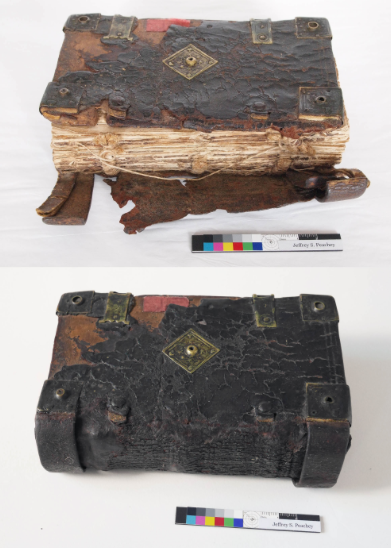
Top: Before, Bottom: After. The only known copy of the first printing of the Ausbund, an Amish Hymnal. Mennonite Historical Library, Goshen College, Goshen, IN.
My recent treatment of the only known copy of the 1564 Ausbund has been getting some press from my hometown area and in Mennonite publications. The Ausbund is one of the earliest Protestant songbooks, still in use by the Old Order Amish.
The treatment is especially interesting since two parts of the book were rejoined after being separated for almost 90 years, and the treatment also involved a textblock infill to deal with the missing leaves, while preserving all the extant spine. The book is a Sammelband, so contains the Ausbund and a number of other texts. The history and provenance of this book are a fascinating story. Reportedly, a dealer tore the book in half in 1928 so that a Goshen College professor H. S. Bender could purchase only the most “valuable” half for $10.00.
If you are interested in a longer, detailed history and description of the treatment, Ervin and I wrote an article: “Ausbund 1564: The History and Conservation of an Anabaptist Icon.” Pennsylvania Mennonite Heritage, October 2016. (pp. 128-135) You can read it here.


 Peachey Conservation