Upcoming Workshop. Cloth Case Bindings: Their History and Repair. October 24-28, 2016. Georgia Archives, Morrow, Georgia

CLOTH CASE BINDINGS: THEIR HISTORY AND REPAIR

October 24-28, 2016

Instructor: Jeff Peachey

Georgia Archives, Morrow, Georgia.

For almost 200 years, the cloth case binding has been the standard way publishers issue books. Throughout the nineteenth century, and even into the twentieth, it was often derided by bibliophiles as a temporary structure, not a ‘real’ book. However, it has proved to be a remarkably durable structure, now commonly used by conservators when rebinding books, by fine small press publications, and in library binding.  Quite likely, there are more cloth cased books than any other rigid board book structure on earth. 

This 5-day workshop will investigate the history of the cloth case binding, concentrating on the early years, 1825-1850. We will parse historic texts that describe this structure, while paying close attention to the introduction of four key pieces of machinery: the rolling press, the board shear, the guillotine, and the stamping press. Boards bindings will be considered as an industrial precursor to the cloth case, and we will make a structural model following a technical description from Cowie’s 1828 The Bookbinder’s Manual. By focusing on historic techniques, this workshop will also serve as introduction or refresher to the essential bookbinding hand-skills. Additionally, we will explore options for conserving and repairing cloth cased books by working on actual books provided by participants. Treatment options presented will include recasing, cloth rebacking, tissue repairs, hinge repairs, and boxing. Basic paper repairs, techniques of toning tissue and cloth, spine lining considerations, and the lifting of fragile material will be addressed. Discussions will include treatment decision making in relationship to specific institutional needs or the desires of private clients.

This workshop is open to all levels of experience: pre-program students, technicians, and mid-career conservators who desire a full time week at the bench. Ideally, a variety of participant experience levels will result in an invigorating exchange of information on binding techniques, institutional protocols, and treatment approaches.  Students should bring 5-10 non-valuable cloth cased books that can be sacrificed or repaired, and basic bookbinding tools.

Students should submit a resume and a brief one paragraph application statement, reviewing their background in bookbinding, book conservation, or other crafts, and stating what they hope to learn.

Workshop Fee: $650 which includes materials.

Application deadline: July 15, 2016.

The application, or questions about the facilities/ housing options/ transportation (Morrow is close to Atlanta) should be sent to Kim Norman: Kim <dot> Norman <at> usg <dot> edu

Other questions about the class should be sent to me.
Shanna Leino’s Online Bookbinding Tool Store

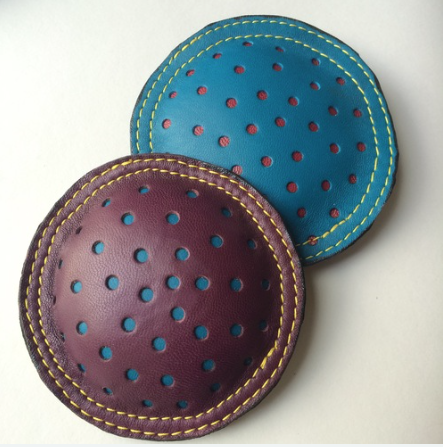
Shanna Leino, who makes beautiful bookbinding tools, now has an ecommerce store, so you easily purchase her wares online. Buying directly from her puts a few more dollars in her pocket, rather than giving it to resellers. Come to think of it, I could use another pair of her leather polka dot paperweights.

Screen Shot 2016-03-08 at 7.34.39 AM
Leather polka dot paperweights. Available from shannaleino.com. Image courtesy Shanna Leino.


Losing It

At Hopes and Fears,  Jared Fischer asks a variety of educators, neuroscientists, and others the question: “How long does it take to lose a skill?”

Most of the answers are theoretical, and the main consensus is that it is dependent on the skill and how it was acquired.  Similar to the ‘you never forget how to ride a bicycle’ adage, crafts and activities that require extensive muscle memory to learn (and the least conscious attention to perform) tend to be the most durable. Many aspects of bookbinding and knife sharpening fall into this category, and these are some of the most difficult skills to initally learn.

It’s a great question, relating not only to the acquisition of craft skills, but the maintenance of them.  Some answers in the article may contain seeds of argument for institutional conservators who feel they are trapped in front of a screen and need to justify bench time. But no practitioners were ask to self-report on their own experience, so I will ask myself.

Q: Jeff, how long does it takes to lose a skill?

A: I usually don’t subscribe to the idea that various crafts and skills sets are so different that there are isolated muscle memories associated with them.  When I teach freehand knife sharpening, for example, I try to emphasize the relationship between sharpening and leather paring: the muscle memory that it takes to hold the knife freehand on the sharpening stone is closely related to the way you need to consistently hold the knife to pare. So in many regards, I think if you are active in some craft activity it can slow the erosion of neglected skills in another.

That said, when I was a kid I tried to learn how the juggle one summer.  It seemed like hundreds of hours were spent, essentially in failure.  But the next summer, I picked up the three balls and for some reason it just worked.  Juggling may be pure muscle memory, since it primarily depends on how accurate you throw the ball.  Now when I try it, I am not nearly as good, but can keep the balls in the air for a short time and suspect if I kept at it could return to a basic proficiency. So in this case, the skill is severely degraded, but not lost.

A dispiriting aspect of this question is that one’s intellectual knowledge of what constitutes skillful performance often increases during the time that the physical ability to accomplish this decreases.

Well worth reading other perspectives:  “How long does it take to lose a skill?”