The Straight Swiss Knife

The Straight Swiss Knife

There are two basic styles of leather paring knives used by bookbinders: an English style knife, with a straight blade positioned around 45 degrees to its length and a French or Swiss style knife with a curved blade positioned roughly 90 degrees to the length. I’ve combined some of the advantages of both of these styles into a new kind of knife — a straight Swiss knife.

For Swiss and French knife users, there are several advantages to a straight blade when compared to a rounded one. Straight blades are easier to sharpen and strop, can cut a straight line the width of the blade with a single downward slice (ie. for labels) and can be used for a final, smoothing cut to even out preliminary paring.  Current English knife users will appreciate some of the advantages of a Swiss style blade orientation. In use, the knife is very comfortable, since two fingers are used to push it, rather than relying just on the thumb.  An acute effective cutting angle is easy to attain, as illustrated below, because of the blade angle. Additionally, it is easy to pare in either direction, instead of flipping the  knife upside down and working on the bevel, which is more difficult to control.

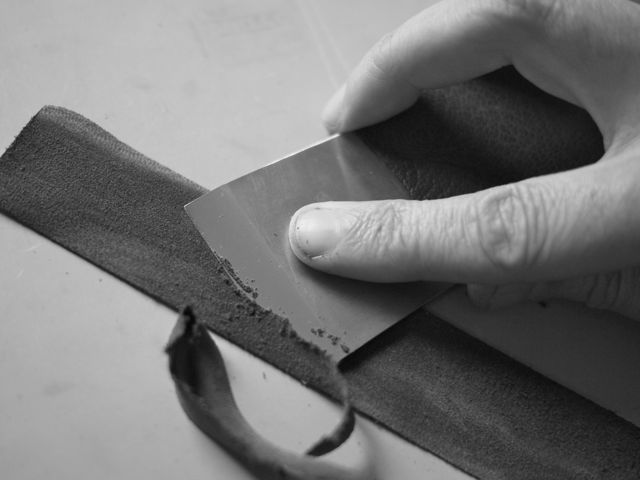
The first pass when edge paring

The wedge shape of this knife is different than a standard Swiss shape, making it comfortable and easy to hold. The leather handle, located roughly at the midpoint of the knife, conforms to the natural shape of the hand when using the knife.  The width of the blade where is it held is 1.75 inches (45 mm) wide. The balance, shape, and weight of the knife give it a substantial presence in the hand.

In the image above, notice that my thumb and middle finger support the blade at the proper angle to the paring surface and pushes the knife forward. Notice that only one side of the blade is used and relatively small strips of leather removed at each pass.   Commonly three or four strips are pared off until the desired turn-in width and thickness is reached. It is very difficult to control cuts with the entire width of the blade unless you are using more of a smoothing cut pictured below, which is almost more of a scraping action — a bit like what a spokeshave does, except that your hands jig the blade.  For the spine area and general scraping, however, a rounded blade is still preferable, since only a small part of the blade is actually cutting at any one time. The relatively wide blade makes it easy to reduce the thickness of a corner with one sweeping slice, which helps make a neat corner.
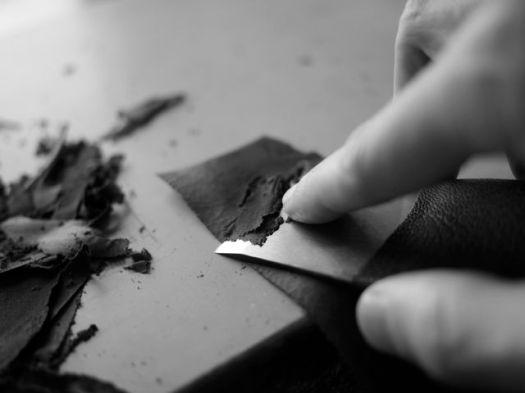
A smoothing, finishing cut using entire width of the blade

SPECIFICATIONS: A2 cryogenically quenched steel, HRC 62. Length: 6.75 inches (171mm).  Width: 1.875 inches (48mm) at cutting edge, tapering to 1.375 inches (35 mm). Thickness: .094 inches (2.4mm). Weight: about 5 oz (142 g). Bevel: 13 degrees. Leather handle. Horsebutt blade cover. Fully sharpened, ready to use.

PRICE:  $125.00


Accidental Verdigris

Verdigris forming around a machine screw secured with PVAc (Polyvinyl acetate)

I made this small brass hammer a couple of years ago.   One face is brass, and the other a removable piece of horse butt leather. When recently unscrewing the face, I was surprised to find verdigris forming.  But it makes sense: the acedic acid offgassing from the PVAc (Jade 403) must have reacted with the copper content in the brass. It you want to make verdigris, this might be a good thing: if you are working on a book with brass or bronze hardware, PVAc should be used with caution.

The brass face of this small hammer is useful for flattening joins when working with a grainy leather, like goat.  If the face is dinged up and dented, it tends to match the leather better than a smooth, clean face, which flattens the leather unnaturally. A second caution: sometimes a dented, irregularly shaped tool may function better than one that is cleaned up and made geometrically perfect. Try it out before you clean it up.

Knockoff of Amman’s Bookbinder

Der Buchbinder  in Eweloser Schaw-Platz oder Newer Schreib-Kalender Auff das Gnaden-Jahr M.DCC.XXIII. Prognosis Astrologica.... 1723.  Image courtesy Musinsky Rare Books.

Jost Amman’s book of trades is iconic, or perhaps even a bit cliched depending on your point of view, and it is commonly used as a representation of  ‘hand-work’ irrespective of the time period under consideration.  The plates of Diderot are similarly used.  Yet these woodcuts, and an unknown number of copies made throughout the centuries, are important documents of technical aspects of many crafts. The illustration of the bookbinder, above, is from a 1723 calander,  the only edition and only copy located, according to Nina Musinsky. She describes this as “a crudely printed but appealing calendar/ almanac, illustrated with primitive wood-cut scenes of trades and professions. The printer Salomon appears to have conceived his Schreib-Kalender as a vehicle for the lively woodcuts, which may be the work of a single artist (IGS).”

On the top: Der Buchbinder, Jost Amman, 1568. Image courtesy Peter Verheyen.

On the bottom: Der Buchbinder, artist unknown, 1723. Image courtesy Musinsky Rare Books.

Often discrete changes contain valuable information: in this image, for example, the beating hammer looks like it is shaped like a double faced one, rather than the single faced style depicted in Amman’s original. Small details like these can help to help to date changes in tool styles. It also appears the sewing supports are wide tapes or thongs rather than cord?  Is the artist of this woodcut adding details from his own time rather than straightforwardly copying Amman?  It is often debatable if these details are oversights, reflections of contemporary practices and tools, mistakes, or simply crude renderings.

More broadly, the reuse of this image, 150 years after its creation, invites speculation about the long tradition of depicting hand work as archaic. As Tom Conroy mentions in his comments to the original post about this image, about half of the tools are for shaping wood boards, a binding style that was rarely used by the 1720’s.  Likely, this image would have already seemed old fashioned to a early 18th century audience. Yet the appeal — and the reuse —  of Amman’s illustrations continue.

Nina: many thanks for bringing this image to my attention and allowing it to be published.

For more information contact: nina (at) musinskyrarebooks.com.

PS. A calendar such as this would make a wonderful christmas gift for a certain NYC based book conservator with a keen interest in the history of bookbinding tools.