New! Redesigned 151 Spokeshave for Leatherwork with Shaving Collector

modified 151 spokeshave
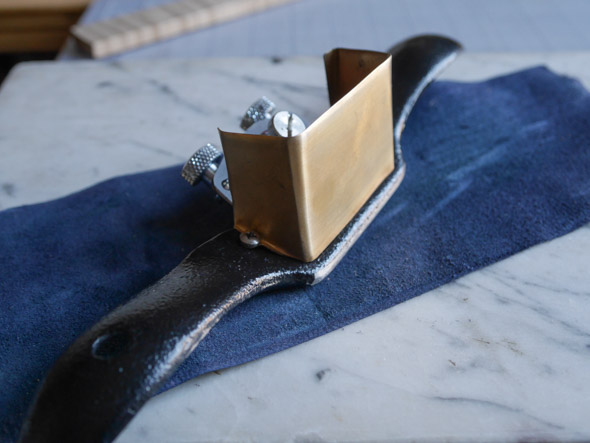
Modified 151 Spokeshave with shaving collector. It also makes a convenient stand when flipped upside down.
modified 151 spokeshave2
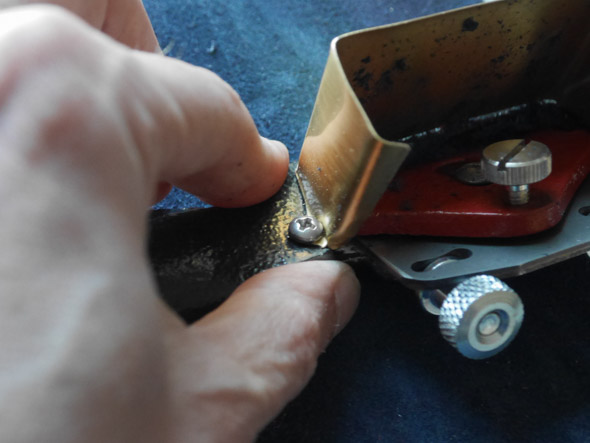
Note that the shaving collector does not interfere with thumb or forefinger placement.

English trained bookbinders often use a modified spokeshave for long shallow bevels on the turn-ins, reducing the thickness in the spine area of a full leather binding, preparing a new piece of leather for rebacking, and for beveling binder’s board.

I’ve improved the modified Stanley 151 spokeshave that I make and sell by adding a shaving collector. I first saw this on a spokeshave  James Brockman was using in 1990. I can’t quite explain why it has taken me so long to get around to making one for myself — I’ve been busy??? He kindly shared details of the design with me, and mentioned he first saw this while working at Roger Powell‘s shop in the late 1960’s or early 1970’s.

The shaving collector really speeds up work with the spokeshave, since you don’t have to stop and clean off stray shavings every couple of minutes, and they don’t get trapped under your leather, which can cause tearing or holes. Additionaly, it is easy to dump the full collector into the trash.   More information about spokeshaves for leather.

Other modifications to the spokeshave include: reducing the effective cutting angle by grinding the base, truing the adjustment knobs, rounding and lessening the surface area of the sole, opening the mouth, flattening the blade bed by filing and filling with epoxy, flattening the blade cap, and replacing the thin chrome vanadium original blade with a Lee Valley PM-V11 one. This blade is reground to a lower angle, sharpened, and the corners slightly rounded to prevent ridges formed in the leather. All of these modifications make the spokeshave a much more precise instrument and reduce chatter

Even if you rough out the leather with Scharffix or Brockman leather paring machine, this spokeshave can quickly help reduce the ridges and unevenness the results from overlapping cuts and blade changes if you are working on large pieces. It is also essential for gradual bevels wider than the width of a double edge razor blade. And it is a lot of fun to use.

MODIFIED 151 SPOKESHAVE: $275.00     How to purchase
 

Losing It

At Hopes and Fears,  Jared Fischer asks a variety of educators, neuroscientists, and others the question: “How long does it take to lose a skill?”

Most of the answers are theoretical, and the main consensus is that it is dependent on the skill and how it was acquired.  Similar to the ‘you never forget how to ride a bicycle’ adage, crafts and activities that require extensive muscle memory to learn (and the least conscious attention to perform) tend to be the most durable. Many aspects of bookbinding and knife sharpening fall into this category, and these are some of the most difficult skills to initally learn.

It’s a great question, relating not only to the acquisition of craft skills, but the maintenance of them.  Some answers in the article may contain seeds of argument for institutional conservators who feel they are trapped in front of a screen and need to justify bench time. But no practitioners were ask to self-report on their own experience, so I will ask myself.

Q: Jeff, how long does it takes to lose a skill?

A: I usually don’t subscribe to the idea that various crafts and skills sets are so different that there are isolated muscle memories associated with them.  When I teach freehand knife sharpening, for example, I try to emphasize the relationship between sharpening and leather paring: the muscle memory that it takes to hold the knife freehand on the sharpening stone is closely related to the way you need to consistently hold the knife to pare. So in many regards, I think if you are active in some craft activity it can slow the erosion of neglected skills in another.

That said, when I was a kid I tried to learn how the juggle one summer.  It seemed like hundreds of hours were spent, essentially in failure.  But the next summer, I picked up the three balls and for some reason it just worked.  Juggling may be pure muscle memory, since it primarily depends on how accurate you throw the ball.  Now when I try it, I am not nearly as good, but can keep the balls in the air for a short time and suspect if I kept at it could return to a basic proficiency. So in this case, the skill is severely degraded, but not lost.

A dispiriting aspect of this question is that one’s intellectual knowledge of what constitutes skillful performance often increases during the time that the physical ability to accomplish this decreases.

Well worth reading other perspectives:  “How long does it take to lose a skill?”

Cady Automatic Hand Micrometer

micrometer3


micrometer4

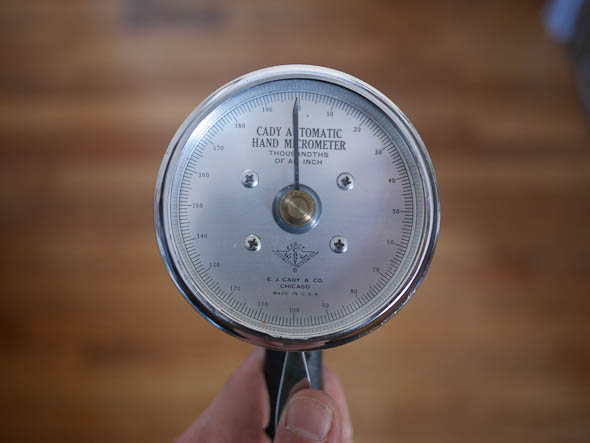
I would have to rank the Cady Automatic Hand Micrometer as one of the most beautiful and well made tools I own.  The E.J. Cady company is still in business, making this exact model which looks like it has not changed in design or construction since the 1950’s. It would not be out of place on the dashboard of a Bentley.

Like most people, I have a number of dial micrometers, or dial thickness gauges as they are sometimes called.  A deep throat Calati is perfect for measuring in the center of large sheets of paper. A super accurate Ames #2 (.0001″) with a 6oz. weight on top is great for obtaining standardized results with slightly compressible material, like leather. A portable, hand held Mitutoyo is small and lightweight, perfect for taking on the road.

Since I only use micrometers these a couple of times a year, the batteries in the digital ones always seemed to be dead. The digital versions are handy, though, if you use them a lot, or need to easily convert between English and Metric systems. The mechanically geared hand on the dial face has a definite nostalgic attraction for me, like the VU meters on a stereo amplifier.

micrometer5
Meet the Family. Left: Calati, Middle: Ames, Right: Mitutoyo