This Is Not an Ambidextrous Scissors

scissors
Boker V 88 Razor Steel Scissors

I purchased this scissors at a flea market last weekend, basically because it looked weird.

I thought it might be ambidextrous, but after playing with it a little, and doing a bit of research, I realized it is not a genuine ambidextrous scissors. But it is an interesting design.


Screen Shot 2016-07-11 at 9.41.36 AM
The 1944 patent claims this is an ambidextrous scissors. Source: https://www.google.com/patents/US2343527?dq=2343527&hl=en&sa=X&ved=0ahUKEwjeyrn9-enNAhWFKyYKHeM3DdYQ6wEIHTAA

Simply putting a thumb and finger ring on each side does not make an ambidextrous scissors. Otherwise any scissors with symmetrical ring holes would be ambidextrous. For a scissors to work properly, the top blade must be attached to the finger ring, so a scissors has to be right or left handed.  This arrangement accentuates the natural action of the hand as it closes, so the cutting edges are squeezed together. If a left hander tries to operate a right handed scissors, the natural action pulls the cutting edges apart, putting the action at a mechanical disadvantage. So a genuinely ambidextrous scissors is a mechanical impossibility, at least if it operates with thumb and finger rings.

Secondly, there is a discrepancy between the patent drawing and the actual product. The patent drawing shows the curved areas of the rings that could be used right or left handed. The actual product uses the same shape on each side, making it uncomfortable to use left handed. Would this difference invalidate the protection of the patent? Possibly this was done to save money when making the mold for casting.

scissors1
Detail, before immersion in vinegar
scissors2
Detail, after four hours in vinegar

Nevertheless, I decided to clean the scissors and sharpen them. These scissors are very comfortable and convenient to use by right handers since it doesn’t matter which way they are picked up.

After taking them apart, I immersed the scissors in white vinegar for four hours, occasionally removing surface rust with a Scotch Brite pad. I’m amazed at how well the vinegar works, and still surprised how satisfying it is to fix up a tool, returning it to useable condition. It just feels good.

If you are interested in the “proper” way to cut paper with scissors, check out this 1927 illustration from Palmer’s A Course in Bookbinding for Educational Trainning 

Miriam Schaer (see first comment) sent me this photo of a lefty scissors (note the top blade attaches to the finger rings), with even weirder placement. I can’t make sense of where you would put your fingers.

scissors3
Photo: Miriam Schaer, http://miriamschaer.com/

New! Redesigned 151 Spokeshave for Leatherwork with Shaving Collector

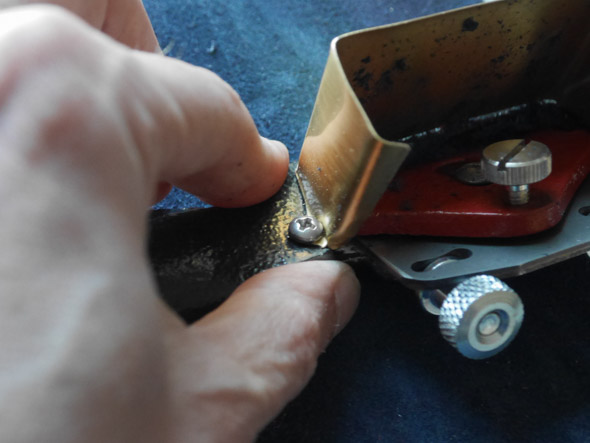
modified 151 spokeshave
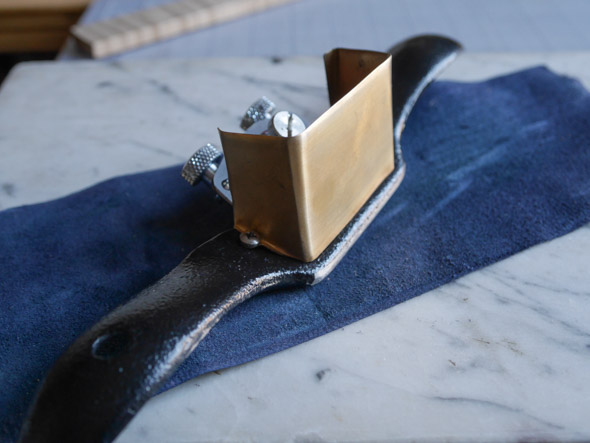
Modified 151 Spokeshave with shaving collector. It also makes a convenient stand when flipped upside down.
modified 151 spokeshave2
Note that the shaving collector does not interfere with thumb or forefinger placement.

English trained bookbinders often use a modified spokeshave for long shallow bevels on the turn-ins, reducing the thickness in the spine area of a full leather binding, preparing a new piece of leather for rebacking, and for beveling binder’s board.

I’ve improved the modified Stanley 151 spokeshave that I make and sell by adding a shaving collector. I first saw this on a spokeshave  James Brockman was using in 1990. I can’t quite explain why it has taken me so long to get around to making one for myself — I’ve been busy??? He kindly shared details of the design with me, and mentioned he first saw this while working at Roger Powell‘s shop in the late 1960’s or early 1970’s.

The shaving collector really speeds up work with the spokeshave, since you don’t have to stop and clean off stray shavings every couple of minutes, and they don’t get trapped under your leather, which can cause tearing or holes. Additionaly, it is easy to dump the full collector into the trash.   More information about spokeshaves for leather.

Other modifications to the spokeshave include: reducing the effective cutting angle by grinding the base, truing the adjustment knobs, rounding and lessening the surface area of the sole, opening the mouth, flattening the blade bed by filing and filling with epoxy, flattening the blade cap, and replacing the thin chrome vanadium original blade with a Lee Valley PM-V11 one. This blade is reground to a lower angle, sharpened, and the corners slightly rounded to prevent ridges formed in the leather. All of these modifications make the spokeshave a much more precise instrument and reduce chatter

Even if you rough out the leather with Scharffix or Brockman leather paring machine, this spokeshave can quickly help reduce the ridges and unevenness the results from overlapping cuts and blade changes if you are working on large pieces. It is also essential for gradual bevels wider than the width of a double edge razor blade. And it is a lot of fun to use.

MODIFIED 151 SPOKESHAVE: $275.00     How to purchase


Losing It

At Hopes and Fears,  Jared Fischer asks a variety of educators, neuroscientists, and others the question: “How long does it take to lose a skill?”

Most of the answers are theoretical, and the main consensus is that it is dependent on the skill and how it was acquired.  Similar to the ‘you never forget how to ride a bicycle’ adage, crafts and activities that require extensive muscle memory to learn (and the least conscious attention to perform) tend to be the most durable. Many aspects of bookbinding and knife sharpening fall into this category, and these are some of the most difficult skills to initally learn.

It’s a great question, relating not only to the acquisition of craft skills, but the maintenance of them.  Some answers in the article may contain seeds of argument for institutional conservators who feel they are trapped in front of a screen and need to justify bench time. But no practitioners were ask to self-report on their own experience, so I will ask myself.

Q: Jeff, how long does it takes to lose a skill?

A: I usually don’t subscribe to the idea that various crafts and skills sets are so different that there are isolated muscle memories associated with them.  When I teach freehand knife sharpening, for example, I try to emphasize the relationship between sharpening and leather paring: the muscle memory that it takes to hold the knife freehand on the sharpening stone is closely related to the way you need to consistently hold the knife to pare. So in many regards, I think if you are active in some craft activity it can slow the erosion of neglected skills in another.

That said, when I was a kid I tried to learn how the juggle one summer.  It seemed like hundreds of hours were spent, essentially in failure.  But the next summer, I picked up the three balls and for some reason it just worked.  Juggling may be pure muscle memory, since it primarily depends on how accurate you throw the ball.  Now when I try it, I am not nearly as good, but can keep the balls in the air for a short time and suspect if I kept at it could return to a basic proficiency. So in this case, the skill is severely degraded, but not lost.

A dispiriting aspect of this question is that one’s intellectual knowledge of what constitutes skillful performance often increases during the time that the physical ability to accomplish this decreases.

Well worth reading other perspectives:  “How long does it take to lose a skill?”