The Straight Swiss Knife

The Straight Swiss Knife

There are two basic styles of leather paring knives used by bookbinders: an English style knife, with a straight blade positioned around 45 degrees to its length and a French or Swiss style knife with a curved blade positioned roughly 90 degrees to the length. I’ve combined some of the advantages of both of these styles into a new kind of knife — a straight Swiss knife.

For Swiss and French knife users, there are several advantages to a straight blade when compared to a rounded one. Straight blades are easier to sharpen and strop, can cut a straight line the width of the blade with a single downward slice (ie. for labels) and can be used for a final, smoothing cut to even out preliminary paring.  Current English knife users will appreciate some of the advantages of a Swiss style blade orientation. In use, the knife is very comfortable, since two fingers are used to push it, rather than relying just on the thumb.  An acute effective cutting angle is easy to attain, as illustrated below, because of the blade angle. Additionally, it is easy to pare in either direction, instead of flipping the  knife upside down and working on the bevel, which is more difficult to control.
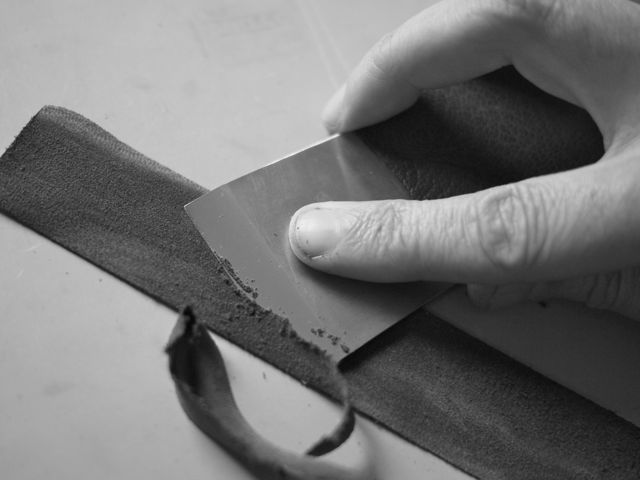
The first pass when edge paring

The wedge shape of this knife is different than a standard Swiss shape, making it comfortable and easy to hold. The leather handle, located roughly at the midpoint of the knife, conforms to the natural shape of the hand when using the knife.  The width of the blade where is it held is 1.75 inches (45 mm) wide. The balance, shape, and weight of the knife give it a substantial presence in the hand.

In the image above, notice that my thumb and middle finger support the blade at the proper angle to the paring surface and pushes the knife forward. Notice that only one side of the blade is used and relatively small strips of leather removed at each pass.   Commonly three or four strips are pared off until the desired turn-in width and thickness is reached. It is very difficult to control cuts with the entire width of the blade unless you are using more of a smoothing cut pictured below, which is almost more of a scraping action — a bit like what a spokeshave does, except that your hands jig the blade.  For the spine area and general scraping, however, a rounded blade is still preferable, since only a small part of the blade is actually cutting at any one time. The relatively wide blade makes it easy to reduce the thickness of a corner with one sweeping slice, which helps make a neat corner.

A smoothing, finishing cut using entire width of the blade

SPECIFICATIONS: A2 cryogenically quenched steel, HRC 62. Length: 6.75 inches (171mm).  Width: 1.875 inches (48mm) at cutting edge, tapering to 1.375 inches (35 mm). Thickness: .094 inches (2.4mm). Weight: about 5 oz (142 g). Bevel: 13 degrees. Leather handle. Horsebutt blade cover. Fully sharpened, ready to use.

PRICE:  $125.00


Peachey’s Ten Commandments of Sharpening

1. Thou shalt not round the bevel or the back.

2. Thou shalt not use jigs.

3. Thou shalt look at the scratch patterns in the metal.

4. Thou shalt use a bevel angle appropriate for the knife and task.

5. Thou shalt not covet thy neighbors knife.

6. Thou shalt sharpen side to side.

7. Thou shalt use a grit progression and entire surface of the stone.

8. Thou shalt not let thy sharpening system become glazed over.

9. Thou shalt not advance to the next grit until the burr develops.

10. Thou shalt not insult thy neighbor by insisting on the absolute superiority of any technique or system.

______________________

COMMENTARY

[1] Rounding the bevel, or the back, is the most common mistake in sharpening.  Though the knife may look ‘sharp’– ie. polished– it will not cut if the included angle becomes too obtuse. Even with careful stropping, eventually the knife will need to be reground and resharpened. A back bevel works fine as long as the included angle is within the desired angle. In practice, a small amount of rounding always occurs when sharpening and stropping: the goal should be to minimize it.

[2] Not relying on jigs will give you much more freedom, and speed, in sharpening a variety of tools.  Many bookbinding knives do not fit it standard jigs, which are often designed for woodworking tools. The hand motions and muscle memory necessary to sharpen freehand is often very similar to the skills necessary to use the knife properly. Throw away your crutches and walk!

[3] Looking at the visual evidence of what you are doing when sharpening is paramount. Even slightly changing the angle of the knife when moving to a finer grit will show exactly what the new grit is doing.  A 10 power magnifying lens is very revealing. Always sharpening in the same direction will disguise the effects of the new grit, often resulting in an unpleasant surprise when a final stropping reveals many deep scratches.

[4] Always use the lowest possible blade angle for the task at hand. For paring leather, this is around 13 degrees.

[5] Knives are very personal.  You need your own, and get to know how to use and sharpen the particular angles it develops.  Most people sharpen with small idiosyncratic deviations from a geometric ideal, and learn to work with these deviations in practice. A well made knife will last the rest of your career, don’t purchase or make an inferior one. In the bookbinding world, it is a major faux pas to borrow a colleague’s paring knife — don’t be a rube!

[6] It is much easier to maintain a consistent bevel sharpening side to side freehand (parallel to the cutting edge), rather than sharpening from the cutting edge to the start of the bevel. I have noticed this in student work as well as my own.  This does necessitate a flat stone or sharpening surface, however.  Of course, it is possible to sharpen in almost any direction, as long as you hand is comfortable and you are able to maintain a consistent angle.

[7] It is much faster and easier to have a series of small grit progressions, rather than one or two large ones.  This also results in less wear per stone. Always buy the longest stone you can afford and use the entire surface of it — moving the blade 10 inches once is basically the same as moving the blade 2 inches,  5 times. Hogging the center will wear a stone unevenly.

[8] Always use a lubricant.  A glazed system will generate heat and cut very slowly.

[9] Feeling, or looking for the burr lets you know that the two planes have exceeded the point where they meet. This assures you there are no flat (dull) areas on the cutting edge. With very fine grits it may not be possible to feel or see this.

[10] Almost any sharpening system can work, if you know what you are doing. I’ve seen people break every one of these commandments and still get a great edge.

______________________

RECOMMENDED SHARPENING RESOURCES

Hock, Ron. The Perfect Edge: The Ultimate Guide to Sharpening for Woodworkers. Cincinnati: Popular Woodworking Books, 2009.

Ron Hock’s brief sharpening notes

Lee, Leonard. The Complete Guide to Sharpening. Newtown, CT: The Taunton Press, 1995.

Maurice Fraser’s sharpening notes

Sugai, Chiharu. The Chef’s Edge: Traditional Hand-Sharpening Techniques for Japanese and Western-Style Yanagi Knives. (DVD) KORIN Japanese Trading Co., 2003.

An Old Brush

Just an old brush, which looks pretty similar to the string bound paste brushes that bookbinders and conservators use.  How many of us would even give it a second thought– passing over it at a flea market, or when cleaning out our own stash toss it?  But this brush can be located and dated to the Mason House, Guilford, Virginia from about 1730.  And according to Gaynor and Hagedorn, it is the only known surviving pre-1800 American brush.

This book contains a great defense of the value of tools, how they help us understand human culture, and the importance of preserving their original condition. And it contains lots of beautifully photographed tool porn.

___________________


Gaynor, James M. And Nancy L Hagedorn. Tools: Working Wood in Eighteenth-Century America. Colonial Williamsburg, Williamsburg, Virginia, 1993. p. 111.
