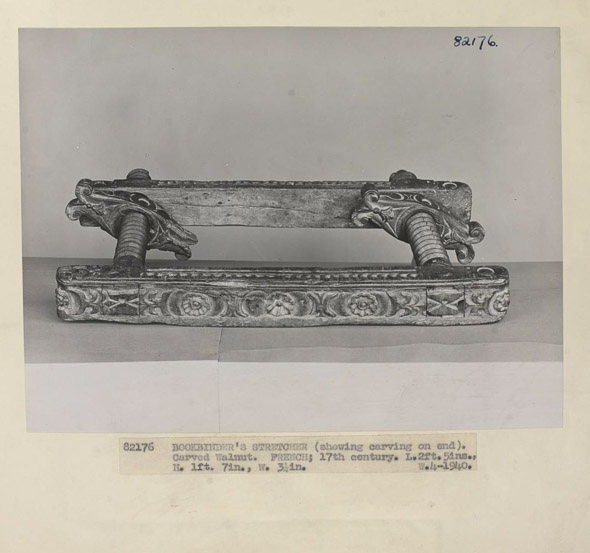
It would be nice to have a book stretcher on occasion, though. Need to turn an octavo into a quarto? No problem! But was this really a book press, or a press intended for some other purpose? The 29 inch long cheeks are very, very thin in profile, and I imagine would deflect quite a bit even with just hand tightening.
Hats off to the V&A has a very progressive large image use policy. You can download them instantly, share them widely, and even use them for publication. There are almost 750,000 searchable images on the V&A site. Let’s hope all institutions free their images.
I recently finished teaching a month long workshop on historic bindings for the Library and Archives Conservation Education Consortium of Buffalo State University, New York University, and the Winterthur/ University of Delaware. LACE for short. Seven MA students in conservation completed six historic models from the 15th to the 20th centuries.
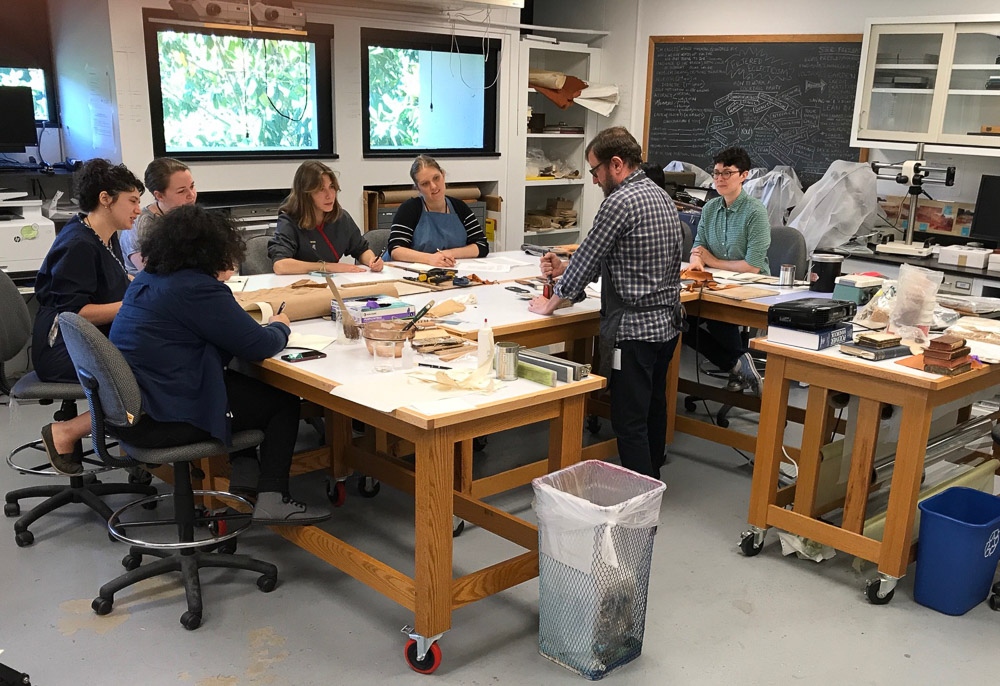
This year it was hosted by The Winterthur/ University of Delaware Program in Art Conservation and took place in the first year student classroom, which is a really great space to teach in. The room has individual work stations for the students, as well as a group area with moveable work tables for lectures, ppt’s, discussion, and demonstrations.
One configuration of the classroom.
It is important that the students can be comfortable and close enough to observe details during demonstrations. In this configuration, students could sit to watch and take notes, and I could stand, which is how I like to work. Having a task light would have made it ideal.
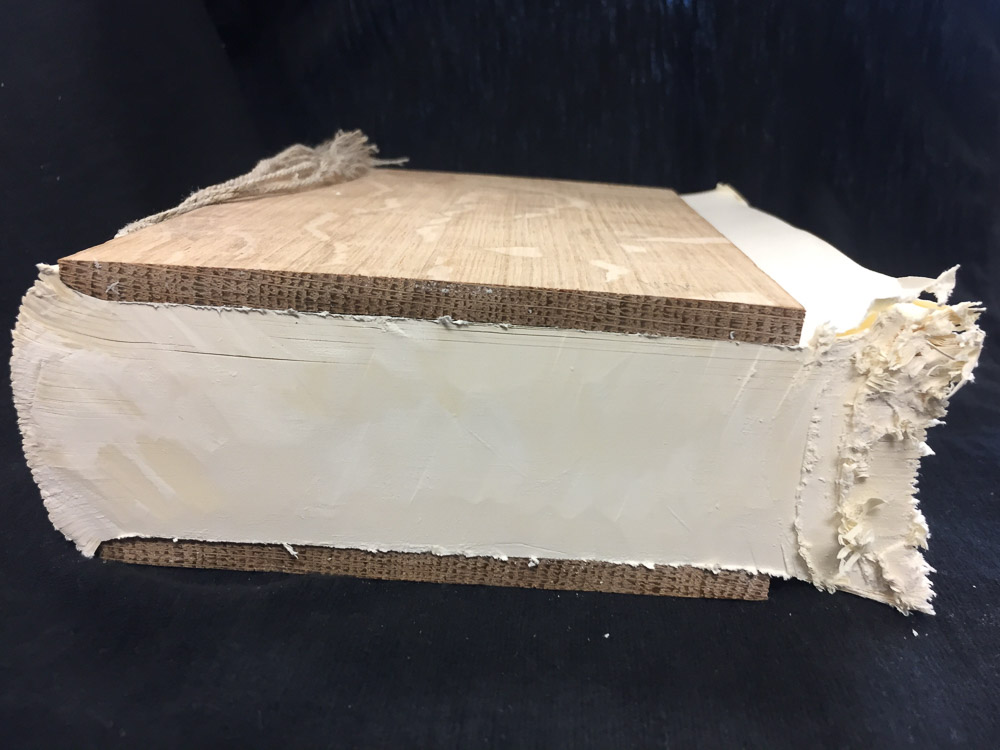
Edge of a bookblock cut with a drawknife. Photo Nicole Alvarado.
For our late Gothic model, some of the students wanted to try out a drawknife instead of a plough for edge cutting. Nicole Alvarado worked the edge in the above image. We found it quite difficult it is to achieve an edge that looked like historic examples. We had to start with the sides of the bookblock in order to shave it down. The resulting edges did not look like the example depicted in Fig. 9.14 from J.A. Szirmai’s The Archaeology of Medieval Bookbinding or on a first first folio of Shakespeare.
The edges on the Shakespeare and in Szirmai were presumably cut with a skewed and sliding stroke of a drawknife, with one stroke at a time advancing a significant amount through the book. It is easy to imagine this when looking at the images. We found it impossible to replicate this, though. Was our drawknife too small, the blade angle too obtuse, modern paper too hard, or our arms too weak? A combination of all of these? Or was a different tool used? In both of these examples, each chop could have been caused by an aze or adze, in order to penetrate so far through the thickness of the bookblock. Time for more experimentation!
Paring and scraping a tawed skin with a round knife. Photo Karissa Muratore.
In bookbinding, usually vegetable tanned goat is the easiest leather to pare, followed by vegetable tanned calf, then tawed goat or calf. Tawed pig the most difficult. Tawed skins are quite abrasive, and quickly dull any knife. Karissa Muratore did a wonderful job of paring an alum tawed calfskin for her Gothic Model binding. Although tawed pigskin would have been traditional, all of the major bookbinding leather producers are no longer offering them, citing difficulty in obtaining quality raw skins.
Karissa’s image illustrates how a rounded blade knife can be used for edge paring (note the pieces in the foreground) and scraping (note the shavings in the background). Scraping is a safe, but slow way to even a skin out, as well as thin the spine and headcap area. I think that 15th century binders would have received the skins the appropriate thickness overall from the tanner, and only had to edge pare.
This late Gothic binding — clasps, alum tawed skin, wooden boards, double cord sewing — is a satisfying final project, combining bookbinding, woodworking and metalworking skills.
By the end of the month, the students were more than happy to demonstrate what they learned about safe, professional, and thoughtful tool use.
The Robert C. Williams Museum of Papermaking in Atlanta has one of the largest — and oldest — papermaking presses I’ve ever seen. Look at the size of the top beam, which is about two feet square!
The entire museum is fantastic. It started at the Massachusetts Institute of Technology in 1939, consisting primarily of Dard Hunter’s papermaking books and artifacts. Then it moved to the Institute of Paper Chemistry in 1954, was added to over the years, and finally landed at Georgia Tech in 2003.
The “Samson Paper Press”, constructed in 1790, was used by Hodgkinson and Co. in Wookey Hole England until the early twentieth century, according to the label. I’m not sure if the name refers to this press in particular, or is a generic term for any massive press.
It has an iron thread which generates much more power than a wooden one, due to the reduction of friction. I’m starting to think that all images of early nineteenth century presses with a ball above the platen also have iron thread. Samson has a ratchet wheel and pawl mechanism to prevent the platen from backing off when fully tightened.
The tommy bar, or press pin, is lying on the black plinth in front of the press and is about six feet long! Not visible is the iron renforcement on the end of the bar which fits into the four holed iron ball. I imagine Samson securely attached to the ceiling or wall, and three or four men working together to fully tighten it. The daylight is roughly 3.5 feet, which would be about the height of a typical post (a stack of the newly formed sheets and felts). Possibly a century of use might account for the deterioration on the lower wooden platen, or it may have been sunk into the earth under the floor. The uprights are iron faced on the two short sides. A few decades later, by the 1830’s, most presses were made completely or iron or steel, making Samson an interesting transitional press, incorporating both wood and iron.
Around the same time, the French papermaking press depicted in Diderot’s Encyclopédie appears to have wooden threads, but a similar iron ratchet mechanism to prevent it from backing off. I have a hard time believing a small wood pawl could withstand the compression.
Encyclopédie, ou dictionnaire raisonné des sciences, des arts et des métiers, etc., eds. Denis Diderot and Jean le Rond d’Alembert. University of Chicago: ARTFL Encyclopédie Project (Autumn 2017 Edition), Robert Morrissey and Glenn Roe (eds), http://encyclopedie.uchicago.edu/.






 Peachey Conservation