500th Blog Post. A Look Back at the First One: Philosophy of Conservation

Eleven years ago when I started this blog. I didn’t have a clear idea of what it would become, I just wanted some kind of presence on the web. Over time it has become a place to investigate book history, advertise my book conservation business, examine some of my tool collection, promote my workshops, dip my toes into the philosophy of craft, and announce new bookbinding tools.

Two years ago, the tools moved to  Peachey Tools.  I use instagram for more image based sharing. The board slotting machine has a following among book conservators, my book conservation and tool businesses keep chugging along, and I do a fair amount of teaching.

Looking over my posts, they keep returning to four main topics: tools, books, craft, and conservation.

An unintended benefit of sustained blogging is how it feeds longer term writing projects: sometimes by immediate gratification, sometimes by regular practice, and sometimes by feedback from readers. Tom Conroy in particular deserves a thank you for his 52 comments, many of which contain new information, and several which exceed the word count of the original post!

Below is my first blog post — a mini-manifesto, really — my philosophy of conservation. Those who know me may be surprised I’m not as pessimistic concerning the future of book conservation as I was in 2008. The quality and sensitivity of book conservation has increased in the past 11 years, at least from what I see of it, and  book conservation education continues to evolve with change as society and the uses and values of books change. But there is still much work to do. Onward!

>

Philosophy of Conservation (originally published  17 April 2008)

It was almost 100 years ago that Douglas Cockerell wrote, “Generally speaking, it is desirable that the characteristics of an old book should be preserved… It is far more pleasant to see an old book in a patched contemporary binding, than smug and tidy in the most immaculate modern cover.”   Today, I am disheartened to find what little has changed; rows and rows of rebound or insensitively rebacked volumes, giving no hint of their original nature.  All to often, books and the information they contain are needlessly  destroyed by inappropriate or outdated techniques.

As microfilming, photocopying, and digital methods of storing and transmitting conceptual information become more and more prevalent, I feel the intrinsic aspects of books and paper artifacts: their physical construction, material content, aesthetics, and tactile qualities, are irreplaceable and will prove to be the most valuable.  These are the aspects I preserve for future generations.

___

Bookbinding and the Care of Books Lyons and Burford,  p. 306

Microfiber. Horsebutt. Bluefin Tuna. Poinsettia.


Nothing quite sums up the Holiday season for me like a poinsettia and hunks of raw blue fin tuna. Stressed? Too much to do before the end of the year? Feeling overwhelmed? Me too. I coped yesterday by playing hooky and indulging in arguably the best chirashi deal in Manhattan at Yuba for $15. Yuba was founded by a couple of ex-Masa employees: $15 there would get you exactly 11 grains of rice.

Other coping mechanisms include buying stuff.


The Peachey Branded Microfiber Towels are in stock! A great stocking stuffer, or you could even make a stocking out of it. I made to logo by having a steel stamp made from my handwriting, then stamped it onto a piece of horsebutt, then had it dye sublimation printed onto the towel. Genuine Horsebutt Strops are always popular.

To be safe, order soon, although the post office estimates December 17 as the deadline.

Five Inexpensive Holiday Gift Ideas for Bookbinders and Conservators, 2018

Peachey branded microfiber towel. $5.00. My first foray into merch! A stylish and practical way to show your support for Peachey Tools. This is a heavy duty, professional grade microfiber towel: 16 x 16 inches, 300+ gsm, 4-thread edge stitching, .1-.2 denier microfibers,  80% Polyester/ 20% Polyamide blend. Perfect for cleaning your knife and microfinishing film during sharpening, the floor, your cutting mat, and even removing excess grease from your nose. The dye sublimation printed logo seems durable on my sample, but it is not possible to have a super dense image on the three dimensional microfiber surface. The fibers fluff up over time: the towel in the image above was washed seven times. The great thing about microfibers is that they trap everything. The terrible thing about microfibers is that they trap everything, so the towel will turn grey over time, likely obscuring the logo anyway. But you will still know it is there! What could be a nicer gift for all your staff members, as well as a gentle reminder to keep things clean? They should be in stock December 11 at Peachey Tools.

.

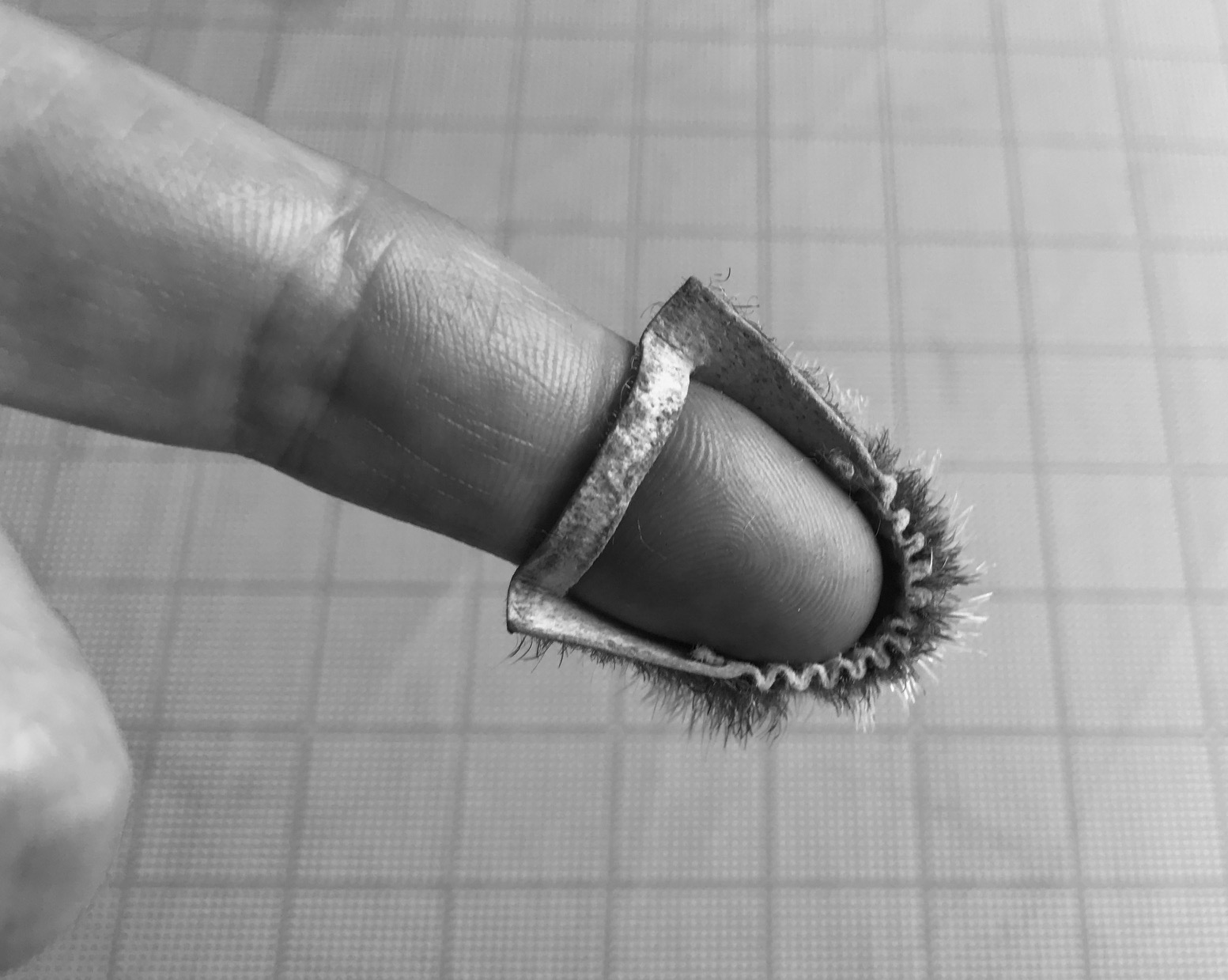
Seal Skin Thimble. You can cut the strap a bit more to fit larger fingers.

Seal Skin Thimble.  $5.00.  A fantastic tool. Much more comfortable than a metal thimble. I purchased this one in an antique store in Adamstown, Pennsylvania, then a quick google search confirmed it is a traditional Indigenous Peoples of the Arctic craft object. The images of them are remarkably consistent, almost identical. For example, they all have a length of thread holding the crimping in place at the tip, and a clever slit that functions as a finger attachment. The seal skin is rawhide (?), stiff enough to resist a needle head puncture, and the fur is a comforting joy to stroke if your sewing is not going well. It also makes a great finger puppet, though this can be a warning sign you have been working alone a bit too long. Available from Quilted Raven Alaska.

.

Londonderry Linen Lacing Thread. Wonderfully soft and not tightly twisted, just like older threads.

Londonderry Lacing Linen Thread, Size 4.  $7.00.  I love this thread. Seriously. I can sew *almost* everything with it. it is perfect for joint tacketing or sewing extensions during board reattachment. Since it is loosely plied, it is easy to flatten it out inside a gathering to minimize swell. Check out this naturally packed sewing.  A loaded stick also helps to control sewing. The soft thickness of this thread gently supports weak or brittle paper. Mary Uthuppuru, proprietor of Colophon Book Arts Supply, is a wonderful, kind, knowledgeable supplier, a true pleasure to do business with. Available in from Colophon Book Arts Supply.

.

Shop Knife. I’ve used this one for a number of years and altered the handle for comfort.

Shop Knife Style “F”. $13.84. This is a knife that I use dull. It is a perfect size and shape right out of the box for cleaning spines and other general scraping tasks. Where it really excels is for marking binders board for boxmaking: the tip is just the right angle, and a knife mark is much more accurate than even a .3mm mechanical pencil. It is easy to carve the handle a bit to make it more comfortable, especially where the blade transitions to the handle. Available from McMaster-Carr.

.


Delrin Hera. $40.00.  I know what you are thinking. $40? Inexpensive? Please allow me to explain. This tool is so useful that you will end up using it constantly. For example, it is great to gently pry some material for lifting, lift a page to turn it, insert adhesive under a detaching fragment, hold down something for photography, score tissue before dry tearing, and so on. You might like it so much you will keep it with you even when you are not working. Seriously, I use this tool at least an hour a day when doing conservation work. Therefore if you use it an hour a day, for 300 days a year, for 30 years, it only costs 4 thousandths of a cent per hour. Inexpensive or dirt cheap?!  Available from Peachey Tools.