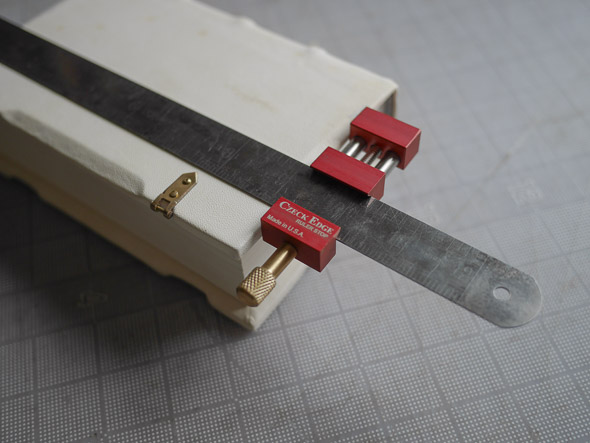
I purchased the Czeck Edge ruler stop about two months ago and keep finding more and more uses for it. It costs around $35 and clamps onto almost any ruler easily and securely.
In addition to a ruler stop, it is accurate enough to convert a ruler into a double square. Although marketed to woodworkers, bookbinders will also find it quite useful. The non-rusting anodized aluminum is slightly more compatible with binders boards, leather, paper and cloth than a hardened steel Starrett double square.
This tool is useful in circumstances where your dividers are not large enough, for example when centering a label in the middle of a bookboard. It can be used for measuring a book without relying on quantification for boxmaking: simply set the stop for the measurement of the book, then transfer the distance with a knife to your board. It could be used for laying out tooling. I’m sure there are many more uses.
The small (3.75 x 1 x .5 inch with the knob) size is appropriate for books. This is a handy little tool at a reasonable price. Czeck it out! Sorry!
Here I am using it to position the catch plates when mounting clasps.
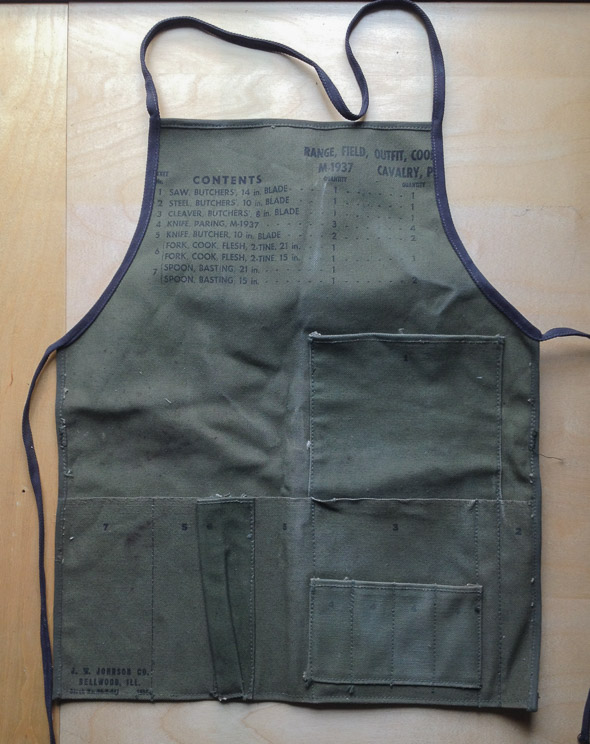
Someone — not me! — converted a standard WWII M-1937 Canvas Field Cooking Outfit Bag into an apron. When not used as an apron, the tools store in the appropriately labeled pockets. Although I can’t condone altering historical artifacts, this is a pretty cool idea.
Someone should make a Bookbinder’s Apron/ Tool Roll. What are the essential bookbinding tools?
Currently my most used tools are: two 1″ Princeton Brush Co. Gesso brushes, two #8 Princeton Brush Co. flat hog bristle brushes, a Delrin Hera, a large Jim Croft elk bone folder, a Green River Shop knife, a Japanese water brush, a 5″ Mundial scissors, Dumont and Sons #2a and #5 tweezers, a M2 Paring knife, a Pentel .7mm mechanical pencil, a thick steelcraft 12″ tempered ruler, an NT A-300GR snap-off knife, a Caselli Micro-spatula, a Delrin folder, and a 6″ Stevens dividers.
Add an adjustable neck, side-ties long enough to knot in front, and you have your first sale right here!
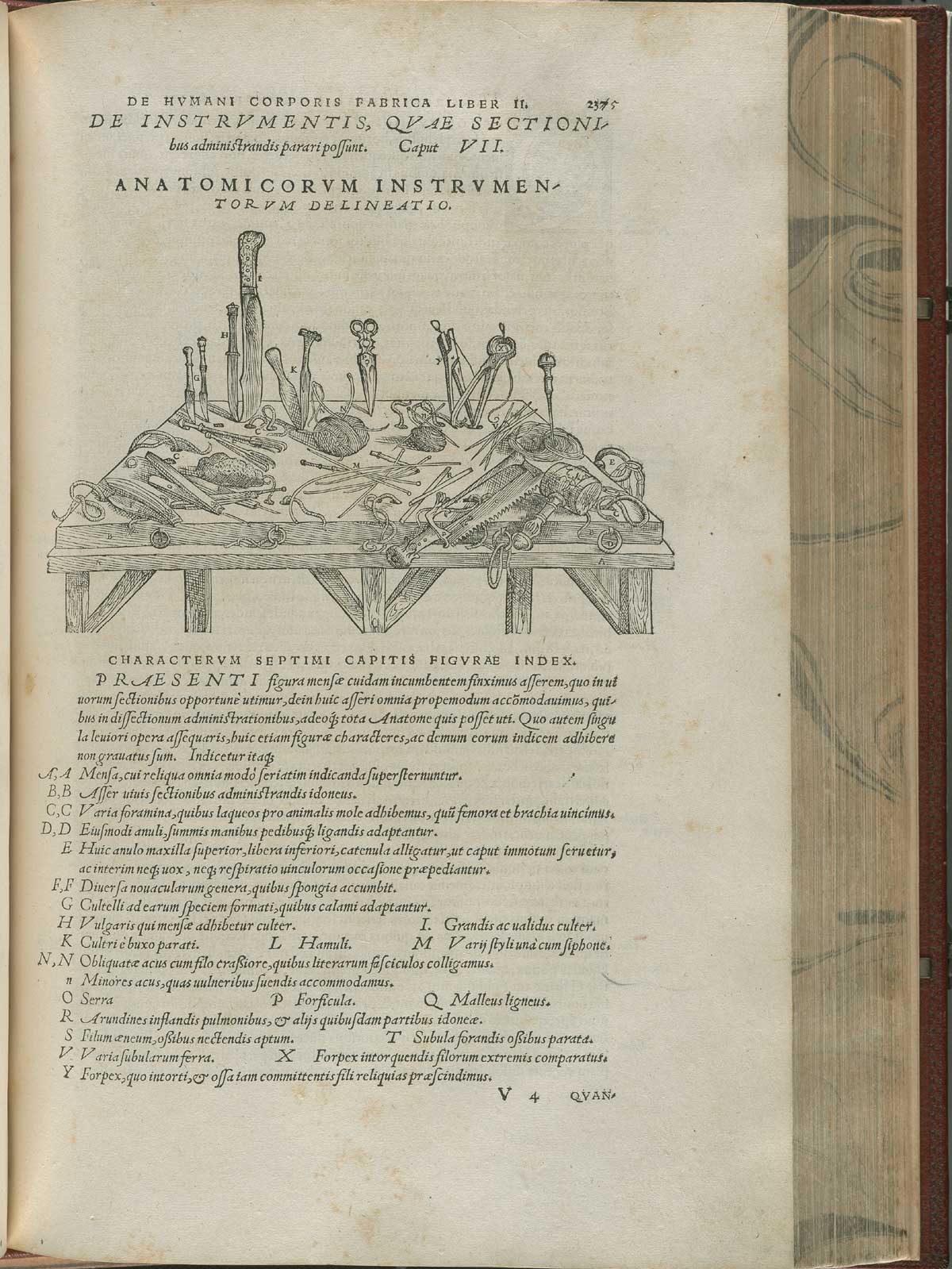
While looking at the surgical tools in De Humani Corporis, I ran across an interesting bit of information from a Cambridge University Online Exhibition. The image is huge, and can be examined in detail. In the text, Vesalius mentions that either silk threads or bookbinder’s threads could be used to prepare a cadaver. In his opinion, German bookbinding thread is the best quality, since it is stronger, thinner, and more well-twisted than thread from other countries. I haven’t noticed this about German 16th C. sewing thread (in large part due to the inflexible spines, see the post below) but it is certainly true for their typically tightly cabled sewing supports. One takeaway is that the thread bookbinders used was the best quality available. Vesalius also describes heating a needle in order to bend it into a “C” or parenthesis shape, a practice bookbinders still perform today. I’m assuming these bent needles, labeled “N” are stuck in bookbinding thread wrapped up in a bun shape. This is likely the earliest image of bookbinding thread.
Anthropodermic bibliopegy, or the binding of books in human skin, has a lurid and enduring fascination. Here; however, we have the cadaver fabricated using a bookbinding material and borrowed or shared tools: Bibliodermic anthropegy???
***
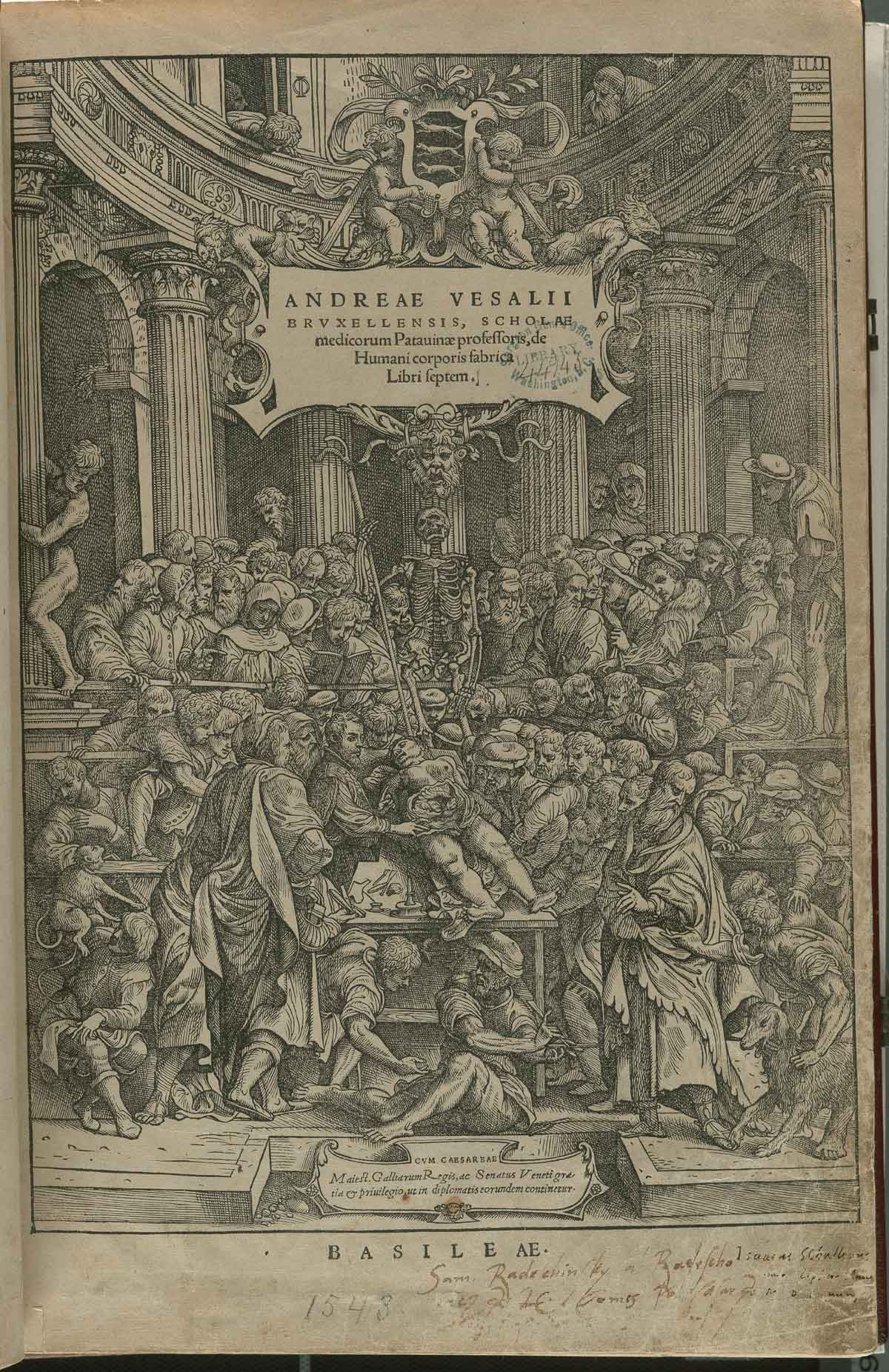
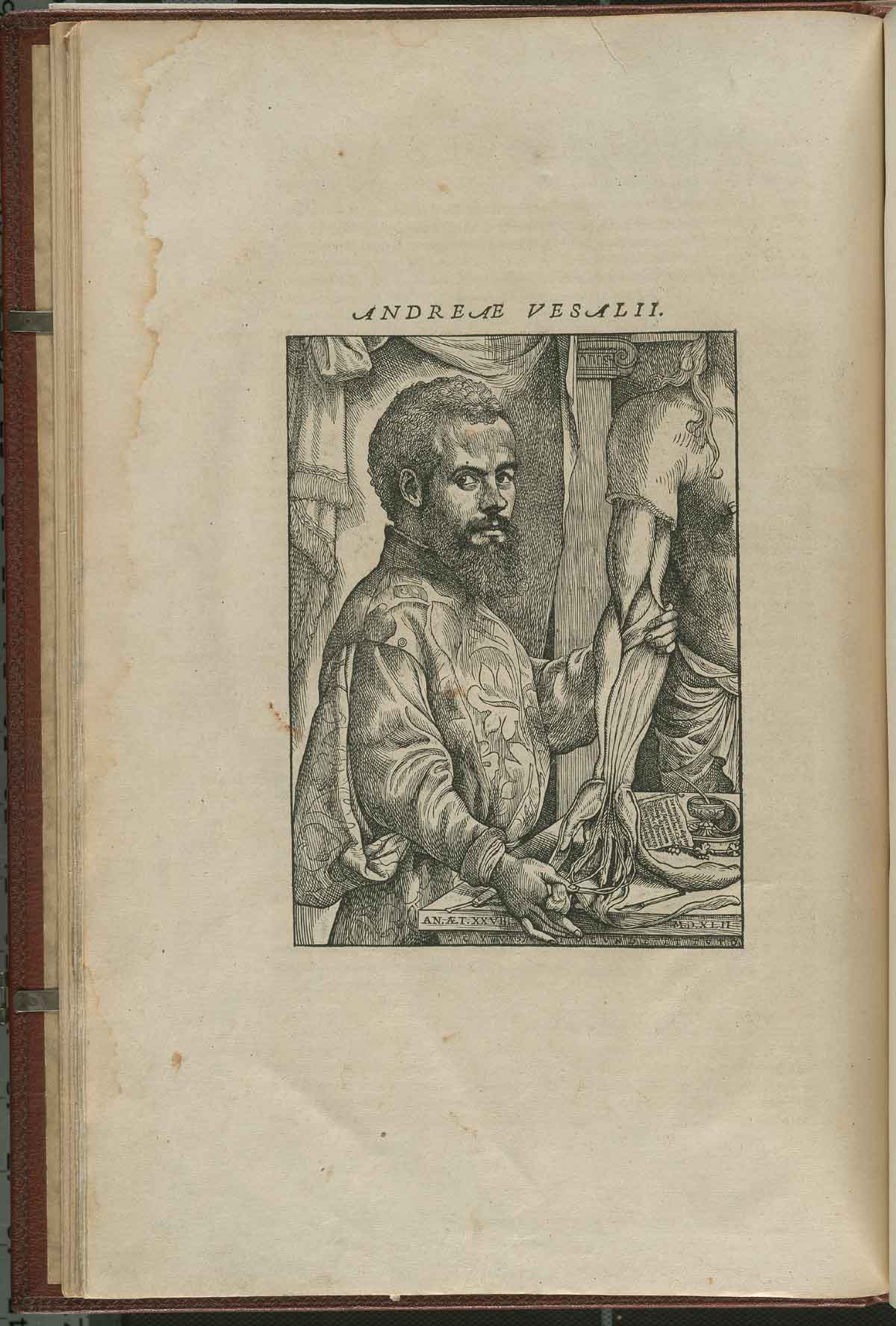
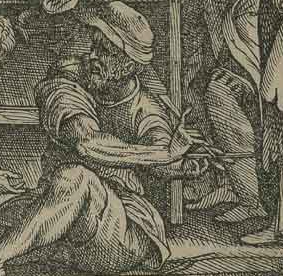
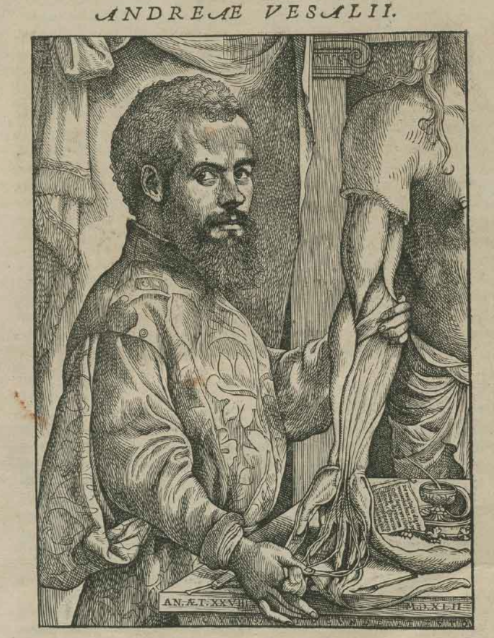
More tools appear on the title page of this book, where a man is stropping or sharpening his razor under the dissection table. The portrait of Vesalius also contains a partially hidden razor lying on the table as he holds body parts of a cadaver. In this case, the razor represents his practical knowledge and experience. His intellectual and theoretical prowess is symbolized by the inkwell and manuscript page on the table behind arm.
The Cambridge exhibition considers that these are ordinary tools, altered by Vesalius, a testament to his manual dexterity. He didn’t need “fancy” instruments, but could use commonly available ones. I wonder about this interpretation, though. Given how many tools even today are shared — and altered — by many crafts, I wonder how many specialist instruments were made only for surgeons. There is no mention of this kind of specialization in J.B. Himsworth’s 1953 The Story of Cutlery, Although it is an excellent resource, it is far from comprehensive.


 Peachey Conservation