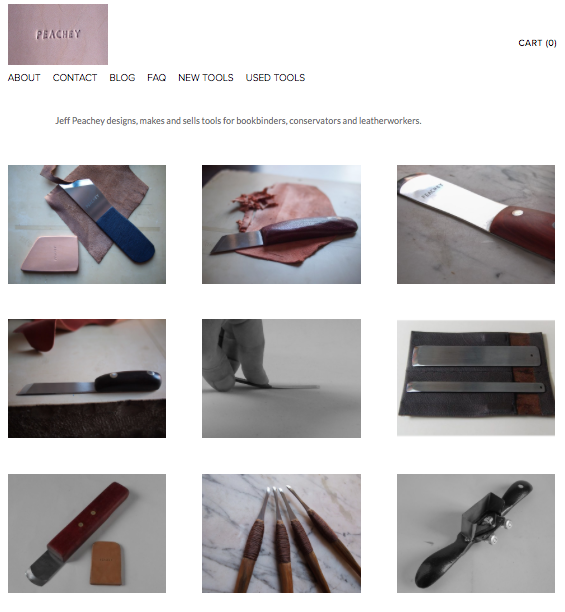
I’ve set up an online store at peacheytools.com for all the tools I make and sell. There is a used tool section (which also includes some experimental unique tools I’ve made) with some great deals to kick things off.

Book Conservation
I’ve set up an online store at peacheytools.com for all the tools I make and sell. There is a used tool section (which also includes some experimental unique tools I’ve made) with some great deals to kick things off.

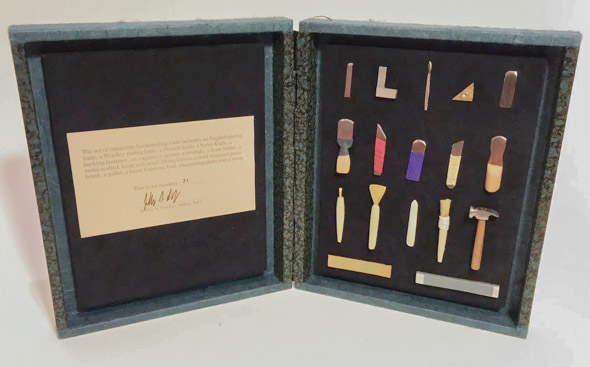
The Miniature Bookbinding Tool set is once again available for sale. I took a couple of years off to rest up my muscles. Ironically, it takes more strength to hold these while grinding and filing, than normal sized ones. The tools are made 1/6th scale, i.e. the Delrin sharpening plate on the left is two inches long, not twelve. They are made from the same materials the larger ones are, but please don’t expect to actually use them, they are much too small to hold comfortably. If you want a knife to use to make miniature books, I recommend my Flexible Mini Knives, and the cutting area can be made narrow if you desire, just let me know. The Miniature Bookbinding Tool Set is for the miniature book enthusiasts (you know who you are) or a gift for the binder who has everything. Seventeen tools are included, l-r: a Delrin sharpening plate, Peachey style French knife, Flexible paring knife, bone folder, small Powell shaped lifting knife, heart shaped finishing tool, brass triangle, engineers square, bookbinder’s hammer, swiss style paring knife, pallet, dissection scalpel, large Powell shaped lifting knife, French paring knife, cord wrapped paste brush, English style paring knife, and a strop. Supplied in a cherry box.
Miniature Bookbinding Tool Set: $800.00
***
Elaine Nishizu, a bookbinder in Los Angles California, made this beautiful box to house a set of these tools. It is in the Guild of Book Workers California Chapter Member Exhibition, 2016. Elaine describes it: “The box structure has a reversible spine that folds back on itself like a Jacob’s ladder. It’s covered in Japanese paper and a French printed paper by Claude Braun. The box is lined with black ultra suede and has a magnetic closure.” Note: this box does not come with the tool set.
1. Visual inspection. When looking directly at the blade edge, with a light source behind you, are there any reflections? If so, these are dull, bent or chipped areas. The cutting edge should be an almost invisibly smooth black line.
2. Visual inspection, with magnification. When looking at the side of the blade, the smoother it is, the sharper it is, and presumably the longer the edge will last. Brent Beach, for example, measures wear in terms of pixels in a microscopic image at 200x. Leonard Lee’s Complete Guide to Sharpening has a number of electron microscope images of blade edges. Take heart, though, even a “sharp” edge will look like the Rocky Mountains if enlarged enough.
3. Shave a few hairs on your arm. If it is sharp enough to shave, it is probably pretty good. WARNING: THIS IS DANGEROUS
4. Rest the blade on a pen held at a 15 degree angle. If the blade, with just the weight of the knife catches the plastic, it is sharp. If it slides off, it is dull. The closer to parallel the pen and the knife are, the sharper the blade is.
5. Do this same test holding the blade and GENTLY and see if it catches on your fingernail. WARNING: THIS IS DANGEROUS.
6. Tsujigiri. This test likely seems a myth. Supposedly, at one time, samurais tested their swords by the number of torsos they could cut through in one stroke. The sharpest one was a #5. WARNING: THIS IS DANGEROUS, IMMORAL AND ILLEGAL.
7. For kitchen knives, see if they can penetrate a tomato or onion, with no downward pressure and no sawing. There are many variables in the toughness of the skin of a tomato though, I imagine.
8. Longer blades can be tested by slicing paper, even toilet paper. There are many youtube videos of this. Slicing cardboard, because of its consistent and abrasive nature, is often a field test of edge durability.
9. Feel the edge ACROSS THE BLADE with your finger, applying virtually no pressure. The smoother it feels the sharper it is. You should be able to feel any slight irregularities, indicating a dull area. WARNING: THIS IS DANGEROUS.
10. Test it on a difficult to cut substrate like styrofoam, cork, or balsa wood.
11. Send the knife to CATRA. They will qualitatively test for initial cutting performance, edge durability, and edge geometry. This will, however, dull your knife, so it is designed for production samples.
12. Possibly the best test is just to use it. Providing you are familiar with the material you are using it on, you can often tell instantly if it is sharp depending on how much force you have to apply.

