Review of the Delrin Folder by Benjamin Elbel

I’ve been following the career of Ben Elbel for a while.  Originally his onion skin binding structure caught my eye. It has a cleverly elegant design, and is one of the few genuinely new binding structures I have seen in the past 25 years. I met him in Amsterdam earlier this summer, and he was kind enough to write up a review of my large Delrin folder in his current newsletter, which is well worth subscribing to. 
Screen Shot 2016-08-21 at 4.16.15 PM
Benjamin Elbel

Benjamin (French nationality, 1983) fell in love with bookbinding while studying art in Strasbourg, France. From the beginning his interest has been towards the experimental side of the craft; however, determined to learn the ‘proper’ ways he embarked on a journey that took him to Switzerland (Ascona- Centro del bel libro), Germany (Göttingen- die Buchmanufaktur) and England (London- Shepherds Bookbinders, Book Works). After these years of working in the trade he started his own bindery, Elbel Libro Bookbinding in Amsterdam providing bespoke bookbinding services. Ben is known for his research in bookbinding and over the years has developed a number of innovative book and album structures such as the onion skin binding, which he shares via workshops and printed tutorials.

THE DELRIN FOLDER by Benjamin Elbel

In May, Jeff Peachey gave a workshop in the Netherlands (the workshop was organised by Herre de Vries, Natasha Herman, Wytze Fopma and Restauratoren Nederland, and took place at bindery FopmaWier). Jeff is an American bookbinder, conservator and tool maker, whose work I have long admired so when I heard he was going to be around I jumped on the occasion to invite him to the bindery.

Jeff made me a gift: a special folder that he’d made, called the ‘Delrin’ folder.
Screen Shot 2016-08-21 at 3.52.25 PM

Delrin is a plastic with a very low coefficient of friction, similar to Teflon, which means that it doesn’t leave shiny marks on materials. However, unlike teflon, it is hard.

I wasn’t sure at first, thinking ‘what do I need a new folder for?’ Also, I was suspicious about the low friction qualities. Only after a while did I start trusting it and seeing its qualities:

1. The friction really is very similar to Teflon. I now use it without fear on virtually anything, except perhaps very rough and very dark papers.

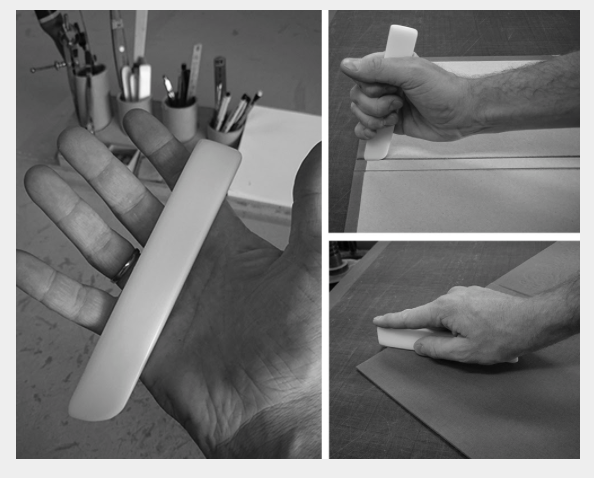
2. Its big size is really comfortable for rubbing down. If held like on the picture above, one can really cover large areas very quickly and apply a lot of pressure with less effort than with a small tool.

3. The thin tip is brilliant for rubbing material in grooves without leaving shiny marks and again, the large size means it can be held like a knife and used with maximum pressure.

As one can see on the pictures I have already used it a lot but it shouldn’t be a problem to re-grind it to refine the tip. Thanks a lot, Jeff, for introducing this new tool!

Republished from Elbel Libro Bookbinding, Newsletter, Summer 2016.  Sign up for it here.
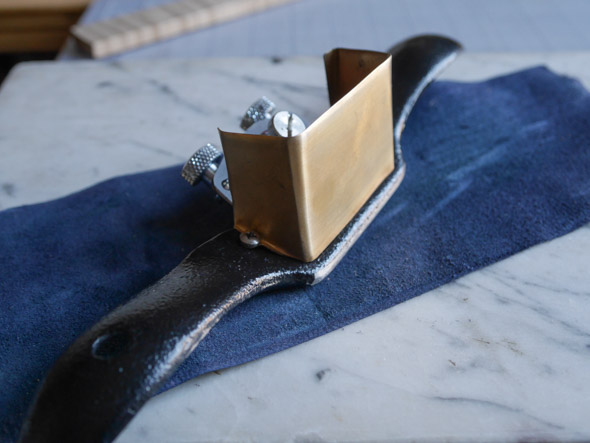


New! Redesigned 151 Spokeshave for Leatherwork with Shaving Collector

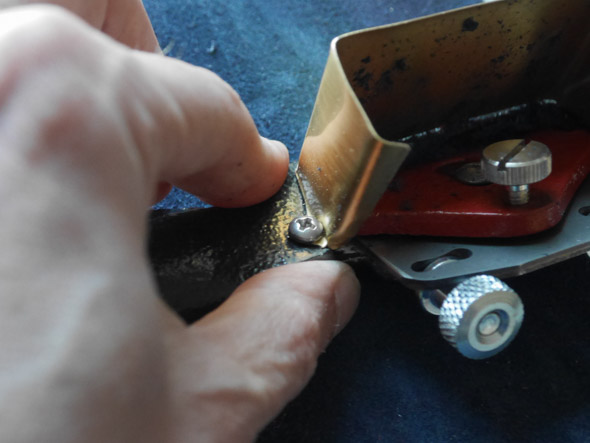
modified 151 spokeshave
Modified 151 Spokeshave with shaving collector. It also makes a convenient stand when flipped upside down.
modified 151 spokeshave2
Note that the shaving collector does not interfere with thumb or forefinger placement.

English trained bookbinders often use a modified spokeshave for long shallow bevels on the turn-ins, reducing the thickness in the spine area of a full leather binding, preparing a new piece of leather for rebacking, and for beveling binder’s board.

I’ve improved the modified Stanley 151 spokeshave that I make and sell by adding a shaving collector. I first saw this on a spokeshave  James Brockman was using in 1990. I can’t quite explain why it has taken me so long to get around to making one for myself — I’ve been busy??? He kindly shared details of the design with me, and mentioned he first saw this while working at Roger Powell‘s shop in the late 1960’s or early 1970’s.

The shaving collector really speeds up work with the spokeshave, since you don’t have to stop and clean off stray shavings every couple of minutes, and they don’t get trapped under your leather, which can cause tearing or holes. Additionaly, it is easy to dump the full collector into the trash.   More information about spokeshaves for leather.

Other modifications to the spokeshave include: reducing the effective cutting angle by grinding the base, truing the adjustment knobs, rounding and lessening the surface area of the sole, opening the mouth, flattening the blade bed by filing and filling with epoxy, flattening the blade cap, and replacing the thin chrome vanadium original blade with a Lee Valley PM-V11 one. This blade is reground to a lower angle, sharpened, and the corners slightly rounded to prevent ridges formed in the leather. All of these modifications make the spokeshave a much more precise instrument and reduce chatter

Even if you rough out the leather with Scharffix or Brockman leather paring machine, this spokeshave can quickly help reduce the ridges and unevenness the results from overlapping cuts and blade changes if you are working on large pieces. It is also essential for gradual bevels wider than the width of a double edge razor blade. And it is a lot of fun to use.

MODIFIED 151 SPOKESHAVE: $275.00     How to purchase


Upcoming Tool Making Workshop in Provo, Utah. June 23-25, 2016.

I’m teaching a three day workshop this June at Brigham Young University.  Not only will there be time to make some knives, delrin folders and lifting tools, but we will also work on hacking/ tweaking/ restoring/ rehabilitating all types bookbinding tools. Come join us!

Bookbinding Tool Making and Tool Repair Intensive: Knives, Folders, Lifters and More.

Brigham Young University, Provo, Utah. June 23-25, 2016.

CLASS DESCRIPTION

In this three day tool making intensive, we will make several knives by hand, using stock reduction, and make a variety of Delrin and Tonkin bamboo folding and lifting tools. Participants should also bring any tools they wish to discuss, sharpen, alter, clean or restore. The specific tools that bookbinders use will be examined in detail: paring knives, lifting knives, scissors, hole punches, scalpels, spokeshaves and board shear blades. The pros and cons of various sharpening systems will be discussed, including water stones, ceramic stones, diamond stones, oil stones, natural stones, silicone carbide powder, aluminum oxide powder, diamond paste, abrasive papers and stropping compounds. Basic principals of tool steel and edge geometry will be discussed. This class will focus on the techniques of efficient free-hand sharpening, which is applicable to any sharpening system. Participants will be provided the 3M Microfinishing film, a large paring or lifting knife blank, and all hard hacksaw blades to two small knives of their choosing, a variety of Delrin blanks and Tonkin Bamboo. The goal is to free participants from the plethora of misinformation and mystique that surrounds sharpening, learn to shape Delrin and bamboo, and learn to maintain and repair common bookbinding tools.

To register, go to: https://gbw.formstack.com/forms/toolmaking

Contact: katie<dot>smith<at>ldschurch<dot>org for information about the facilities

Contact me if you have questions about the workshop content