Box Making Weights

box weights

Jeff Altepeter, the other bookbinder named Jeff that is obsessed professionally interested in bookbinding tools, is the Bookbinding Department Head at North Bennet Street School. Recently he has begun manufacturing box making weights, often referred to as “L” weights, though it seems angle weights would be more descriptive. Whatever you call them, they are really, really nice. Not only do they speed production and increase accurate corner wall miters — so there is less sanding — but because of their clamping pressure you end up with a stronger join.

Jeff explains that  “Tini Miura turned us onto the design [calling them “L” weights] years ago at the American Academy of Bookbinding and they used to be sold by Lucinda Carr of Jumping Bird/ Mesa Canyon Studios. When she lost interest in manufacturing them, I picked it up because my students here at NBSS fight over the sets I have in the classroom. They are useful when building the walls of boxes, measuring for boxes, and as nice single hand weights at about 7 pounds each.”

These are solid steel, precision machined on the inner faces and zinc plated. They are 2 inches square on the short ends, 4 inches on the long ones. Current cost is $160.00 for a set of two plus $25 shipping in the US. Up to two sets can ship at this price. Larger orders ship at cost.

Contact Jeff Altepeter to purchase:  jaltepet <AT> gmail <DOT> com
The Dinkification of Tools

French knives
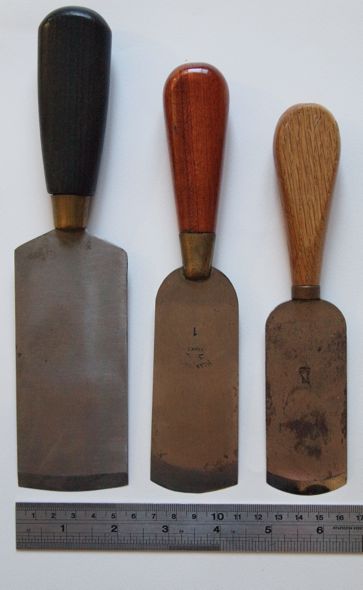
The dinkification of French leather paring knives. A completely unscientific approach. L-R: Big old knife, Medium moderately old knife, Small modern version.

Sometimes I half-jokingly refer to the dinkification of tools —the tendency of tools to get smaller, lighter, more flimsy, and often less functional — over time.

The above photo of three French Style leather paring knives from my collection illustrates this tendency nicely. I’m pretty sure they are arranged from the oldest on the left, to the newest on the right. Observe the cheapening of handle material: from ebony, to a stained wood, to a varnished one. The blades get thinner and narrower. The changes in the curve of the cutting edge is also of interest. The narrowest knife also has the greatest curve, which in my experience indicates it is designed for scraping than cutting, which runs counter to what I know historically about the history of leather paring.


Heat Treated Tonkin Hera

Tonkin

I’ve done some research and ramped up the quality of the bamboo I use to make hera.

First I have decided to use Tonkin, a super strong and resilient bamboo which is used by bamboo fly fishing rod makers. As evident in the image above, it has a preponderance of dark “power fibers”, which give it strength and a pleasing density.  Look at the end of a chopstick for comparison, which is generally pure white weak pith. There are over 1,000 species of bamboo.

I’ve also decided to heat treat the bamboo after initial shaping.  Dr. Wolfram Schott has a fantastic paper, Bamboo in the Laboratory, if you are interested in more details. His Bamboo under the Microscope is also highly recommended. Both breaking strength and modulus of elasticity increases according to his research and tradition in rod making. I’m not totally convinced it makes a difference for such small tools, but it certainly doesn’t seem to hurt. And the stove adds a comfortable warmth on these increasingly cold fall days!

Heat treated Tonkin Hera for sale, $25


New Hera