Uses for a Delrin Hera

Image courtesy Joan Weir
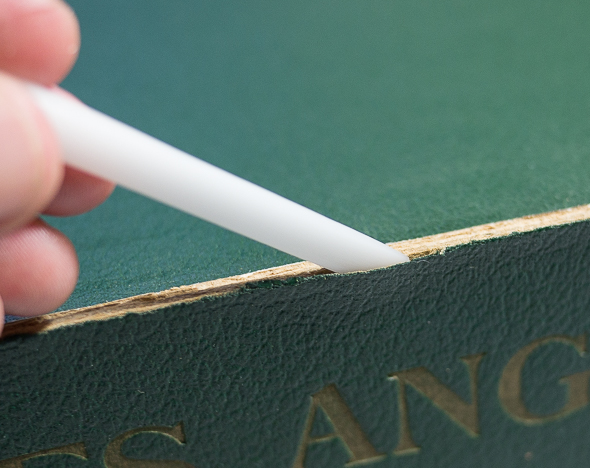
Image courtesy Joan Weir. This delrin hera is .25 inches wide and 6.5 inches long.

“My new favorite tool. Every paper conservator should have one in their tool kit. Fabulous for control on soft of thin supports, makes adhesive and hinge removal a breeze. Beats Teflon by far.”   – Joan Weir, Paper Conservator, Art Gallery Ontario, Toronto, Canada.

I also find myself using this tool more and more.  Some other uses:

  • Manipulating fragile pages or tissue
  • Delaminating boards or covering material
  • Keeping lifted areas open during rebacking or board attachment
  • Lightly scoring tissue in complex shapes for paper repairs
  • Applying controlled pressure during paint consolidation or tissue repairs
  • Inserting adhesive into delaminating areas
  • Delicate scraping. Better edge retention than teflon and softer than steel on paper
  • Tape removal. Can be heated to 180 degrees Fahrenheit and resistant to most solvents
  • Holding things during photography. Less reflective than steel and looks cleaner

Only $40   How to purchase and more info 


lifting

Box Making Weights

box weights

Jeff Altepeter, the other bookbinder named Jeff that is obsessed professionally interested in bookbinding tools, is the Bookbinding Department Head at North Bennet Street School. Recently he has begun manufacturing box making weights, often referred to as “L” weights, though it seems angle weights would be more descriptive. Whatever you call them, they are really, really nice. Not only do they speed production and increase accurate corner wall miters — so there is less sanding — but because of their clamping pressure you end up with a stronger join.

Jeff explains that  “Tini Miura turned us onto the design [calling them “L” weights] years ago at the American Academy of Bookbinding and they used to be sold by Lucinda Carr of Jumping Bird/ Mesa Canyon Studios. When she lost interest in manufacturing them, I picked it up because my students here at NBSS fight over the sets I have in the classroom. They are useful when building the walls of boxes, measuring for boxes, and as nice single hand weights at about 7 pounds each.”

These are solid steel, precision machined on the inner faces and zinc plated. They are 2 inches square on the short ends, 4 inches on the long ones. Current cost is $160.00 for a set of two plus $25 shipping in the US. Up to two sets can ship at this price. Larger orders ship at cost.

Contact Jeff Altepeter to purchase:  jaltepet <AT> gmail <DOT> com

The Dinkification of Tools

French knives
The dinkification of French leather paring knives. A completely unscientific approach. L-R: Big old knife, Medium moderately old knife, Small modern version.

Sometimes I half-jokingly refer to the dinkification of tools —the tendency of tools to get smaller, lighter, more flimsy, and often less functional — over time.

The above photo of three French Style leather paring knives from my collection illustrates this tendency nicely. I’m pretty sure they are arranged from the oldest on the left, to the newest on the right. Observe the cheapening of handle material: from ebony, to a stained wood, to a varnished one. The blades get thinner and narrower. The changes in the curve of the cutting edge is also of interest. The narrowest knife also has the greatest curve, which in my experience indicates it is designed for scraping than cutting, which runs counter to what I know historically about the history of leather paring.