Old Horse Butt

horse butt

Detail from: Frederick W. La Croix  The Leather Specimen Book (Milwaukee: Pfister and Vogel Leather Co., 1915) Winterthur: TS965 L14. Courtesy Winterthur Museum, Garden and Library.

This small sample of horse butt is interesting because it is the earliest dateable horse butt I have seen, almost 100 years old.  Also note it is called a “Razor Strop Butt.” The skin itself looks much like the modern horse butt strops that I sell in my tool catalog, though it is almost twice as thick, suggesting an older animal. I haven’t found any material that works as well for stropping leather paring knives, which at 13 degrees approach the acute angle of a straight edge razor blade, which are often around 10 degrees. Horse butt has the right combination of elasticity, durability, firmness and density to make the perfect strop. It always cheers me up a bit to see a natural material—like hog hair bristles for our brushes—that hasn’t been supplanted by an artificial invention; perhaps because they subtly challenge unspoken assumptions of our technophillic culture.

Some Christmas Gift Ideas for Bookbinders

Loaded stick OLYMPUS DIGITAL CAMERA

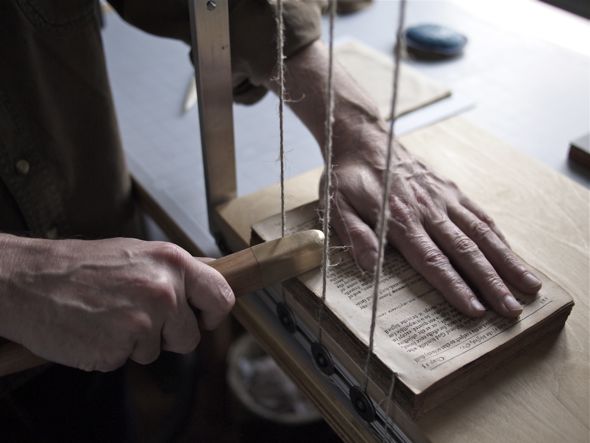
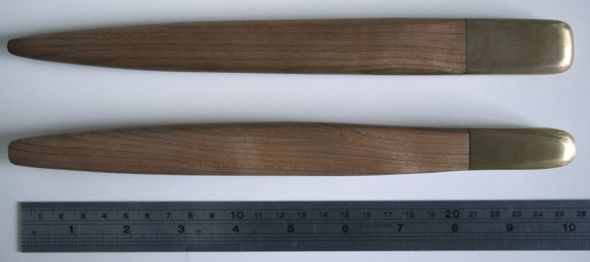
A loaded stick (aka knocking down stick) is great for firmly compressing signatures while sewing. A gentle tapping can accomplish this task much more effectively than leveraged pressure.  This stick has a comfortable waxed cherry handle and a brass head.  The head is screwed into the handle and gently rounded on the edges to avoid damaging the leaves. This tool has a wonderful balance. The head is 2 inches (5cm) long, 1 inch (2.5 cm) wide, and .75 inch (1.75 cm) thick.  It is generally used on the wide portion, though the narrow area can be used if the supports are closely spaced, or there are specific areas that need more compression. Overall length 10 inches (25 cm), and overall weight is approximately 8 ounces (230 g). This is a safe christmas gift for any bookbinder, since this is the first public announcement of my version of these, and I’ve only given one to a friend.  $125.00

*
Geartie

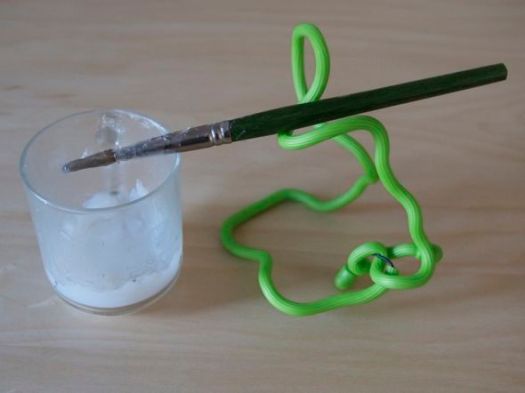
Gearties are essentially a twist tie on steroids, and are available is a variety of lengths. The one pictured above is 32 inches long.  They consist of an unhardened (steel?) core and some type of rubber (silicone?) exterior that is waterproof.  I’ve used them for numerous purposes in and out of the studio: to hold a flashlight, support a book board, keep a frozen duck breast underwater for a quick thaw. The possibilities are endless. Gearties are on sale everywhere, and are made by Niteize. Various prices for different sizes.

*
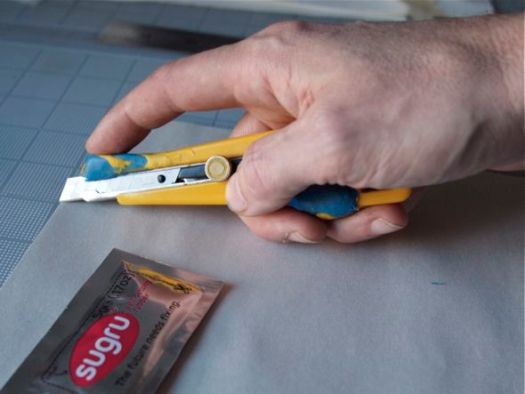
Sugru

A self setting, air hardening rubberized clay like material called sugru is great for pimping out your favorite knives as well as other (non-book) repair necessities.  I made some more comfortable finger rests for my favorite utility knife,  the Olfa Model 300. Again, it seems to be some kind of silicone, the ingredients list Methyltris (methyl-thylketoxime) silane, Gamma-Aminopropyl Triethoxysilane. Available from Sugru. Various prices for different sized packets.

*
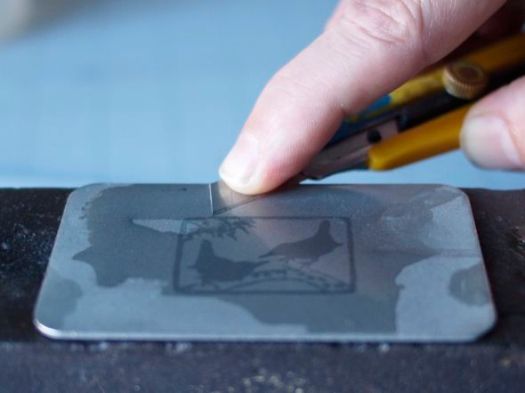
Wren Haven Sharpening Card

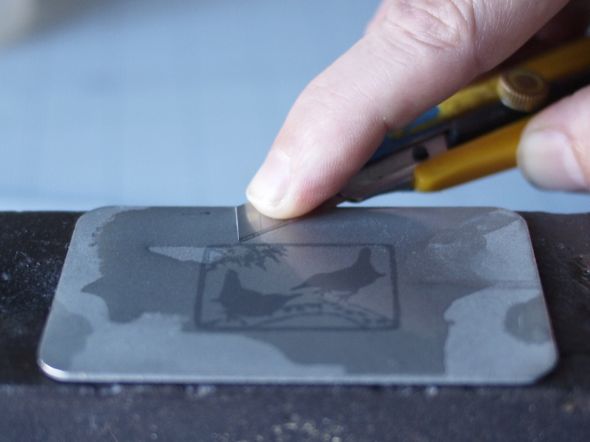
This .25 micron diamond sharpening card from Wren Haven Tools is perfect for keeping small blades sharp. Only $12.00.

Lifting Knives…Not Just For Lifting

Paring the spine with a lifting knife

Although the small and large set of lifting knives that I make and sell are intended primarily for lifting, I find the smaller knife also useful for paring the edges of a spine that has been removed. The edges need to be pared to achieve a smooth join when it is replaced.

Some binders use a Dremel or Foredom tool, and Jim Reid-Cunningham demonstrated this at the Guild of Book Workers 2013 Standards Conference in Washington DC last week. He used a conically shaped coarse grinding stone. Some binders use a scalpel for this, though I haven’t found a blade shape that is easy for me to use.

I generally use a small lifting knife which gives me a lot of control, especially when paring a spine with raised bands intact. Notice that I am working with the knife bevel down. This raises the angle I hold the knife at considerably so that I do not have to flatten out the spine. It also allows me to quickly adjust the angle of the knife to match the curve of the leather of the bands.

Whichever method you use, likely the most important aspect is to lift the spine as smoothly, cleanly and evenly as possible in the first place.