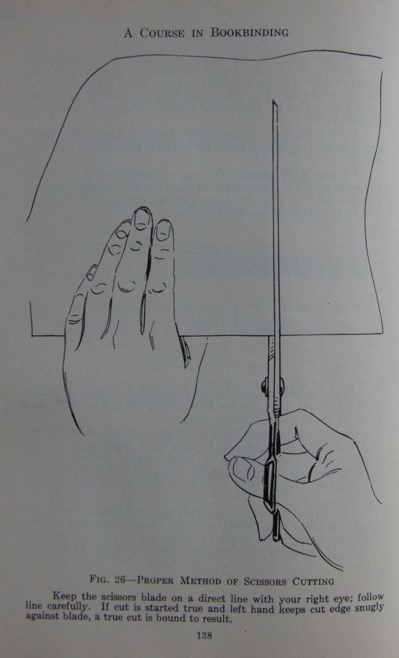
The Proper Method of Using a Scissors

scissorsPalmer, E.W.  A Course in Bookbinding for Vocational Training. New York: Employing Bookbinders of America, 1927.

I’ve never thought too much about using a scissors, and can’t even recall ever being taught.  I’d usually hold the sheet of paper on the left side, with my thumb on top of the paper.  But after reading Palmer, I’m a convert the “proper method”.  It seems to result in a straighter cut, since the paper ends up slightly curling parallel to the direction of cutting, as well as acting as a more stable counter point for the action of the blade.  This right eye view, shows the exact perpendicularity of the scissors to the paper plane, as well as reminding us that often diagrams can show essential information much more clearly than a photograph can.

Of course, this is a small matter, and not using the “proper method of scissors cutting” will not hasten the end of civilization as we know it. But it does relate to the demise of technical education in general, and makes one worry about the hundreds (hundreds of thousands?) of other techniques that have disappeared, are almost forgotten or will become lost in the future.

C. Hammond Hammers

hammond1910

C. Hammond Catalog, 1910. Courtesy of Gary Roberts, who runs the website, toolemera, which has tons of other fascinating trade catalogs, mainly woodworking,  he has scanned from his personal collection.

Bexx Caswell, a recent NBSS grad,  noticed that the Edith Diehl hammer I wrote about earlier is actually a blank book hammer.  Bexx also also saw a similar hammer at Campbell-Logan Bindery in Minneapolis. The basic form descended from the French cobblers hammer I wrote about, but it is great to be able to trace its linage more precisely. The Diehl hammer that I own has some additional stamps (under the line that reads “PHLIA” it is stamped “CAST STEEL”) which leads me to think it is earlier than the one pictured in this catalog, since advertising cast steel is commonly more of a 19th century convention.

It is instructive to note that there were specialized hammers for Stationary Binders verses Bookbinders.  The large, long peen may have been useful when forming the extreme arch many blank book spines have.  Currently, most binders get by with one hammer, which mirrors the general decline in the diversity of specialized hand tools which continues to this day. Nineteenth century bookbinders also had specific hammer shapes for rounding, backing and, of course, beating.

a new bone?

dyed bone

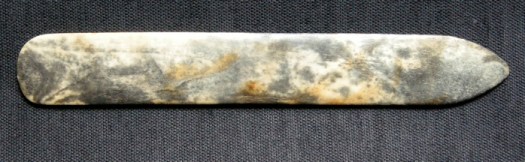
The Library Preservation blog mentioned a very cool Martha Stewert branded bone folder, made from melamine.  I also picked up a nifty new bone from a flea market, but haven’t been able to identify the material it is made from. The coloring appears to penetrate the thickness. It has the density, rigidity and pore structure of bone.  But the mottled appearance and seams on the edges could indicate tortoise shell which has been laminated.  Or it might be some kind of horn.