
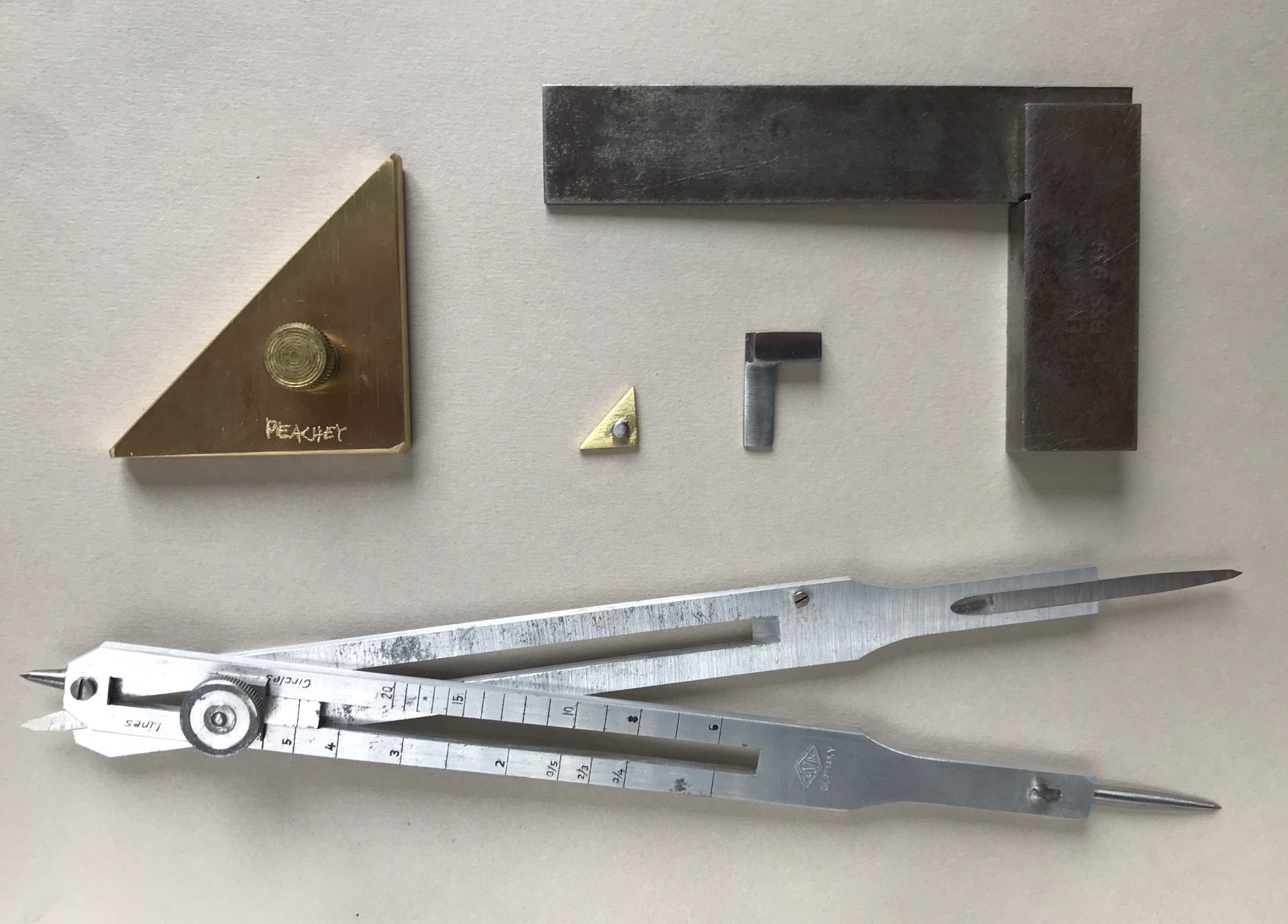
Proportional dividers are ancient tools, dating back to Roman era, though as late as 1955 some thought they were a Renaissance invention. The Alvin 450 is really handy when making miniatures, like the triangle and engineer’s square above, that I made for Fritz Otto Buchbinder. They allow you to quickly see and measure what a reduction in the actual reduction size would be. Using one is a much more intuitive than having to divide 100ths of an inch into something. But don’t get me started on numeric measuring!

Other uses are to convert a given length of line into equal parts, divide a circle into equal parts, and even generate angles. All of which are useful for bookbinders. The 450 can generate proportions down to 10:1 for lines, and 20 :1 for circles. A regular dividers can do these things, but it takes some set up time.
They make a great addition to my dividers collection. I found them at a flea market, still in a fake leather covered wooden box, with a nifty sliding pin latch, all for $10. They originally sold for $9.75, so they have held their value. New ones are still available, though considerably more costly, having a list price of $216, though commonly found for $132.
Obviously, though, one can never have too many tools. I’m still looking for a used 458 (10 inches long) and a 950 (stainless steel)….


Using the bosses’ email.
Thank you for being able to make tools that are truly appropriate for my slightly smaller hands. They fit and feel as if they were natural extensions of me. I will certainly recommend them to my friends.
I also completely agree on using units to measure. Other than direct, my favorite measuring device is my eyes. Wie sagte mein Meister, “Augenmaß eichen!”
My pleasure!
The proportional dividers you show are common (I had a pair made by Park, probably in the first half of the 1900’s, but gave them to a son-in-law) and cheap versions are still actively being made in India and sold on Amazon. However, if you want to use something sublime, try to find decimal proportional dividers made by K&E (also sold under other drafting house names like Bruning, Deitzgen, etc.). I believe K&E started making these around 1900, right around when they introduced the CF/DF scales on slide rules and probably stopped manufacturing them around 1975 or somewhat before. Once you try these, you’ll be hooked, as they are both good firm joint dividers and a precision instrument for setting up proportional dividing with no iteration. Accurate work with any other type of dividers requires careful iteration with a machinist’s rule. The distinguishing feature on these types of dividers is that a rack is cut into one of the legs and a pinion and vernier scale are used to adjust the dividers’ ratio with no iteration.
http://www.mathsinstruments.me.uk/page65.html shows some of this type, but not the K&E.