The Scratches Don’t Lie and The Big Board: Impressions from Teaching in the Netherlands.

Earlier this summer, I spent a couple of throughly enjoyable weeks in the Netherlands, teaching two workshops through the auspices of Restauratoren Nederland, at the beautiful bindery of Wytze Fopma in Friesland. First there was a 3-day sharpening/ spokeshave modification class, a wadlopen and tour of Mennonite sites, then a 5-day 18th c. French binding class. It was all very, very good.

Each time I teach, I keep adding current research. I’ve taught versions of the sharpening class over thirty times, and the French at least a dozen. It sounds cliche, but I do learn something new each time.

This class, Constant Lem, book conservator at Koninklijke Bibliotheek, convinced me of the importance of the 180 degree shoulder that the French bindings often have.  I’d considered and worked on this, however working together we made progress on this historically unique(?) structural feature.

photo-35
The steel folder, which Ben Elbel calls “score!”.

Before the workshop, I visited Ben Elbel, of Elbel Libro, in Amsterdam. He has a large studio, is doing some very nice work, and has a board beveling machine that I plan to steal at some point. Ben gave me a nifty steel folder which he sells. It is a nice size for detailed work, fitting comfortably in the hand, well made, and is also useful for blind lines. It comes in an attractive die cut storage folder. Metal folders keep popping up every now and then in the history of bookbinding: the earliest I’ve seen was patented in 1889.

Below are images from the workshop.
weir7
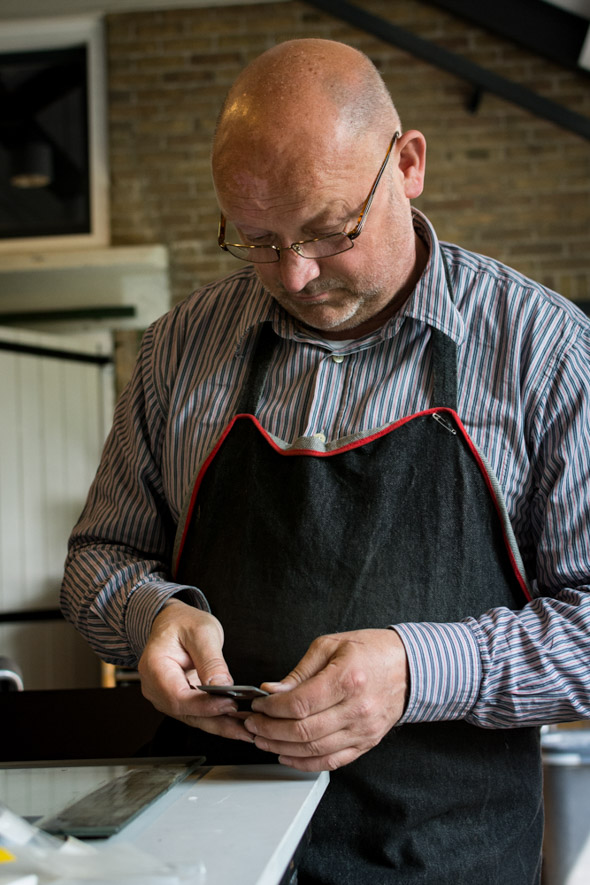
Examining a spokeshave blade while sharpening.  Photo copyright Anke van der Schaaf, 2015. All rights reserved. http://www.fopmawier.nl

One of the most important aspects in freehand sharpening involves looking at reflections and scratch patterns in the blade, in order to understand what you are doing and what needs to be done. The visual feedback lets you know how to alter your hand pressure or technique. The scratches don’t lie.


weir2
Tallying up The Big Board.  Photo copyright Anke van der Schaaf, 2015. All rights reserved. http://www.fopmawier.nl

The Big Board is a learning tool I use in the French class to keep track of questions, deviations from historic practice, instructor mistakes, material differences, etc.  Whoever has the most observations wins a prize, in this case a small lifting knife. Often there are over 150 observations. This helps keep us aware of inaccuracies generalized from our modern craft training that can creep into the historic style we are trying to understand.

As invasive treatments continue to become more infrequent in book conservation, the type of knowledge gained from making historic models will help keep book conservators relevant (I hope!), by increasing our knowledge of how these books were originally made.  Conservation as interpretation?


weir4
Beating a textblock before sewing. Photo copyright Anke van der Schaaf, 2015. All rights reserved. http://www.fopmawier.nl

Not only did we have a custom made beating hammer, but we borrowed an anvil from the Blacksmith. A wonderfully solid substitute for a beating stone!
 

weir5
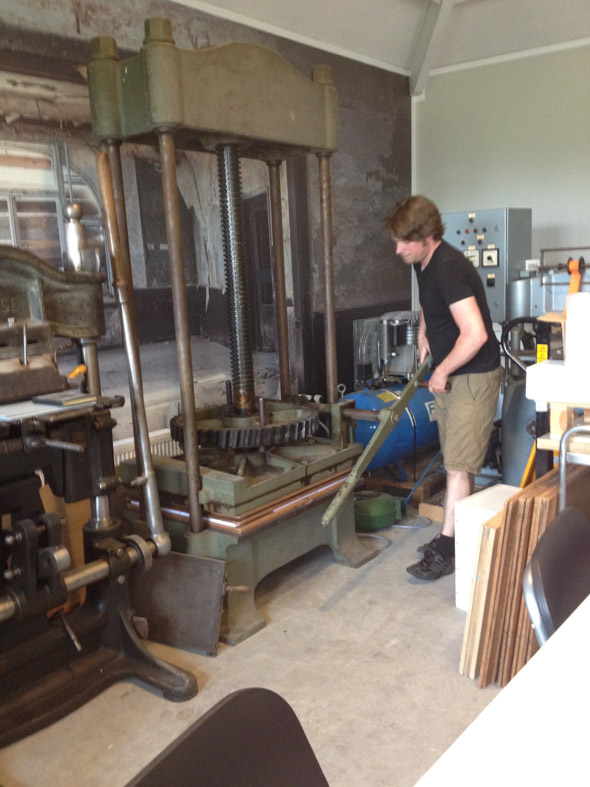
Wytze’s large standing press. He said it took nine people to tilt it back upright after it was brought in through the door. A huge blocking press is on the left.  Come to think of it, EVERYTHING in the bindery was super heavy duty. My photo.

Wytze has the most massive operational standing press I’ve ever seen. He mentioned that it is the largest in Holland. He is operating the worm drive. Once the center screw is tightened as much as possible, to generate even more pressure, the drive can crank the main press screw another turn or so. The drive can be easily disengaged to quickly raise or lower the press. As a demonstration, he pressed some of our textblock paper so hard it sunk into the MDF pressing boards, creating a clamshell. It had little to do with the class, but was too impressive not to mention.
 

DSC00341
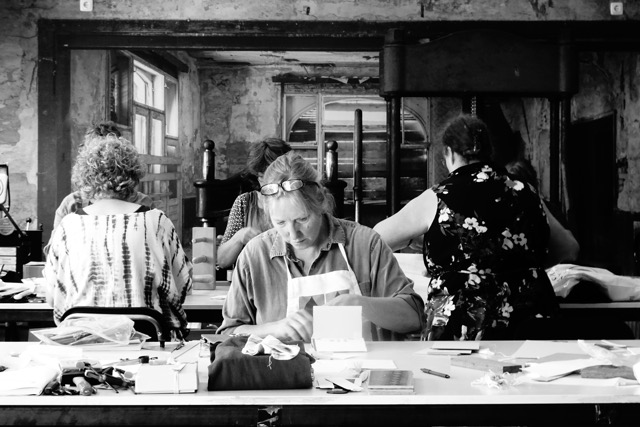
Some of the class at work. Photo copyright Natasha Herman. http://www.redbonebindery.com


weir1
The finished books. Photo copyright Anke van der Schaaf, 2015. All rights reserved. http://www.fopmawier.nl

On the left is an 18th century skull the Wytze found, the finished books, an 18th century (?) French (Dutch?) beating hammer on the right, and in the back, the printed handouts for the workshop bound en-broche by Wytze and Herre. We started with the same tan calfskin; the color variations on the finished books resulted from varying applications of glair, paste wash, and warm burnishing. These are powerful and inert ways to control the color and surface sheen of leather without dyeing.

The skull and beating hammer literally and symbolically bookend this workshop: we were working with the head and the hand, using theory and praxis, to learn more about the nature of 18th c. French binding.


How to Rejuvenate a Glazed-over Oil Stone

carb1
Emanuel E. Ericson and Walter E. Burton Carborundum Brand Products for the Home Craftsman. The Carborundum Company: Niagara Falls, NY, 1935. My Collection.

In 1935, the Carborundum Company published a 93 page pamphlet of surprisingly useful tips and assorted product information. It also has a beautiful cover which typographically and color-wise captures the mid-1930’s aesthetic. Carborundum is Silicone Carbide (SiC), the material many (all?) synthetic oil stones are made of, and the coating on many abrasive papers. The pamphlet cost 20 cents in 1937, according to an advertisement in Popular Mechanics.

The next time I purchase an old glazed over oil stone at a flea market, I’ll try the tip below to clean it, which involves heating it to drive out the old oil and swarth.

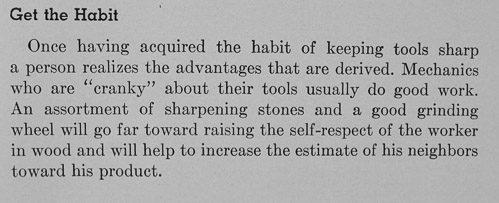
It also contains good advice concerning the habit keeping tools sharp. Get into the habit and become “cranky”!

_________________________________________

Emanuel E. Ericson and Walter E. Burton  Carborundum Brand Products for the Home Craftsman. The Carborundum Company: Niagara Falls, NY, 1935.

carb2

carb3


Upcoming Workshop. Cloth Case Bindings: Their History and Repair. October 24-28, 2016. Georgia Archives, Morrow, Georgia

CLOTH CASE BINDINGS: THEIR HISTORY AND REPAIR

October 24-28, 2016

Instructor: Jeff Peachey

Georgia Archives, Morrow, Georgia.

For almost 200 years, the cloth case binding has been the standard way publishers issue books. Throughout the nineteenth century, and even into the twentieth, it was often derided by bibliophiles as a temporary structure, not a ‘real’ book. However, it has proved to be a remarkably durable structure, now commonly used by conservators when rebinding books, by fine small press publications, and in library binding.  Quite likely, there are more cloth cased books than any other rigid board book structure on earth. 

This 5-day workshop will investigate the history of the cloth case binding, concentrating on the early years, 1825-1850. We will parse historic texts that describe this structure, while paying close attention to the introduction of four key pieces of machinery: the rolling press, the board shear, the guillotine, and the stamping press. Boards bindings will be considered as an industrial precursor to the cloth case, and we will make a structural model following a technical description from Cowie’s 1828 The Bookbinder’s Manual. By focusing on historic techniques, this workshop will also serve as introduction or refresher to the essential bookbinding hand-skills. Additionally, we will explore options for conserving and repairing cloth cased books by working on actual books provided by participants. Treatment options presented will include recasing, cloth rebacking, tissue repairs, hinge repairs, and boxing. Basic paper repairs, techniques of toning tissue and cloth, spine lining considerations, and the lifting of fragile material will be addressed. Discussions will include treatment decision making in relationship to specific institutional needs or the desires of private clients.

This workshop is open to all levels of experience: pre-program students, technicians, and mid-career conservators who desire a full time week at the bench. Ideally, a variety of participant experience levels will result in an invigorating exchange of information on binding techniques, institutional protocols, and treatment approaches.  Students should bring 5-10 non-valuable cloth cased books that can be sacrificed or repaired, and basic bookbinding tools.

Students should submit a resume and a brief one paragraph application statement, reviewing their background in bookbinding, book conservation, or other crafts, and stating what they hope to learn.

Workshop Fee: $650 which includes materials.

Application deadline: July 15, 2016.

The application, or questions about the facilities/ housing options/ transportation (Morrow is close to Atlanta) should be sent to Kim Norman: Kim <dot> Norman <at> usg <dot> edu

Other questions about the class should be sent to me.