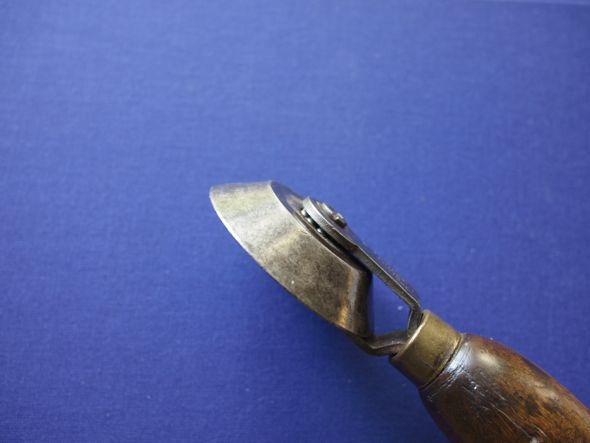
Everhard Ball Bearing Beveled Stitcher

Fillet or creaser?

At the massive Brimfield Flea Market last month, I picked up this unusually well made tool. Note the ball bearings barely visible around the axle. Not only does is spin freely, but there is zero play side to side. And the wheel is very heavy.

At first I thought it was an unusual fillet, used for marking lines in leather. But it turns out it was made for the tire/ rubber industry. It is marked “The Everhard Mfg. Co.”, and is known as a beveled stitcher,  used to smooth wavy edges of uncured rubber. It also bears a striking morphological resemblance to a leatherworkers wheel. Even if it can’t be usefully adapted for bookbinding work, it is still a wonderfully well made object to have.

Yikes! Have I started down the slippery slope from tool user to collector? Is this a problem?

Punching Holes

hole punch

Sometimes a new tool comes along that causes a paradigm shift;  the older ones are almost instantly obsolete.  The Japanese screw punch is one such example. I can’t recall the last time I used or saw someone use another tool to make small holes in paper, vellum and leather.  Yet the hole punch above, which a “J.J. THATCHER” thought enough of to mark his name on, works perfectly. Stylistically, we can see much more elaborate decoration than on the more modern Japanese screw punch. Functionally, it does not have the interchangeable bits or the automatic twist action that the Japanese screw punch has. This tool is extremely well made, comfortable to use, elegant, perhaps even a little decadent with the amount of hand finishing that went into it. Aren’t these the elements we want imbued in our hand-bound books? Can a tool help to do this? Can beautiful tools increase the users pleasure while working which then is reflected in the product?

Old Horse Butt

horse butt

Detail from: Frederick W. La Croix  The Leather Specimen Book (Milwaukee: Pfister and Vogel Leather Co., 1915) Winterthur: TS965 L14. Courtesy Winterthur Museum, Garden and Library.

This small sample of horse butt is interesting because it is the earliest dateable horse butt I have seen, almost 100 years old.  Also note it is called a “Razor Strop Butt.” The skin itself looks much like the modern horse butt strops that I sell in my tool catalog, though it is almost twice as thick, suggesting an older animal. I haven’t found any material that works as well for stropping leather paring knives, which at 13 degrees approach the acute angle of a straight edge razor blade, which are often around 10 degrees. Horse butt has the right combination of elasticity, durability, firmness and density to make the perfect strop. It always cheers me up a bit to see a natural material—like hog hair bristles for our brushes—that hasn’t been supplanted by an artificial invention; perhaps because they subtly challenge unspoken assumptions of our technophillic culture.